


Find Out Whether Google or Meta Fits Your Funnel Right Now
Share this Article



Key takeaways
There is no universal winner between Google Ads and Meta Ads in 2026. Google captures existing demand through search intent, while Meta creates new demand through discovery and creative.
Google wins the bottom of the funnel and Meta wins the top. The strongest accounts run both so customers discover on Meta and convert on Google.
Automation is now the default on both platforms, which means clean conversion signals, strong creative variety, and reliable tracking matter more than manual controls.
Meta's removal of detailed targeting exclusions in March 2025 forced advertisers to rely on broad targeting, Advantage+, and creative-led optimization instead of audience sculpting.
Conversion numbers will never perfectly match across Google, Meta, and analytics platforms. Focus on consistent measurement rules and first-party tracking instead of chasing perfect attribution.
Google Ads vs Meta Ads — if you're trying to decide between the two in 2026, the honest answer is that there is no single winner for every business. These platforms work differently because people use them differently.
Google Ads is built around search intent, which means you show up when someone is actively looking for a solution.
Meta Ads is built around discovery, which means you show up while people scroll content and may not be shopping yet.
In 2026, both platforms have pushed harder into AI automation, broader targeting, and privacy-safe tracking, so the best results usually come from matching the platform to your funnel stage and using clean measurement.
What Are Google Ads?
Google Ads is a paid advertising platform that places your ads in front of people who are actively searching for a solution. They are on Google Search, YouTube, Gmail, and across the Google Display Network.
How Google Ads work:
- You bid on keywords; your ad appears when someone searches a matching query
- Google's auction factors in bid amount, Quality Score, and expected click-through rate to determine placement
- Smart Bidding uses machine learning to adjust bids toward your conversion goal automatically
- Conversion tracking connects ad clicks to pipeline events: demos, signups, or purchases
- Performance Max extends reach across all Google inventory using a single asset-based campaign
Click Here to Discover the Ultimate Google Ads Strategy for Startups in 2026 ->
What Are Meta Ads?
Meta Ads is a paid social platform that places your ads in front of people while they browse Facebook, Instagram, Messenger, and the Audience Network. This is based on who they are, not what they're searching for.
How Meta Ads Work
- You define an objective (awareness, leads, conversions), and Meta's algorithm finds the audience most likely to complete it
- Targeting works through demographics, interests, lookalikes, and first-party retargeting audiences
- Advantage+ campaigns automate audience expansion and creative testing. This is now the default recommended approach
- The ad unit itself (image, video, carousel) carries most of the conversion weight; creative quality determines performance
- Attribution is modelled, not deterministic, meaning Meta credits conversions across click and view windows using its own system
Google Ads vs Meta Ads: The 10 Main Differences
[table]
Dimension | Google Ads | Meta Ads
Buyer mode | Active — searching for a solution | Passive — scrolling, not shopping
Demand type | Captures existing demand | Creates and expands demand
Primary signal | Keyword intent | Audience profile + creative response
Funnel stage | Bottom and mid-funnel | Top and mid-funnel
Creative role | Message matches the query | Attention-stopping hook and format
Conversion speed | Faster — buyer is already in-market | Slower — requires nurturing and retargeting
Attribution model | Click-based, CRM-connectable via offline imports | Modelled — view-through + click with AI estimation
Privacy impact | Affected by cookie deprecation; Enhanced Conversions compensates | EU restrictions limiting personalization; Advantage+ compensates
Automation default | Smart Bidding + Performance Max | Advantage+ Audiences + automated placements
Best for B2B SaaS | Demand capture — competitor and category keywords | Demand creation — brand awareness and ICP retargeting
[/table]
What is the core difference between Google Ads and Meta Ads?
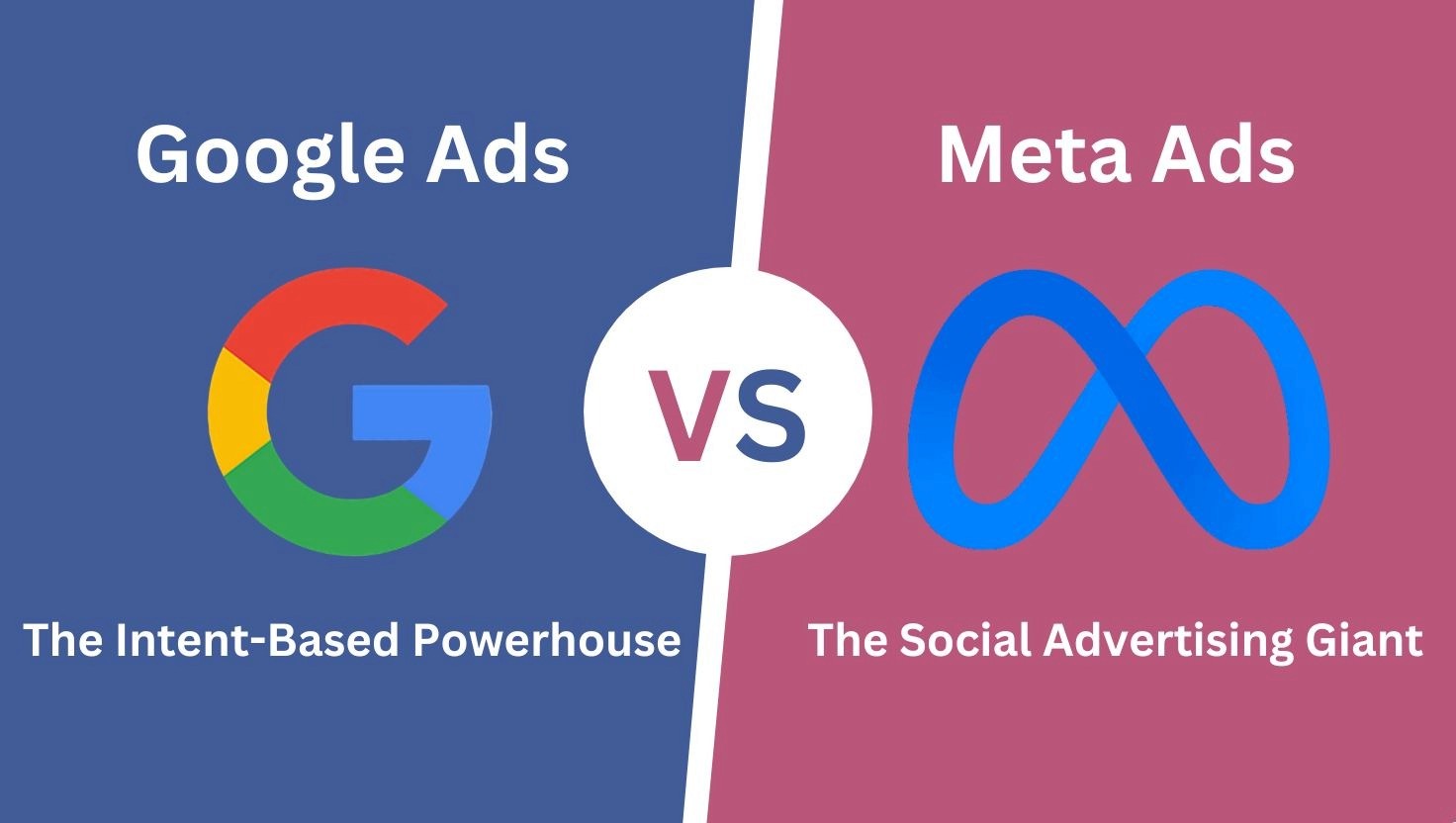
The core difference between Google Ads and Meta Ads is intent versus discovery.
Google Ads captures people who are actively searching for a solution, while Meta Ads creates demand by placing your offer in front of people who are scrolling content and not yet shopping.
Google Ads captures demand that already exists. When someone types a query like “best HR software for small business” or “roof repair near me,” they are showing clear intent and are usually closer to a decision. That’s why Google Search often produces faster conversions, especially for services, B2B, and high-consideration purchases.
Meta Ads creates or expands demand. People on Instagram or Facebook are typically not searching for products. They’re browsing posts, watching Reels, or messaging friends. Meta places your offer into that flow and relies on creative, repetition, and strong hooks to generate interest. That’s why Meta can be excellent for building awareness, launching new products, and scaling e-commerce when your content and offer are strong.
In practical terms, Google is usually strongest at the bottom of the funnel, while Meta is usually strongest at the top and middle of the funnel. The best advertisers in 2026 often run both so the customer discovers the brand on Meta and then converts later through Google search or retargeting ad campaigns.
Learn about Demand Generation vs Lead Generation and Why Google Ads Are Used ->
Google Ads Vs Meta Ads: What Are The Cost And Performance Benchmarks For 2026?

In 2026, Google Ads typically delivers higher CPCs but higher-intent traffic, while Meta Ads delivers cheaper reach and clicks that depend heavily on creative quality and tracking setup. Actual results vary widely by industry.
Benchmarks are averages, so they should guide expectations, not predict your exact results. Still, they are useful for planning budgets and setting reasonable targets. Recent benchmark reporting shows Google Search tends to deliver higher-intent traffic, while Meta tends to deliver cheaper reach and clicks, with results heavily depending on creative quality and tracking.
WordStream published updated the benchmark reporting for both Google Ads and Facebook/Meta Ads, which many marketers use as a baseline for CTR, CPC, and CPL expectations.
[table]
Metric (Typical Range) | Google Ads (Search-led accounts) | Meta Ads (Facebook/Instagram-led accounts)
Average CPC | Higher on average | Lower on average
CTR | Often higher on Search due to intent | Often lower, but strong creative can lift it
Conversion speed | Faster for high-intent queries | Often slower, needs nurturing and retargeting
Best fit | Demand capture, services, B2B, local | Discovery, e-commerce, lifestyle, awareness
Optimization driver | Keyword intent + landing page quality | Creative + offer + audience/AI learning
[/table]
For Google Ads, multiple 2026 benchmark roundups also emphasize that CPC and conversion rates vary widely by industry, with “high-stakes” categories (legal, insurance, finance) often much more expensive than e-commerce categories. For Meta Ads, 2026 benchmark reporting highlights performance improvements in some objectives year-over-year and underlines that cost per lead and conversion rate can look strong when targeting and tracking are set up correctly.
Discover the Google Ads Mistakes that can Drain 6 Figures from your Budget
Google Ads vs Meta Ads: 3 Things That Changed in 2026 and is Impacting Paid Ads Results
Three things changed in 2026 that directly impact results: Meta removed detailed targeting exclusions, automation became the default across both platforms, and tightening privacy regulations forced advertisers to rely on first-party data and server-side tracking.

- Meta removed detailed targeting exclusions
One of the biggest Meta changes advertisers felt in 2025 was the removal of “detailed targeting exclusions,” which used to let advertisers target an interest while excluding another.
Meta removed this feature in late March 2025, pushing advertisers further toward broad targeting, Advantage+ approaches, and creative-led optimization.
If you relied on exclusions to keep audiences “clean,” you likely had to rebuild your structure or accept more overlap and let the algorithm learn.
- Automation became the default, not the option
Across both platforms, automation is now the center of how performance improves.
Google’s ecosystem is increasingly driven by Smart Bidding and multi-network campaign types, while Meta continues to scale Advantage+ and automated targeting expansion.
That doesn’t mean strategy is dead. It means your strategy shifts from “manual controls everywhere” to “clear conversion signals, strong creative variety, and clean data.”
- Privacy and regulation keep tightening
Privacy changes continue to reduce the reliability of browser-based tracking, so server-side measurement and first-party data are now “table stakes.”
On the Meta side, Europe is also forcing major shifts in how personalization works. Meta has said EU users will be able to limit data sharing, which can reduce ad personalization and increase reliance on contextual targeting.
This matters because it can change performance in EU markets and may force advertisers to rely more on creative testing and first-party signals.
Click Here to See How Google Uses First-Party Data (SaaS and B2B Industries) ->
How Does Targeting Work on Google Ads vs Meta Ads in 2026?
Google Ads targeting still works through intent signals like keywords, search terms, and in-market behavior, while Meta Ads targeting works through broad delivery, first-party audience signals, and creative variations that feed its AI system.
Google Ads targeting is still built on intent signals, especially keywords, search terms, and “in-market” behavior.
Even when you run automated campaign types, your results usually depend on whether you’re matching real demand, filtering irrelevant searches, and sending people to a landing page that matches the promise of the ad.
In many accounts, the biggest performance swings still come from query quality, offer clarity, and conversion tracking consistency, not “clever tricks.”
Meta Ads targeting is increasingly a mix of broad delivery and first-party audience signals.
You still have demographics, interests, lookalikes, and retargeting, but in 2026 Meta’s system tends to work best when you stop over-segmenting and instead feed it strong creative variations plus clear conversion events.
Because detailed targeting exclusions are gone, many advertisers now focus on creative angles and messaging “clusters” rather than trying to perfectly sculpt audiences.
Why Don't Google Ads and Meta Ads Conversion Numbers Match?
Google Ads and Meta Ads conversion numbers don't match because each platform uses different attribution windows, view-through counting rules, and modeling methods, so the same conversion gets credited differently across systems.
The main reasons:
- Different attribution logic: Google defaults to data-driven attribution across clicks; Meta credits across both clicks and view-throughs using its own modeled system
- Double-counting is built in: A buyer sees a Meta ad, then Googles your brand and converts. Now both platforms claim the win
- Meta interrupts; Google captures: Meta gets the first touch because it puts your ad in front of someone who wasn't looking. Google gets the last touch because the buyer came back with intent
What this means for creative strategy:
[table]
Platform | Why It Works Differently | What Performs Best
Meta | Interrupts attention when buyer wasn’t looking for you | Short-form vertical video, UGC testimonials, clear hooks, simple product demos
Google | Captures attention now that buyer is already searching | Message match between ad copy and landing page; clarity over creativity
[/table]
The 2026 shift to know:
Meta is deepening AI-driven personalization, including signals from Meta AI interactions, which means the algorithm has more context to match ads to likely converters.
The practical implications include consistent brand messaging and a strong creative library. They matter more than ever, because the system needs variety to find what works for each user.
The rule: Don't chase perfect number alignment across platforms. Build consistent measurement rules, use first-party tracking, and judge each platform on the pipeline it influences, not just the conversions it claims.
Tracking and Attribution: Why Your Numbers Don’t Match
A common frustration people discuss online is that Meta’s reported conversions and Google’s reported conversions rarely match analytics platforms perfectly. That’s normal because attribution windows, view-through counting, and modeling methods differ. The key in 2026 is not chasing “perfect matching,” but using consistent measurement rules across channels and improving data quality.
What matters most now is implementing strong first-party and server-side tracking where possible, keeping event definitions consistent, and importing the conversions that actually reflect business value. As platforms lean harder into automation, your conversion signal quality directly impacts how well the algorithms learn.
Google Ads Attribution for B2B SaaS: Discover What's Actually Working in 2026
What do advertisers complain about most on Google and Meta in 2026?
Advertisers complain most about losing control to automation, inconsistent platform support, and lack of transparency inside automated campaign types, with rising concerns about ad fraud and brand safety on Meta following late 2026 enforcement issues.
Across community discussions and industry reporting, advertisers keep bringing up a few recurring themes. They worry about losing control as automation increases, they complain about inconsistent support, and they want better clarity on where spend is going inside automated campaign types.
Another rising concern is ad quality and fraud, especially on social platforms. Investigations highlight issues around scam ads and enforcement challenges on Meta, which matters to advertisers because it can impact brand safety and the quality of traffic.
The point is not that “Meta doesn’t work.” The point is that advertisers should use brand safety settings, monitor placements, and validate lead quality with offline conversion tracking.
Click Here to See How SaaS Companies are Using AI for Google Ads in 2026 ->
Which Platform Should You Choose in 2026?
Choose Google Ads in 2026 if your customers are already searching for what you sell, since it offers the fastest path to revenue.
Choose Meta Ads if your customers are not yet searching, since it lets you create demand and retarget later.
The best choice depends on your goal, audience awareness level, and how your customers actually buy.
[table]
Your main goal | Google Ads is usually stronger when... | Meta Ads is usually stronger when...
Immediate leads/sales | Demand already exists and search volume is real | You have strong retargeting and offer-led creative
Brand awareness | You want intent-based reach (e.g., YouTube + Search) | You want cheap reach and frequent exposure
E-commerce scaling | People research products actively (Shopping/Search) | Your product is visual and impulse-friendly
B2B lead gen | Buyers search solutions and compare vendors | You can educate with video, build trust, and retarget
Local services | “Near me” searches and high-intent keywords exist | You want always-on retargeting and community reach
[/table]
In many real accounts, the “winner” is a combined approach. Meta warms the audience and grows branded demand, while Google captures that demand when the user is ready to act.
What is a simple full-funnel strategy that works in 2026?
A simple full-funnel strategy is to run Meta as your discovery engine and Google as your capture engine: Meta builds awareness and traffic with short-form video and social proof, while Google converts high-intent searchers ready to buy.
A practical 2026 playbook is to run Meta as your discovery engine and Google as your capture engine.
Meta runs short-form video and social proof content to build awareness and traffic. Google runs high-intent search and shopping queries to convert users who are ready.
Retargeting runs on both platforms, and your measurement plan focuses on the same business outcomes across channels.
This approach fits how people actually buy in 2026: they discover on social, research on search, compare options, and then convert after multiple touches.
Learn about Top of the Funnel Marketing in Google Ads and Campaign Setup
The Bottom Line
Google Ads vs Meta Ads isn't an either-or decision — it's a sequencing decision. Google captures demand from buyers already searching. Meta creates demand from buyers who haven't started yet. The strongest accounts run both as one connected system.
That's exactly how we run paid media at Scalix AI. We pair Google Ads for demand capture with LinkedIn for demand creation (specifically designed for B2B SaaS) so you're not just winning the buyers who already know they need you, but building the pipeline of buyers who will.
If your current campaigns are only doing one or the other, you're leaving pipeline on the table. Book a free audit and we'll show you exactly where the gap is and how to close it.


