
Key takeaways
SEO vs PPC for SaaS isn't a choice — it's a sequencing decision.
B2B buyers are 70% decided before they talk to sales. Be there earlier.
PPC stops the moment you stop spending. SEO compounds.
Shared PPC and SEO data always outperforms running them in silos.
ROI crossover for SaaS SEO hits between months 8 and 12.
SEO vs PPC for SaaS: Smart Growth Strategy | Boost Leads & Lower CAC
Choosing between PPC and SEO is one of the most confusing decisions in SaaS marketing. Many founders and marketers ask a simple question: which channel is better? Some want faster results and lean toward PPC. Others want long-term growth and choose SEO. This way of thinking creates a false choice.
PPC and SEO are not competitors. They are two different tools that serve different purposes at different stages of the SaaS buying journey. When SaaS companies try to pick one channel instead of understanding how both work together, they often waste time, budget, and opportunities.
This guide explains how PPC and SEO really work for SaaS companies, how buyer behavior affects results, and how strong SaaS teams combine both channels to build sustainable growth.
Understanding How SaaS Buyers Make Decisions

To understand PPC versus SEO, you first need to understand how SaaS buyers behave. SaaS products are rarely bought on impulse. Most purchases involve research, comparison, internal discussions, and budget approval. Buyers often visit multiple websites, read reviews, compare tools, and return several times before making a decision.
B2B buyers are nearly 70% through their purchasing process before they engage with a sales team. This means that most decisions are already forming long before a demo is booked or a trial is started. Because of this, search visibility during the research phase is just as important as visibility during the decision phase.
SEO usually performs best when buyers are learning about a problem or exploring possible solutions. PPC usually performs best when buyers already know what they want and are comparing vendors or looking for pricing, demos, or trials. Both channels often reach the same buyer, just at different moments in their journey. This is why treating SEO and PPC as opposing strategies does not reflect how SaaS buying actually works.
What SEO Means for SaaS Today
SEO meaning for SaaS has changed a lot over the years. It is no longer about publishing large volumes of blog posts or stuffing keywords into pages. Modern SaaS SEO is about building trust, authority, and clear answers around a focused topic area.
Strong SaaS SEO starts with understanding real user intent. Buyers search for problems, not products, especially early in the journey. They want clear explanations, examples, and guidance. Effective SaaS SEO content helps users understand their problem, learn about possible solutions, compare tools, and finally see how a product fits their needs.
This often includes educational guides, use-case content, comparison pages, integration pages, and product-led explanations. When done correctly, SEO keeps a SaaS brand visible throughout long buying cycles, even when buyers are not ready to convert yet.
One of SEO’s biggest strengths is trust. Organic results feel earned rather than paid. Because of this, many B2B buyers trust organic content more than ads. Over time, this trust compounds. In many SaaS industries, organic traffic converts about 1.5 to 2 times higher than paid traffic over the long term, mainly because users arrive with stronger intent and familiarity.
What PPC Means for SaaS Today
PPC is often misunderstood as simply buying traffic. In reality, PPC is a speed and precision tool for SaaS growth. It allows teams to test ideas, reach high-intent users, and get feedback quickly.
PPC works especially well for high intent keywords because the users expectations are clear. These include branded keywords, competitor searches, product-specific terms, and retargeting campaigns. For early-stage SaaS companies, PPC is often the fastest way to learn which messages resonate and which audiences respond.
Another strength of PPC is control. SaaS teams can turn campaigns on or off, adjust budgets, and test new positioning without waiting months for results. This makes PPC valuable during launches, repositioning, or expansion into new markets.
However, PPC also has clear limits. Costs per click in SaaS are often high, especially in competitive categories like fintech, HR, or marketing software. When spending stops, results stop. There is no compounding effect. PPC works best when it is focused on high-intent searches and supported by strong landing pages and clear conversion paths.
SEO vs PPC: Performance and Conversion Reality
Many SaaS teams compare SEO and PPC using surface-level metrics like clicks or conversion rates. While these metrics matter, they do not tell the full story. SaaS success depends on long-term cost efficiency, pipeline quality, and customer lifetime value.
SEO usually delivers higher-quality traffic over time, especially for complex products that require education. PPC usually captures demand faster but at a higher ongoing cost. The real difference is not which channel converts better, but how each channel supports different stages of growth.
Cost and ROI Differences Between SEO and PPC
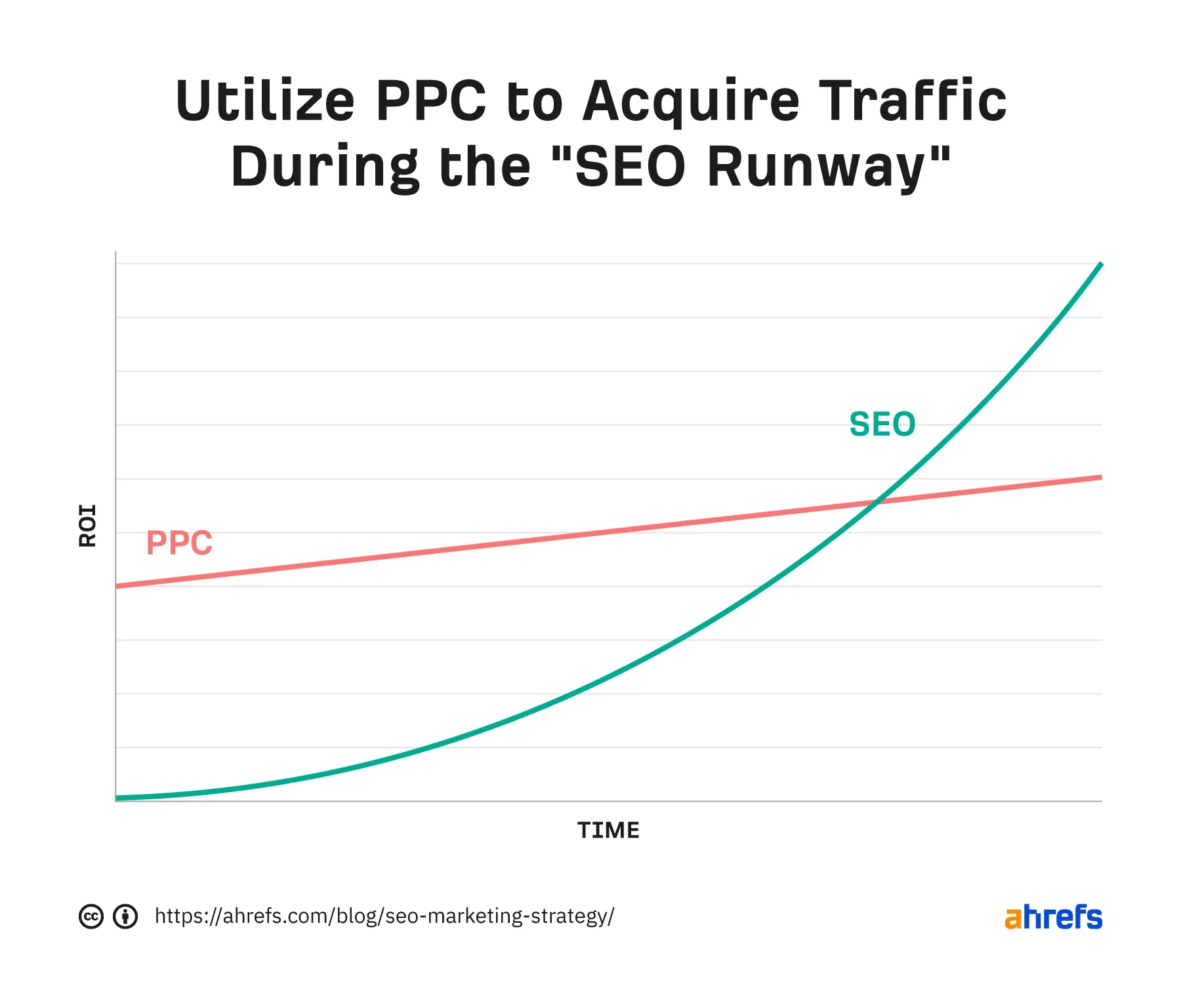
SEO and PPC follow very different cost models. SEO requires upfront investment in content, technical improvements, and authority building. Results take time, often several months, but once rankings are established, traffic continues without increasing spend at the same rate.
For many SaaS companies, SEO becomes more cost-effective than PPC after about 8 to 12 months, depending on competition and execution quality. This is often called the ROI crossover point.
PPC provides predictable traffic and fast feedback, but costs scale directly with volume. Every click has a price, and there is no residual value once campaigns stop. For this reason, PPC rarely replaces SEO as a long-term growth engine.
When SEO Makes Sense for SaaS
SEO works best when a SaaS company understands its audience and has achieved product-market fit. It is especially valuable for companies with longer sales cycles, higher contract values, or complex products that require education.
The best SEO agencies in the US support sustainable growth by lowering long-term acquisition costs and building inbound demand that compounds over time. For many mature SaaS companies, SEO becomes the foundation of their acquisition strategy.
When PPC Makes Sense for SaaS
PPC is most useful when speed matters. Early-stage SaaS companies often rely on PPC to validate demand, test messaging, and generate early pipeline. PPC is also effective for launches, promotions, and capturing high-intent searches that SEO may not yet rank for.
When used strategically, PPC provides clarity and acceleration that SEO cannot deliver in the short term.
Here is a Quick Comparison between SEO and PPC for SaaS Businesses
[table]
Factor | SEO | PPC
Time to results | 3–6 months | Immediate
Cost model | Upfront, compounding | Pay per click
ROI curve | Increases over time | Flat / tied to spend
Trust | High (organic) | Lower (ads)
Scalability | Content-driven | Budget-driven
[/table]
Why the Best SaaS Companies Use Both
High-performing SaaS companies do not choose between SEO and PPC. They combine them into one search strategy. PPC data helps identify which keywords and messages convert best. SEO then targets those insights for long-term growth.
SEO also improves PPC performance by building brand trust. Buyers who recognize a brand from organic search are more likely to click paid ads and convert. Appearing in both paid and organic results increases total visibility and reinforces authority.
This integration allows SaaS companies to capture demand, build trust, and grow efficiently across the full funnel.
Common Mistakes in SaaS Search Marketing
Running SEO and PPC in silos
Treating SEO and PPC as separate channels leads to inconsistent messaging, fragmented data, and missed insights that could improve your overall SaaS marketing strategy.
Optimizing for traffic instead of buyer intent
Focusing only on traffic growth instead of high-intent keywords results in unqualified visitors that don’t convert into pipeline or revenue for your SaaS business.
Applying short-term eCommerce tactics to SaaS
Using eCommerce-style tactics in SaaS marketing overlooks the need for education, trust-building, and multiple touchpoints across the buyer journey, especially in B2B SaaS.
Building a Smarter PPC and SEO Strategy
A strong SaaS search strategy aligns each channel with buyer intent. SEO supports awareness and consideration by educating users. PPC supports decision-making and conversion by capturing high-intent demand.
Success should be measured using meaningful metrics like demos booked, trials started, pipeline influenced, cost per customer, and lifetime value, rather than clicks alone.
Final Thoughts
The whole “SEO vs PPC” debate is kind of the wrong question.
If you’re growing a SaaS product, you don’t win by picking one. You win by understanding when your buyer is searching, what they’re looking for, and showing up in the right place at the right time.
SEO compounds over time by building trust, capturing demand, and continuing to work in the background.
PPC, on the other hand, is immediate. It puts you in front of high-intent buyers right now.
When used correctly, they don’t compete; they reinforce each other.
But here’s where most teams get it wrong: PPC isn’t just “turn on Google Ads and scale.” That’s usually where the budget gets burned.
PPC is all about control and practice, knowing which keywords actually convert, cutting wasted spend fast, and turning campaigns into something predictable.
Scalix AI understands that well.
We help SaaS and AI companies turn PPC into a reliable acquisition channel, not an experiment that kind of works sometimes.
Time and again, we have helped our clients spend less and get more qualified leads in the pipeline. We don’t just say that our campaigns tie back to revenue; we actually prove it.
You should let SEO compounding on the side, but if you need traction now, PPC is the fastest way to achieve it.