Picking the right LinkedIn format for your business shouldn't be guesswork.
Get a clear roadmap for improving performance and maximizing ROI.
Share this Article



Key takeaways
Thought Leader Ads produce CTRs 2 to 3 times higher than Sponsored Content across virtually every B2B SaaS account.
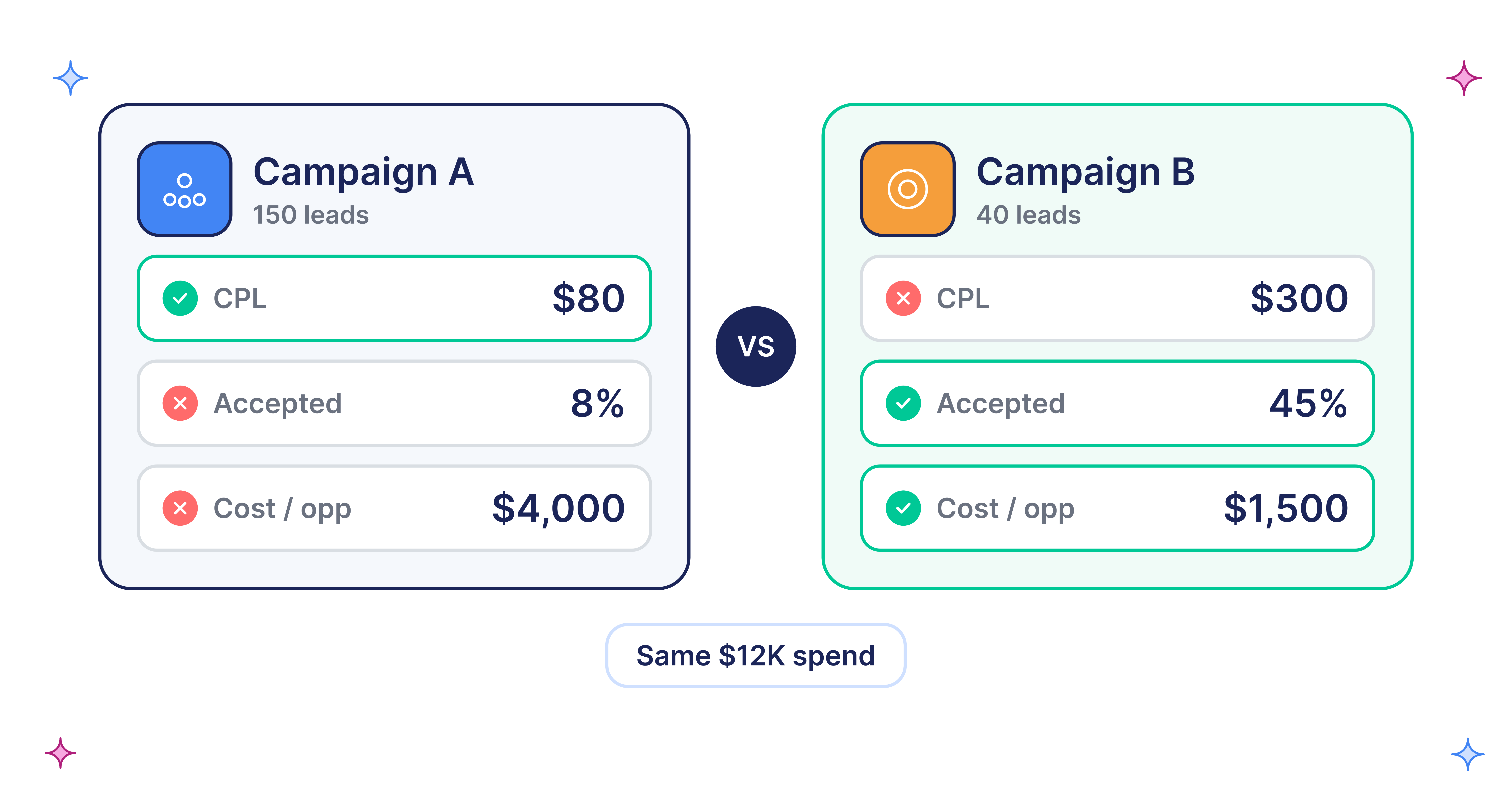
Lead Gen Forms look cheaper per lead but produce 5 to 10 percent qualified rates vs 15 to 30 percent for landing pages.
Document Ads have the highest engagement of any format because the audience treats them as content, not advertising.
Conversation Ads work best for high-ACV, high-consideration offers and almost never work for everything else.
Text Ads and Dynamic Ads still exist but are legacy formats LinkedIn is quietly deprecating in favor of newer ones.
LinkedIn offers nine main ad formats, and most B2B SaaS companies only ever use one or two of them. That is not always a mistake, but it often means treating every campaign objective the same way.
The reality is that LinkedIn ad formats are designed for different jobs. Some are built to introduce your company to buyers who have never heard of you. Others are designed to capture demand, generate leads, or move prospects already in the market toward a sales conversation. Choosing the wrong format does not always make a campaign fail, but it can make it significantly less efficient than it should be.
That is why conversations about LinkedIn performance often focus on targeting, creative, budgets, and bidding while overlooking one of the most important decisions in the campaign itself: the ad format.
This guide breaks down every LinkedIn ad format available in 2026, what each one is actually designed to do, where it performs best, where it falls short, and how to choose the right format for each stage of a B2B SaaS funnel.
The goal is not to convince you to use every format LinkedIn offers. It is to help you understand which formats deserve a place in your strategy and which ones are unlikely to move the pipeline for your business.
What are the different types of LinkedIn ads in 2026?
LinkedIn offers nine main ad types in 2026, each designed for a different stage of the funnel and a different audience temperature. Let’s look at the full list with a brief description of what each does best:
[table]
Ad type | Best for | Funnel stage
Sponsored Content | Awareness and content distribution at scale | TOFU and MOFU
Carousel Ads | Visual storytelling across multiple ideas or features | TOFU and MOFU
Document Ads | Lead capture through high-value gated content | MOFU and BOFU
Conversation Ads | High-touch outreach for considered B2B offers | BOFU
Message Ads | Direct, personalized one-to-one outreach | BOFU
Video Ads | Brand storytelling and demand creation at scale | TOFU
Thought Leader Ads | Native-feeling content from credible individual voices | All stages
Text Ads | Low-cost awareness on the LinkedIn sidebar | Legacy / TOFU
Dynamic Ads | Personalized awareness based on viewer’s LinkedIn profile | Legacy / TOFU
[/table]
The mistake most B2B SaaS companies make is choosing a format based on what they've used before or what they're familiar with, rather than what the goal of the campaign actually requires. The right format for a brand awareness campaign isn't the right format for a demo booking campaign. We'll walk through each one.
For founders new to the channel, our guide on LinkedIn Ads for B2B SaaS covers how to think about the channel as a whole before getting into format-level decisions.
- LinkedIn Sponsored Content
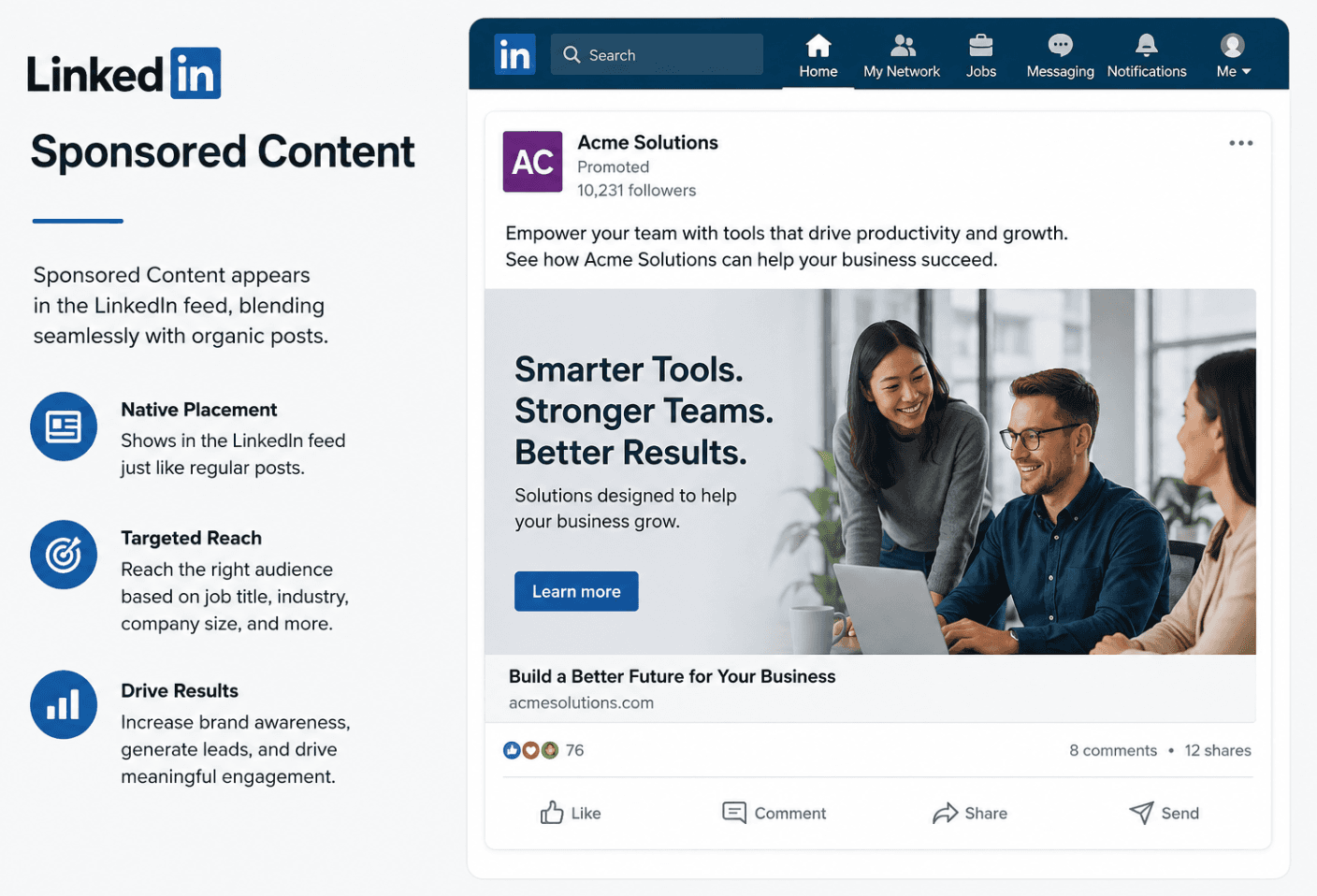
Sponsored Content is the default ad format on LinkedIn and the format most B2B SaaS companies spend the majority of their budget on. These ads appear directly in the feed and look similar to organic posts, with a small "Promoted" label indicating they are paid placements.
The reason Sponsored Content remains so widely used is its flexibility. The same format can support awareness campaigns, content downloads, webinar registrations, and demo requests. What changes is not the format itself, but the audience, message, and offer.
That flexibility is also why performance varies so widely. The best campaigns align the creative to the buyer's stage in the journey. A cold audience rarely wants a demo. A prospect already familiar with your company may not need another educational guide. Sponsored Content performs best when the content matches the buyer's level of awareness.
The biggest shift in recent years has been creative quality. LinkedIn users have become much better at ignoring content that feels overtly promotional. Posts built around genuine industry insights, firsthand experience, or strong opinions consistently outperform polished corporate messaging.
For B2B SaaS companies, cold-audience Sponsored Content typically generates CTRs between 0.4 and 0.6 percent, while warm audiences often reach 0.8 to 1.2 percent. Those numbers may look low compared to Meta, but the audience is fundamentally different. LinkedIn users click less often, but the people who do click are far more likely to match the buyer profile you're trying to reach.
- LinkedIn Carousel Ads

Carousel Ads let you stack two to ten cards inside a single sponsored post, with each card carrying its own image and copy. The format is designed for ideas that can't be communicated in a single image: multi-feature product walkthroughs, step-by-step explainers, or comparison content where you need the viewer to swipe through to absorb the full message.
Where Carousel Ads work: visual demonstrations of how a product works, breakdowns of a multi-step methodology, before-and-after comparisons, and any content that benefits from the viewer actively engaging with the post rather than passively reading it. The swipe action itself is a low-friction commitment that signals genuine interest, which makes Carousel Ad engagement a better intent signal than a passive feed scroll.
Where Carousel Ads fail: when the content doesn't need multiple cards. A lot of B2B SaaS companies use Carousels because they want to "fit more in," not because the content actually requires it. If the same message could be delivered in one strong image, a single-image Sponsored Content ad will outperform the Carousel almost every time.
Best practice: each card should be able to stand alone while also building on the previous one. A weak third card kills the engagement of the whole sequence.
- LinkedIn Document Ads

Document Ads are one of the highest-engagement formats on LinkedIn in 2026, and most B2B SaaS companies aren't using them. These ads display PDF documents directly in the feed, where users can scroll through and read the content without leaving LinkedIn.
The reason Document Ads work so well is the user doesn't recognize them as advertising in the same way they recognize a Sponsored Content post. The viewing experience is closer to reading a useful piece of content than viewing an ad. Engagement rates run dramatically higher than standard Sponsored Content. The cost per engagement is often the lowest of any format LinkedIn offers.
The format is best suited to high-value gated content: industry reports, benchmark studies, playbooks, and any asset where the reader benefits from seeing real substance before they're asked to convert. A Document Ad of a 12-page industry report will outperform a Sponsored Content post linking to that same report, because the prospect can preview the value before deciding whether the download is worth their information.
Where Document Ads don't work: top-of-funnel awareness campaigns that aren't tied to a downloadable asset, or any campaign where the goal is direct conversion rather than education and trust building. The format is best at the middle of the funnel, where the buyer is researching but not yet ready to book a demo.
- LinkedIn Conversation Ads
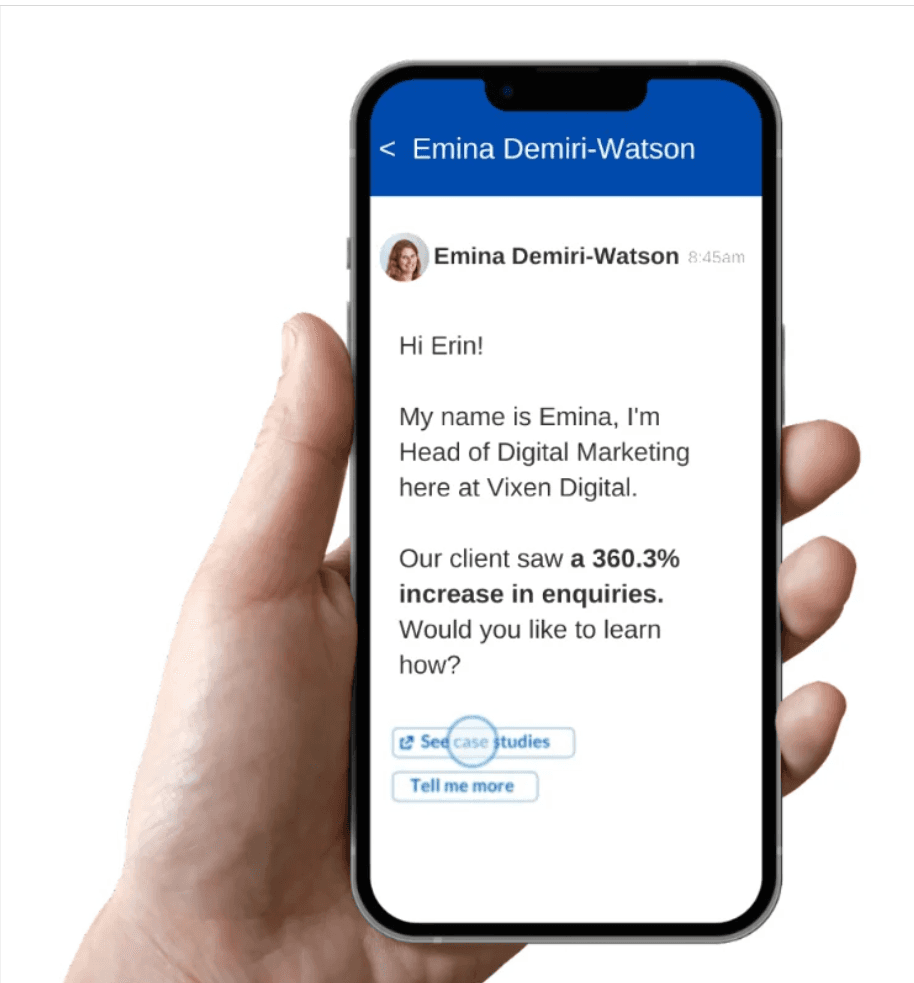
Conversation Ads are interactive ads that arrive in a prospect's LinkedIn inbox and let them choose from a series of branching options. Think of them as a chat-style ad where the viewer engages with multiple CTAs in a single interaction rather than seeing a single message.
Linkedin Conversation ads perform well when you have high-consideration B2B offers. This is where the buyer benefits from being walked through their options before making a decision. Enterprise software demos, services with multiple use cases, or products where different ICPs need different value propositions all benefit from the format. The branching logic lets you serve different content based on what the viewer is actually interested in.
Where Conversation Ads fail: low-consideration offers, generic awareness campaigns, and any campaign that's not tightly built around the branching structure. A Conversation Ad that asks the viewer to choose between three options that all lead to the same page is just a more expensive version of a Sponsored Content ad. The branching has to actually mean something.
Performance varies widely by industry. CTRs can hit 4 to 5 percent on well-designed campaigns to qualified audiences, but they crash to under 1 percent if the targeting is broad or the offer doesn't justify the interaction. This is a precision format. It rewards specificity and punishes laziness.
- LinkedIn Message Ads
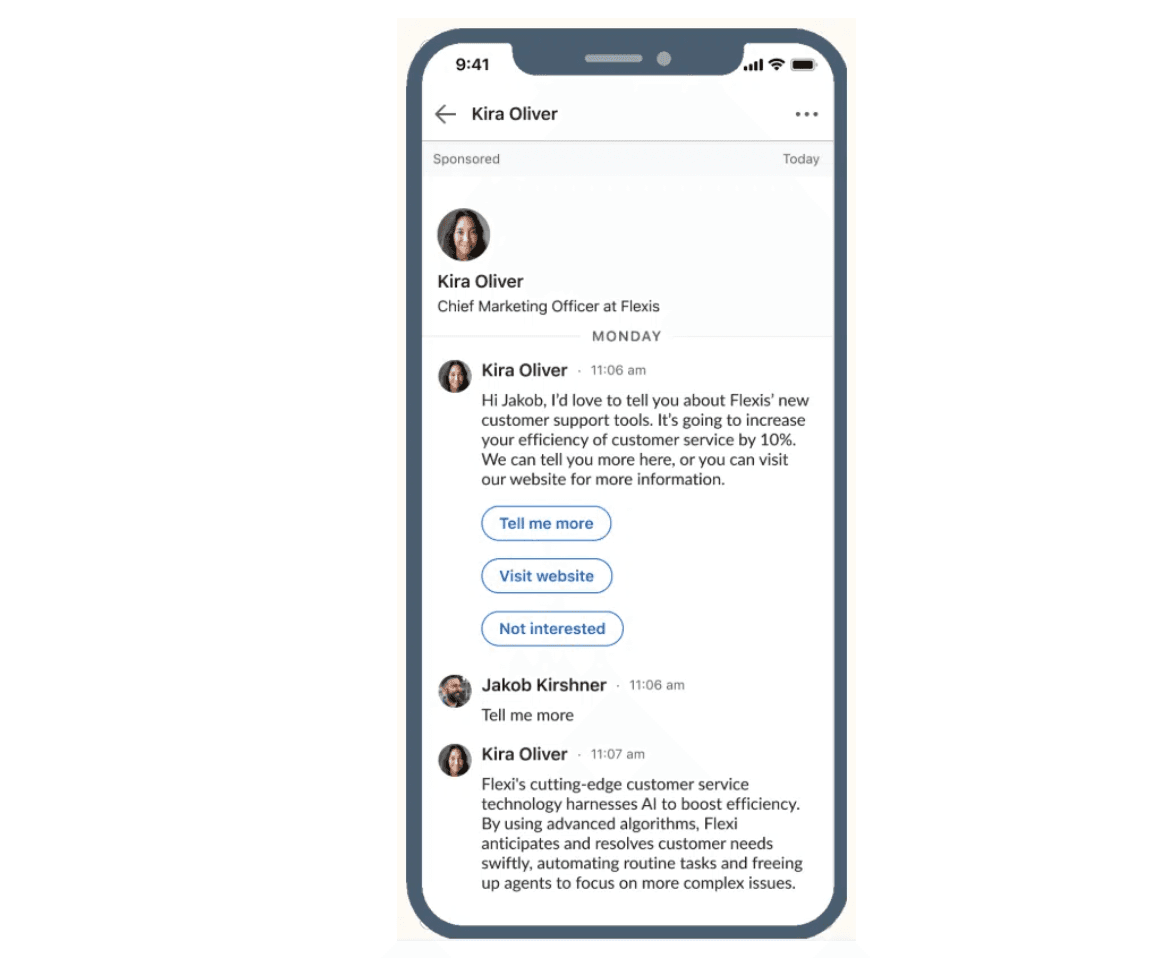
Message Ads (formerly known as Sponsored InMail) deliver a one-to-one direct message into a prospect's LinkedIn inbox. The format used to be one of LinkedIn's best-performing options. In 2026, it's significantly less effective than it was five years ago, and most B2B SaaS companies should approach it carefully.
The decline isn't really LinkedIn's fault. It's a saturation issue. Prospects in the typical B2B SaaS ICP receive multiple Message Ads per week, and they've learned to recognize and ignore them quickly. Open rates have dropped meaningfully across nearly every industry over the past three years.
Where Message Ads still work: highly personalized outreach to a small, tight audience, often for specific high-value moments. Invitations to private events, account-based outreach to a list of fewer than 500 target accounts, or executive-level offers where the message is genuinely tailored to the recipient's company or role. The format works when it doesn't feel like a Message Ad. It fails when it feels like the templated outreach prospects are already drowning in.
If you're considering Message Ads, the question to answer first is whether the offer is significant enough to justify a direct inbox interruption. If it isn't, the budget will produce better results in Sponsored Content or Thought Leader Ads.
- LinkedIn Video Ads

Video Ads on LinkedIn appear in the feed as autoplaying video content, with most viewers watching for under 15 seconds. The format is well suited to top-of-funnel brand storytelling, demand creation, and the early stages of awareness where the goal is to introduce a buyer to your category or company rather than convert them to a specific offer.
The video format has one significant advantage: emotion and personality come through in ways that static images can't replicate. For B2B SaaS companies building a brand voice or differentiating in a crowded category, video gives you tools that text and image ads don't.
The only issue is the cost and creative complexity. Video ads cost more to produce well, and the bar for what counts as "well-made" on LinkedIn has risen over the past two years. Poorly produced video underperforms standard image ads in almost every test. If you can't invest in genuinely high-quality video creative, image-based Sponsored Content will produce better results for less spend.
Video ads on Linkedin that work in 2026: short, founder-led talking head videos shot in a studio or office environment. Real people talking about real problems.
What doesn't work: polished corporate brand videos that look like television commercials. LinkedIn rewards content that looks native to the platform.
- LinkedIn Thought Leader Ads

Thought Leader Ads are the highest-performing format on LinkedIn in 2026, and the gap between them and standard Sponsored Content is significant. These ads run from an individual's LinkedIn profile (typically a founder, executive, or subject matter expert) rather than the company page, which means they look almost identical to organic posts in the feed.
LinkedIn users trust individuals more than they trust companies. A post from a real person with a real face and a credible voice gets read. A company page post gets scrolled past. When you're paying to put your message in front of an audience, the format that doesn't feel like advertising wins.
CTR benchmarks for Thought Leader Ads in B2B SaaS run between 0.8 and 1.5 percent on cold audiences and 1.5 to 2.0 percent on warm audiences. Compared to Sponsored Content CTRs of 0.4 to 0.6 percent, that's a 2 to 3x improvement on essentially the same audience with essentially the same message. The only thing that changed is who the post comes from.
The format works best when the spokesperson has a credible, established voice on the platform (or is in the process of building one). It usually doesn’t work when the post comes from someone the audience has no reason to trust or recognize.
If you have a founder or executive willing to put their face on the campaign, LinkedIn Thought Leader Ads deserve a deep dive because the strategic implications go well beyond just "boost a personal post."
- LinkedIn Text Ads and Dynamic Ads

Text Ads are small, sidebar-based ads that appear on the right side of LinkedIn's desktop interface. Dynamic Ads are similar in placement but personalize the creative based on the viewer's LinkedIn profile data (name, photo, company, etc.).
Both formats are legacy options. LinkedIn has been quietly deprioritizing them in favor of feed-based formats, and most B2B SaaS companies in 2026 don't use them at all. The CPM is lower, but the engagement is also lower, and the placement on the sidebar has become less prominent over time as LinkedIn has redesigned the desktop interface.
Occasionally, they work well for very large-scale brand awareness campaigns where the goal is impressions rather than engagement, and niche use cases where personalized creative makes sense (recruiting ads, event invitations targeted by company). For most B2B SaaS demand generation, the budget will produce better results in Sponsored Content or Thought Leader Ads.
If you're considering these formats, the test to run is whether your goal is impressions or actual engagement. Sidebar formats deliver impressions cheaply. They rarely deliver pipeline.
Which LinkedIn Ad Type is Best for B2B? (2026 LinkedIn Playbook)
The best LinkedIn ad type for B2B SaaS is Thought Leader Ads, paired with Sponsored Content for scale and Document Ads for gated content offers. That combination covers the entire funnel and produces the strongest pipeline economics in 2026.
Here's the logical sequence for a B2B SaaS company building a LinkedIn program from scratch:
- Start with Thought Leader Ads if you have a founder or executive willing to be the face. This is the highest-performing format and the fastest path to learning whether your message resonates.
- Layer in Sponsored Content once Thought Leader Ads are working. Sponsored Content scales better because it's not constrained to a single individual's voice.
- Add Document Ads for high-value gated content offers (industry reports, playbooks, benchmark studies). These produce the highest engagement of any format and work especially well in the middle of the funnel.
- Test Carousel Ads when you have visual content that genuinely benefits from multi-card storytelling. Don't use them just to "fit more in."
- Consider Conversation Ads only for high-consideration offers with branching logic that genuinely serves the prospect. Most B2B SaaS companies don't need them.
- Skip Message Ads unless you have a highly personalized, high-value reason to interrupt someone's inbox.
- Skip Text and Dynamic Ads unless you have a specific niche use case.
For deeper context on whether LinkedIn pricing makes sense for your business, the how much do LinkedIn ads cost breakdown covers the unit economics.
And for the broader strategic question of where LinkedIn fits in your overall channel mix, LinkedIn Ads vs Google Ads is worth reading alongside this guide. It will help you decide whether you want to stick to the traditional paid media or adopt a long-term demand generation strategy.
LinkedIn Ads Examples That Actually Work
Strong LinkedIn ad creatives follow a few consistent patterns across formats. Instead of treating these as writing tips, it helps to think of them as performance constraints that show up across high-performing campaigns.
Core creative patterns
[table]
Pattern | What it means in practice | What works | What fails
First line clarity | The first 1–2 lines decide whether the post gets expanded | Direct problem statements or counterintuitive hooks | Generic intros that "warm up" the reader
Specificity over messaging | Concrete outcomes outperform positioning statements | "$1.2M pipeline in 90 days from LinkedIn" | "We help B2B SaaS scale on LinkedIn"
Offer-to-audience match | CTA depends on where the buyer is in their journey | Education for cold audiences, demos for warm audiences | Pushing demos too early
Native-first creative | Ads should feel like content, not advertising | Founder-style posts, screenshots, raw video | Overdesigned graphics and stock-heavy visuals
[/table]
Most underperforming LinkedIn campaigns fail in predictable ways. The creative is usually too broad, too polished, or asking for too much commitment too early in the funnel.
High-performing campaigns tend to do the opposite. They open with specificity, speak to a clearly defined audience moment, and look like content that could have appeared organically in the feed.
For more on how to think about audience temperature and where each format fits in demand generation vs lead generation strategy, that breakdown covers the structural logic.
The Bottom Line
LinkedIn's nine ad formats look like options. They're actually tools, each designed for a specific job.
Most B2B SaaS companies waste budget by either defaulting to one format for everything or testing all nine without a clear hypothesis about which one matches their actual goal.
The companies that produce real pipeline from LinkedIn pick two or three formats deliberately, run them long enough to actually optimize, and measure performance against pipeline impact.
The best agencies for LinkedIn ads do one thing in common: They use a format that helps them achieve the campaign target, not just earn impressions and engagement.
If you're choosing between formats and want a second opinion grounded in real campaign data, that's exactly what ScalixAI was built for.