


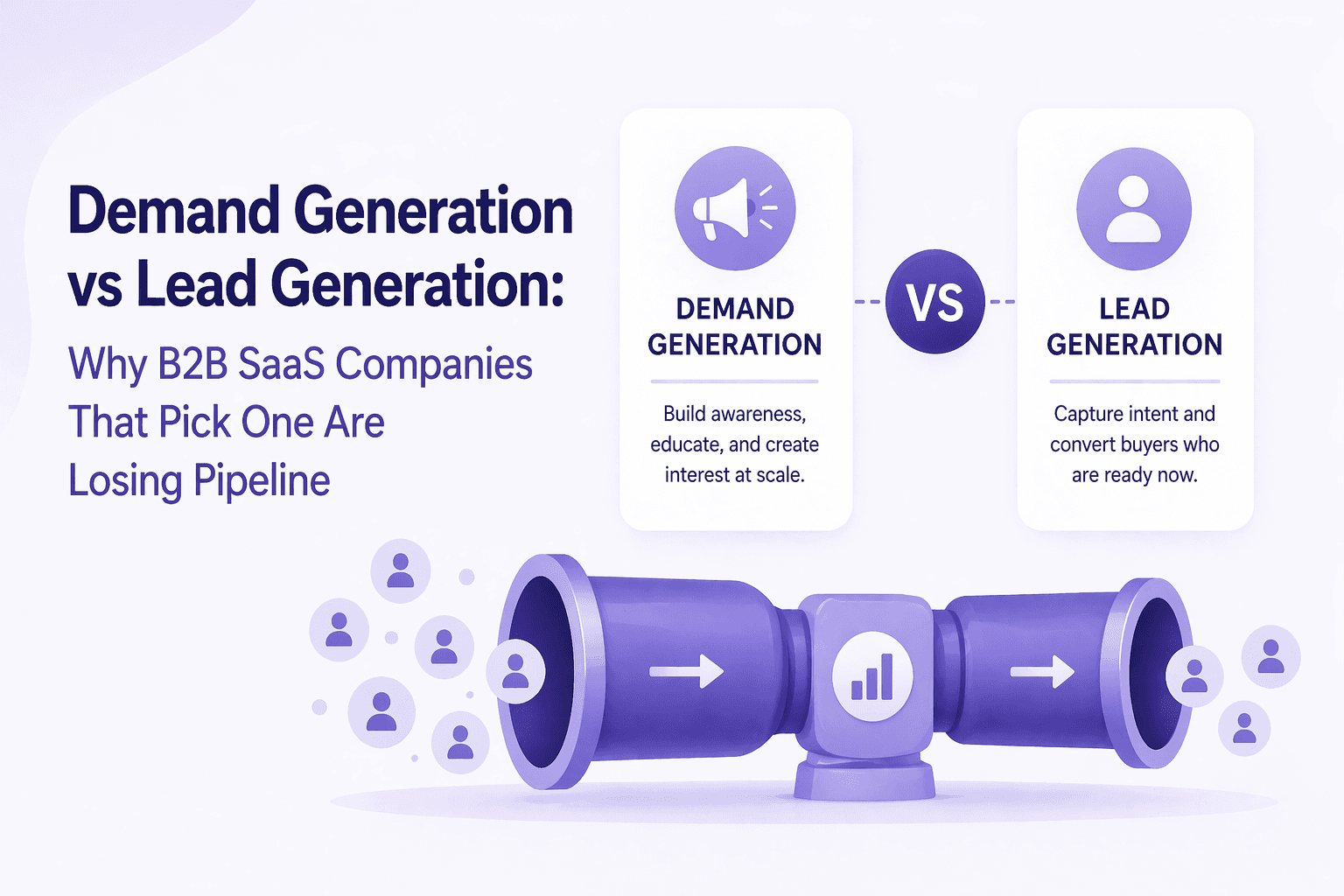
You Don't Have A Lead Problem. You Have A Demand Problem.
We Run Google Ads + LinkedIn Ads As One Integrated System. Flat Fee.
Share this Article



Key takeaways
Only 5% of your addressable market is actively searching for a solution right now. Demand gen works on the other 95%.
The research-backed budget split for B2B SaaS is 60% demand gen, 40% lead gen — most companies invert this and then wonder why their buyer pool keeps shrinking.
B2B buyers now spend only 17% of their total buying journey actually talking to vendors. The rest is self-directed research you cannot track with last-click attribution.
Google Ads captures existing demand. LinkedIn Ads creates new demand. Both are necessary. Neither works as well alone.
The companies winning right now are not spending more — they are connecting their demand gen and lead gen into one pipeline system with unified attribution.
Demand generation vs lead generation — this debate is quietly splitting marketing budgets, confusing SaaS founders, and costing growth-stage companies real pipeline every single quarter.
I'm Waqas, founder of Scalix AI. I spent 9 years inside Google's ads ecosystem, and now I run a B2B paid media agency that works exclusively with SaaS companies. Every week, I talk to founders who are either running Google Ads with no brand in the market or posting on LinkedIn every day with no system to convert the attention they're earning. Both are leaving pipeline on the table.
Here's what nobody says clearly enough: demand generation and lead generation are not opposing strategies. They are two parts of one system. Demand gen creates future buyers. Lead gen captures current ones. When you run them together and connect the attribution between them, your CAC drops, close rates climb, and your sales team stops complaining about lead quality.
In this blog, I will discuss how I look at demand gen and lead generation, and explain with examples how I handle both.
What Is Demand Generation in B2B SaaS?

Demand generation is the process of creating awareness and interest among buyers who are not yet actively looking for a solution. It is proactive, brand-building marketing. You are not waiting for intent to appear; you are building it.
In B2B SaaS, this typically includes:
- LinkedIn thought leadership and brand awareness campaigns targeting your ICP by job title, seniority, and company size
- Ungated educational content, like blog posts, YouTube videos, podcasts, and original research that solves real problems your buyers face before they know they need you
- Community presence in industry Slack groups, LinkedIn communities, and peer forums, where buyers research silently
- Webinars, virtual events, and co-marketing partnerships that build category authority
- PR and analyst relations that shape how your product category is discussed
The goal of demand generation is simple: You want the VP of Operations at a 300-person Series B SaaS company to know your name before they have the problem you solve. When the problem surfaces, you're the first name in the conversation.
This is a long game. Demand gen typically takes 6 to 18 months to compound into a measurable pipeline. That timeline scares most founders. But the alternative, endlessly fighting over the same 5% of in-market buyers, is what's causing CAC to rise across the industry.
What Is Lead Generation in B2B SaaS?

Lead generation is the process of capturing qualified intent from buyers who are already in-market and actively evaluating solutions. It is reactive marketing. Demand exists. Your job is to capture it before a competitor does.
In B2B SaaS, this typically includes:
- Google Ads targeting high-intent keywords: "[category] software," "[competitor] alternative," "best [tool] for [use case]."
- Competitor conquesting campaigns on Google and Bing, targeting searches for products your ICP is already using
- A high-converting lead capture page with one specific offer, a demo, a free trial, or an ROI calculator, matched to the query intent
- Retargeting ad campaigns on LinkedIn, Google Display, and Meta that follow warm visitors who didn't convert the first time
- Gated content, including detailed case studies, comparison guides, and pricing pages that require a demo request or email to access
Lead generation is measurable, immediate, and produces the ROI rows your board wants to see. You can trace ad spend to demos booked to revenue closed. That is exactly why every B2B SaaS company defaults here. The problem is not that lead gen is wrong. The problem is that lead gen without demand gen is fishing in a pond that shrinks every year.
Demand Generation vs Lead Generation: Side-by-Side Comparison
[table]
Dimension | Demand Generation | Lead Generation
Primary objective | Build awareness among future buyers | Capture intent from in-market buyers
Buyer stage | Problem-unaware or category-aware | Actively evaluating and comparing
Channels | LinkedIn Ads, content, podcast, events, community, ABM awareness | Google Ads, competitor conquesting, retargeting, demo pages
Content type | Ungated thought leadership, videos, original research | Demo pages, comparison pages, ROI calculators, case studies
Core metrics | Brand search volume, share of voice, engagement depth, pipeline influence | MQLs, SQLs, demos booked, cost per SQL, CAC
Attribution | Dark funnel — difficult to attribute directly | Direct — click-to-demo trackable
Time to pipeline | 6–18 months | Immediate to 90 days
Budget split | ~60% (LinkedIn 2024 B2B Benchmark) | ~40%
CAC impact | Lowers long-term CAC through brand equity | Efficient short-term, but CAC compounds upward without demand gen
Sales cycle effect | Shortens cycles — prospects arrive pre-educated | Can lengthen if brand awareness is low
Risk of over-indexing | Awareness without a conversion system | Shrinking buyer pool, rising CPCs, diminishing returns
[/table]
Why 95% of Your Market Is Not Googling for You Right Now
Here is the number that reframes this entire conversation: at any given moment, only 5% of your total addressable market is actively searching for a solution like yours.
The other 95% are aware of the problem, or will be soon, but they are not raising their hands yet. They are not on Google. They are not comparing your pricing page to a competitor's. They are in Slack channels, on LinkedIn, listening to podcasts, and talking to peers.
This is where most B2B SaaS companies have a blind spot. They build their entire go-to-market strategy around capturing the 5% who are in-market. And they do it well — Google Ads, optimized landing pages, SDR sequences. But the 5% pool is finite, and every competitor is fishing in the same water.
Demand generation is what you do with the other 95%. You build awareness. You create the category frame. You become the name people remember when they move from "I have this problem" to "I need to find a solution." When they finally get to Google, you are the branded search, not the keyword battle.
The Two-Sides-of-the-Same-Coin Problem
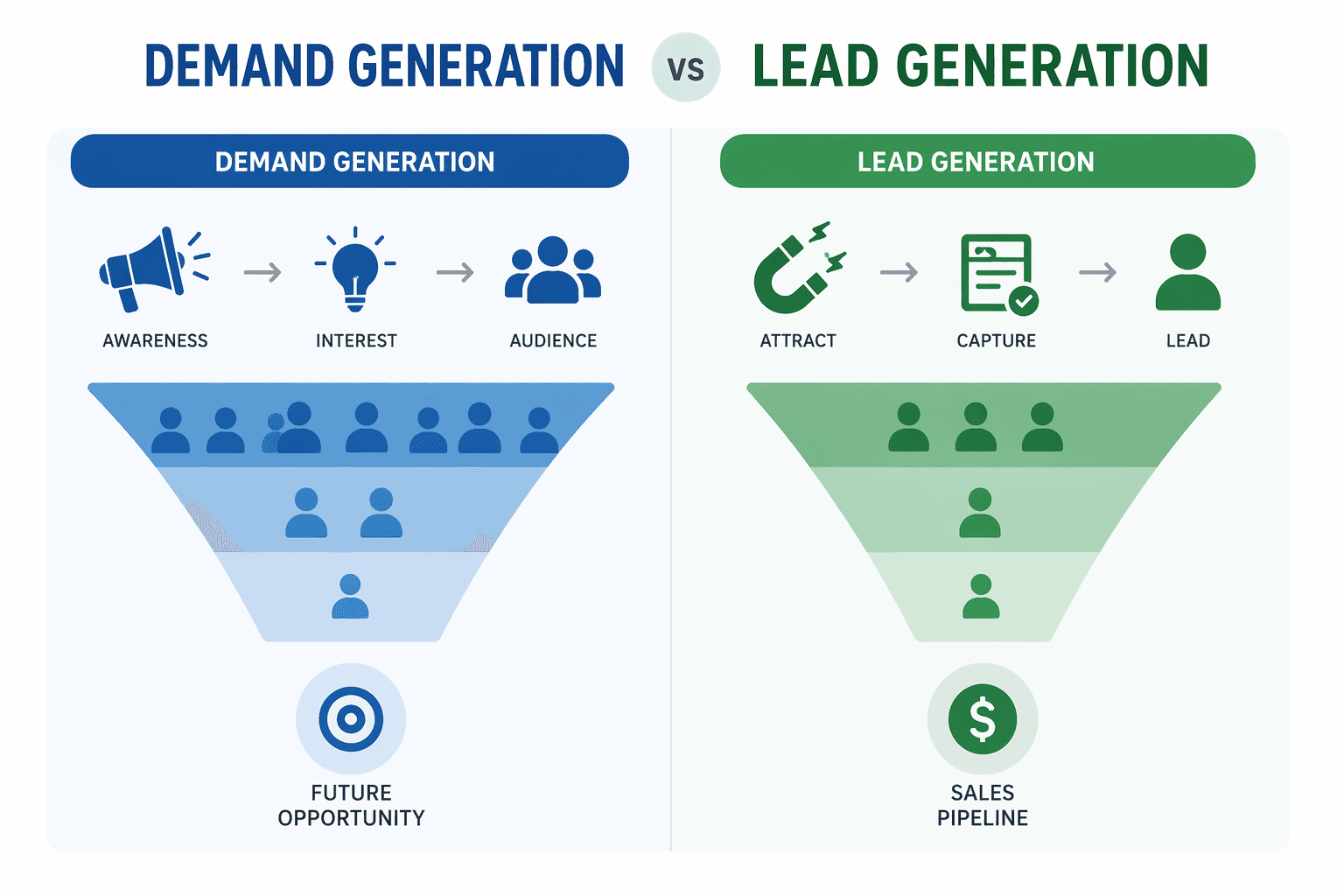
Most SaaS companies do not choose demand gen or lead gen out of strategy. They choose based on what is measurable and what leadership asks for each quarter.
If you only do lead gen, you capture the 5% who are actively searching. In the short term, the pipeline looks healthy. But the in-market pool is not growing, and you never built the brand that would have made your CPCs cheaper, your close rates higher, and your sales cycles shorter. By month 12 or 18, your cost per SQL is climbing, your sales team is complaining about lead quality, and you cannot figure out why nothing changed in the playbook, but the numbers are worse.
If you only do demand gen, you post on LinkedIn. You publish content. You build an audience. But there is no system to capture the demand you are creating. People know your name, admire your point of view, and then Google your competitor's terms when they are ready to buy because your competitor had Google Ads and a good demo page, and you did not.
Both scenarios are the same fundamental mistake: treating these two things as a choice rather than a sequence.
[table]
Scenario | What Happens to Your Pipeline
All lead gen, no demand gen | Pipeline looks fine at first. Buyer pool shrinks over 12–18 months. CAC rises 10–20% annually. Quality declines.
All demand gen, no lead gen | Brand builds. But no conversion system. Revenue lags brand investment by 12+ months. Board loses patience.
Integrated 60/40 model | Demand gen builds the buyer pool. Lead gen captures it. Attribution connects both. CAC trends down over time.
[/table]
The Attribution Challenge: Why Your CRM Is Lying to You
Here is a conversation I have had with nearly every SaaS founder I work with.
Me: "How did your last five closed deals hear about you?"
Them: "Google."
Me: "Did you ask them?"
Them: "That's what the CRM says."
The problem is that Google ads attribution, and virtually every last-click model, only captures the final measurable touchpoint before conversion. It misses the six LinkedIn posts the buyer saw over three months. It misses the podcast episode. It misses the peer recommendation in a private Slack community.
This is the dark funnel: the B2B buying activity that happens before a buyer ever fills out a form, triggers a pixel, or clicks an ad. It is enormous. And it is almost entirely driven by demand gen investments that most companies are either not making or not measuring.
Traditional attribution models like first-touch and last-touch capture only about 10% of B2B buyer behavior, leaving 90% of the actual journey unaccounted for.
The practical fix is not to abandon Google ads attribution; it is to layer self-reported attribution on top of it. We put "How did you hear about us?" on every demo request form at Scalix. The CRM attributes the demo to Google Ads. The form says LinkedIn content or a peer referral was the real origin. Both are useful. Neither alone tells the full story.
Additional attribution moves worth implementing:
- Multi-touch attribution models (linear, time-decay, or data-driven) that distribute credit across the full buyer journey
- Pipeline influence reporting to know which campaigns touched deals that closed, even if they were not the last click
- Brand search volume tracking. A rising branded search volume is a direct signal that demand gen is working, even when it cannot be attributed to a specific conversion
What Happens to Your CAC When You Only Invest in Lead Gen
CAC is the metric that exposes this mistake most clearly. Let me explain the mechanics.
When you run lead gen without demand gen, you are competing for a fixed pool of active buyers. Every other SaaS company in your category is also running Google Ads against the same keywords. As competition increases, CPCs rise. As CPCs rise, cost-per-lead rises. As cost-per-lead rises, cost-per-SQL rises. And your CAC climbs every year without anything in your playbook changing.
This is not a campaign optimization problem. It is a demand-supply problem.
Demand gen solves it by expanding the pool. Every buyer who encounters your brand through LinkedIn content, a podcast, or a piece of ungated research is a future buyer you did not have to bid against a competitor to reach. When they eventually search for a solution — and they will — they are already familiar with you. Your branded CPCs are a fraction of your category CPCs. Your demo-to-close rate is higher because they arrived educated. Your sales cycle is shorter.
How to Build Both Engines: The Integrated Pipeline Model
The best way I can explain how demand gen and lead gen relate is through the Pipeline Engine model:
Demand gen is the fuel. Lead gen is the engine.
Here is how it flows:
Step 1 — Content and brand ads (demand gen):
LinkedIn thought leadership and brand campaigns expose your ICP to your product category and point of view — long before they're ready to buy. This is your demand creation layer.
Step 2 — Brand search volume grows:
As more of your ICP becomes aware, branded searches increase. Your Google Ads branded CPCs drop significantly versus category CPCs because you're no longer competing blind.
Step 3 — Retargeting kicks in:
Retargeting ad campaigns on LinkedIn and Google re-engage people who consumed your content but haven't converted. They've already shown intent through engagement — this is your warmest non-converting audience.
Step 4 — High-intent Google Ads capture ready buyers:
When a buyer enters evaluation mode and searches "[your category] software" or "[competitor] alternative," your Google Ads are there. This is your demand capture layer.
Step 5 — Lead capture page converts intent:
A specific, high-converting landing page matched to the search query converts that intent into a demo, trial, or conversation.
Step 6 — Sales close faster:
Because the prospect already knows your name, has seen your perspective, and arrived educated through demand gen touchpoints, the sales cycle is shorter, and the close rate is higher.
This is not two separate marketing motions. It is one pipeline system.
Here’s how you can research high-intent PPC keywords ->
The Timeline: What to Realistically Expect at Each Stage
One reason founders avoid demand gen is timeline anxiety. Here is what the realistic return curve looks like:
Months 1–3: Foundation building. Google Ads go live for immediate lead gen. LinkedIn brand campaigns launch. Content starts publishing. No pipeline results from demand gen yet — this is normal.
Months 3–6: Early signals emerge. Branded search queries start appearing in Google Search Console. LinkedIn engagement rates climb. Self-reported attribution on demo forms starts showing LinkedIn as an origin source for the first time.
Months 6–12: Compounding begins. Branded search volume is measurably growing. Google Ads CPCs on brand terms are low. Sales calls start with "I've been following your content on LinkedIn." Retargeting audiences are large enough to run efficiently.
Year 2 and beyond: The moat widens. Pipeline quality is meaningfully higher. CAC is trending down versus pure lead gen benchmarks. Competitors start copying your content approach. You are now the category authority, not just a bidder on category keywords.
The companies that never see this return are the ones that shut off demand gen at month 4 because it did not produce an MQL yet.
How to Balance Demand Gen vs Lead Gen by Company Stage
The right allocation shifts as you scale. Here is the framework we use at Scalix:
[table]
Company Stage | ARR Range | Demand Gen % | Lead Gen % | Primary Channels
Pre-seed / Seed | $0–$2M | 30–40% | 60–70% | Google Ads, content SEO, LinkedIn organic
Series A | $2M–$10M | 40–50% | 50–60% | Google Ads + LinkedIn Ads, ABM starts
Series B | $10M–$30M | 50–60% | 40–50% | LinkedIn brand campaigns + Google Ads scale
Series C+ | $30M+ ARR | 60–70% | 30–40% | Full brand investment, demand creation at scale
[/table]
At seed stage, Google Ads for startups is usually the right first channel. You need pipeline signal fast. Google captures existing demand with measurable ROI and tells you which messaging converts before you invest in building an audience on LinkedIn.
As you move into Series A and B, you need to start building the brand that makes your lead gen cheaper and more effective over time. This is when LinkedIn Ads, specifically, thought leadership and brand awareness campaigns, start to justify their budget in the form of declining CPCs and improving close rates.
Google Ads for B2B SaaS: Demand Capture Done Right
If there is one channel that directly moves the pipeline in the shortest time for B2B SaaS, it is Google Ads. Here is why:
Google Search captures existing demand. When a Head of RevOps searches "revenue operations software for Series B SaaS," they have a problem and are actively comparing options. Your job is to show up at that exact moment with the right ad, the right landing page, and the right offer.
This is why Google Ads attribution is foundational. If you are not tracking conversions from click to lead to SQL to closed-won revenue, you are optimizing campaigns for the wrong outcome. Most agencies optimize for cost-per-click or cost-per-lead. We optimize for cost-per-SQL because leads that do not become qualified opportunities are not worth buying at any price.
At Scalix, our Google Ads campaigns for B2B SaaS are structured around three distinct intent layers:
- Branded campaigns: Protect your brand, capture warm demand, maintain low CPCs
- Competitor conquesting: Intercept buyers who are already evaluating alternative solutions to what they're using
- Category and problem-aware campaigns: Catch buyers researching the problem you solve, not yet solution-aware
Each layer requires a different landing page, different messaging, and different bid strategies. Lumping them together into one campaign — which most companies do — is the fastest way to burn budget on traffic that never converts.
Google Ads vs Meta Ads for B2B SaaS is a question I get constantly. Here is my honest take:
[table]
Dimension | Google Ads | Meta Ads
Intent level | High — buyers are actively searching | Low to medium — interruption-based
B2B targeting | Keyword intent + audience layering | Interest, behavior, lookalike
Best use case | Demand capture (in-market buyers) | Retargeting, top-of-funnel awareness
Avg. B2B CPL | $150–$400 for qualified demos | $80–$200 but lower conversion quality
Attribution | Strong with proper tracking | Challenged by iOS privacy changes
Verdict for B2B SaaS | Primary lead gen channel | Secondary — retargeting and awareness only
[/table]
LinkedIn Ads: The Best Demand Generation Channel for B2B SaaS
LinkedIn is the only platform where you can reach a VP of Finance at a 300-person healthcare SaaS company, by exact job title, seniority, company size, and industry, and serve them thought leadership content before they have ever heard of you.
When people ask about the best agencies for LinkedIn Ads, the conversation always comes back to the same question: Does the agency understand the difference between running LinkedIn as a demand generation channel versus running it as a lead generation channel? Most do not. They optimize LinkedIn for form submissions and measure cost-per-lead. That is the wrong framework. LinkedIn audiences are expensive and not in buying mode. The ROI on LinkedIn comes from:
- Brand awareness campaigns with thought leadership content, targeting cold ICP audiences
- Thought Leader Ads amplifying the founder or key team members' personal content to build trust at scale
- Retargeting campaigns against website visitors, video viewers, and document engagement audiences, your warmest non-converting LinkedIn audiences
- Document ads that deliver ungated value without asking for anything in return, building brand credit that compounds over time
LinkedIn Ads should make your Google Ads cheaper over time. As your demand gen investment builds brand familiarity, more of your ICP will search for you by name. Branded keyword CPCs are a fraction of competitive category terms. That compound effect is the real return on LinkedIn, it shows up in your Google Ads performance, not just your LinkedIn metrics.
What Makes a Lead Capture Page Actually Convert
You can have perfect demand gen, perfect Google Ads, and perfect targeting. If your lead capture page is generic, you are losing conversions at the last step and paying full price for the traffic that leaves.
Here is what separates a high-converting B2B SaaS lead capture page from one that leaks pipeline:
- Headline matches the query: The page headline should reflect exactly what the ad or search term promised. A visitor who clicks "Project management software for engineering teams" and lands on a generic "Book a Demo" page loses confidence immediately.
- Social proof above the fold: One or two recognizable customer logos and a single short testimonial from a company in the visitor's vertical. Not a wall of logos, just one that is specific and relevant.
- A single, clear offer: One CTA. Not three options. "Book a 30-minute demo" is better than "Book a Demo, Start a Free Trial, or Download Our Guide."
- Friction calibrated to deal size: Low-ACV SaaS should minimize friction, just include first name and work email only. High-ACV SaaS should qualify through the form, so ask about team size or current tool to improve lead quality, even if it reduces volume.
- What happens next: Explicitly tell the visitor what happens after they submit. "You'll receive a calendar link within 2 minutes." This alone increases conversion rates because it eliminates uncertainty.
Check out strategies to improve conversion rates for B2B SaaS ->
Retargeting Ad Campaigns: The Bridge Between Demand Gen and Lead Gen
Retargeting ad campaigns are the most underused lever in B2B SaaS paid media. They are the mechanism that takes demand gen audiences, people who engaged with your content but never converted, and routes them back into a lead gen path.
The retargeting stack we built for Scalix clients:
Tier 1 — All website visitors, 30 days
Re-engage everyone who visited your site. These people have some awareness. Serve them a product-specific message and a clear reason to come back.
Tier 2 — Pricing or demo page visitors (non-converters), 14 days
Your hottest retargeting audience. They considered converting and did not. Serve them a vertical-specific case study, a relevant customer testimonial, or a limited-time incentive.
Tier 3 — LinkedIn video viewers and content engagers, 60 days
These are your demand gen audiences warming up. They are not ready for a hard demo push. Serve them a low-friction offer — a webinar, a specific guide, or a founder-led video.
Tier 4 — Customer lookalikes
Build lookalike audiences from closed-won customers on both LinkedIn and Google. Target them first with brand awareness, then retarget with lead gen offers as they engage.
Retargeting consistently delivers the best pipeline ROAS of anything you run because the audience is already warm. Yet most SaaS companies put 90% of their budget into cold prospecting and 10% into retargeting. That ratio should be closer to 70/30.
Click here to discover more growth strategies for SaaS ->
How Scalix Helped DELVE Run Demand Gen and Lead Gen as One System

When Delve came to me in April 2025, they had a clear goal: build commercial traction fast enough to support a Series A raise.
The challenge was a textbook demand gen vs lead gen problem.
They needed an immediate pipeline from in-market buyers; the compliance leads actively searching for automation tools. But they also needed to build credibility and reach senior enterprise decision-makers who were not yet in a buying cycle. Google Ads alone could capture the first group. It could not touch the second.
So we ran both channels as one system.
On the lead gen side, I rebuilt their Google Ads campaigns from the ground up. This included tighter targeting, intent-layered campaign structure, and conversion tracking tied to qualified demos.
On the demand gen side, we ran LinkedIn to reach CISOs, Head of Security, and Compliance leads at enterprise accounts, the senior decision-makers who needed to see Delve's name before they were ready to act.
The two channels were connected, not siloed. LinkedIn warmed the accounts. Google Ads captured them when they moved into evaluation mode.
Over six months, the results were:
- Google Ads drove $5.59M in influenced pipeline and $1.04M in closed-won revenue
- LinkedIn drove $1.35M in pipeline and $169K in closed-won revenue
- $7M total influenced pipeline and $1.2M closed-won within six months
- Delve went on to raise a $32M Series A led by Insight Partners, with participation from CISOs at Fortune 500 companies
The LinkedIn investment did not show up in last-click attribution. But it showed up in the sales calls; prospects who arrived already knowing Delve's name, already sold on the AI-native differentiation, already past the "who are you?" stage. That is demand gen doing its job.
We didn’t want two separate budgets fighting over attribution credit. Hence, we created a pipeline system where each channel makes the other more effective.
The Metrics You Should Actually Track for Each
The demand gen vs lead gen debate usually breaks down here: CFOs want to see numbers, and demand gen metrics look fuzzy compared to a cost-per-lead row on a spreadsheet.
Here is how to present both in a way that tells a complete story:
[table]
Metric Type | Demand Gen Metrics | Lead Gen Metrics
Awareness | Branded search volume (Google Search Console), share of voice | —
Engagement | LinkedIn engagement rate, video completion rate, time on page | —
Pipeline influence | Self-reported attribution %, CRM-tracked touchpoints in closed deals | MQLs, SQLs, demos booked per month
Efficiency | Branded CPC trend (should decline QoQ), organic traffic growth | Cost per SQL, CAC, CAC payback period
Revenue quality | Sales cycle length (demand gen-influenced vs cold), win rate by source | Deal size, close rate, revenue per demo
[/table]
Show your board both. Demand gen metrics tell you whether the long-term engine is building. Lead gen metrics tell you whether you are capturing revenue right now. Neither alone tells the truth.
The Bottom Line
Demand generation vs lead generation is the wrong framing. The right framing is: demand creation feeds demand capture, and demand capture funds the next round of demand creation.
SaaS companies that pick one are not making a strategic choice; they are making a timing trade-off with a bad long-term payoff. Either they build an audience with no conversion system, or they fish a shrinking pond until their CAC makes the math stop working.
The companies that win are the ones running both as one connected system.
And that is exactly how Scalix runs paid media for B2B SaaS companies. Our Google Ads management services are built for founders and marketing teams who want pipeline, not just clicks.
We give you proper conversion tracking, a full-funnel campaign architecture, and a LinkedIn Ads program running alongside it, so your demand gen and lead gen investments compound rather than compete for credit.
If your Google Ads are generating traffic but not qualified demos, or if you have no brand presence in the market yet, book a free audit. We will review your current setup, show you where pipeline is leaking, and give you a specific plan to fix it.


