




Key takeaways
PPC keyword ideas that convert come from search term reports, not keyword planning tools alone.
Most advertisers only bid on product keywords, but comparison and purchase terms convert far higher.
A keyword list that never evolves is a campaign that slowly stops working.
Dynamic Search Ads surface high-intent queries your manual keyword list never thought to include.
The best PPC campaigns win on better keyword ideas, not bigger budgets.
A few months ago, we audited a Google Ads account for a fast-growing SaaS startup. At first glance, everything looked like it should be working. The campaigns were structured well, the ads copy was clean, and the landing pages were well designed. But the conversions showed a different story.
The company was spending thousands every month, and most clicks weren’t turning into customers.
This is a very common situation. Many companies spend anywhere from $100 to $10,000 per month on PPC campaigns, often averaging close to $9,000–$10,000 when you include ad spend and management costs.
When that kind of budget is involved, every keyword matters. So, we looked into the account, we found out that the problem was not with the ads, but it was more to do with the keywords.
They had built their entire strategy around a short list of obvious search terms. The kind everyone starts with. And that was precisely the problem. The best PPC campaigns rarely win because of obvious keywords. Instead, they win because of better keyword ideas.
After restructuring the keyword strategy and expanding the list with new search patterns, the campaigns started capturing real demand.
The result, honestly, was exactly as we predicted. More qualified traffic, better conversion rates, and campaigns that actually scaled.
This is what this guide is about. It’s about learning how to find PPC keyword ideas that drive real results, not just clicks.
Why Most PPC Keyword Lists Stay Too Small
When most companies start PPC keyword research, they follow the same pattern.
They brainstorm a few terms related to their product, plug them into Google Keyword Planner, and build campaigns around whatever suggestions appear.
This process works for a while, but eventually, performance slows down because the keyword list never evolves.
Here’s what usually happens.
[table]
Common Keyword Strategy | What Happens
Using only product keywords | Competition is high and CPC increases
Copying competitor keywords | Campaigns look identical to everyone else
Relying only on keyword tools | High-intent searches get missed
Ignoring search term data | New opportunities stay hidden
[/table]
The key learning here is to treat keyword discovery as an ongoing process.
Here’s what you should constantly be doing:
- Reviewing search behavior
- Expanding keyword ideas
- Filtering irrelevant traffic
- Identifying new intent signals
That is where real campaign growth comes from.
A Simple Framework for Generating PPC Keyword Ideas
Instead of thinking about keywords as a flat list, it helps to organize them into intent layers.
Each layer captures a different stage of the buyer journey.
[table]
Keyword Type | Example | Intent Level
Product keywords | CRM software | Medium
Solution keywords | Sales pipeline software | High
Problem keywords | Manage sales leads | Medium
Comparison keywords | HubSpot alternatives | Very High
Purchase keywords | CRM pricing | Very High
[/table]
Most advertisers only target the first category, but the best Google Ads growth campaigns capture all five layers. This approach actually helps increase the number of keyword opportunities.
Finding New Google Ads Keywords Inside Your Own Data
One of the best places to find new keyword ideas is already inside your account. Don’t overlook your list.
Mining Search Term Reports
Search term reports show the exact queries that triggered your ads. They often reveal high-intent searches you never targeted directly.
Let’s look at this example:
[table]
Search Query | Clicks | Conversions | Opportunity
AI customer support tool | 120 | 14 | Add as keyword
Best AI support platform | 64 | 9 | High-intent keyword
Customer support automation software | 51 | 6 | Expand campaign
[/table]
It’s important that you review these reports regularly as it will help you uncover valuable keyword opportunities that traditional PPC keyword research might miss.
Use Dynamic Search Ads (DSA) to Discover Keywords
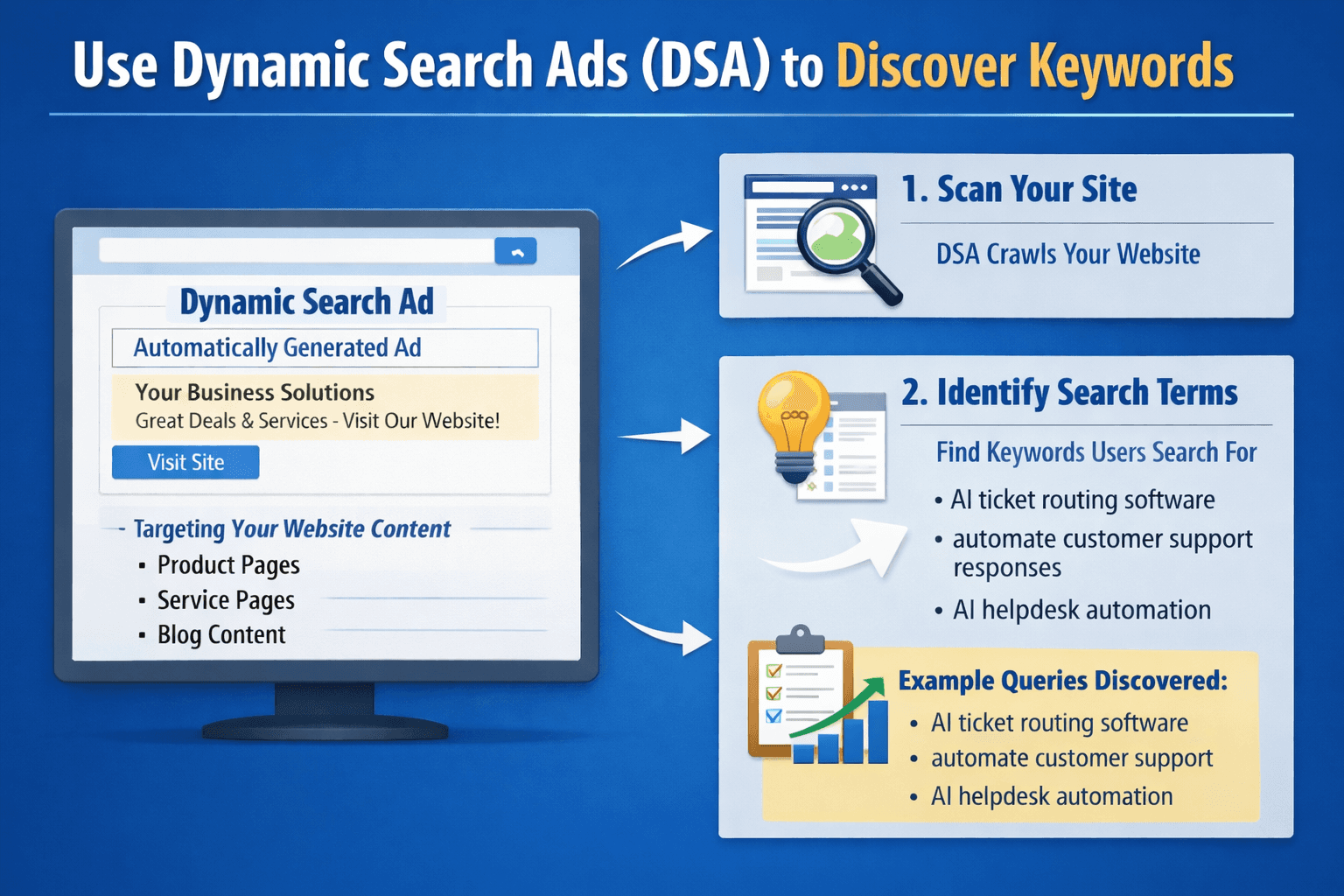
Dynamic Search Ads (DSA) can be surprisingly useful for keyword discovery. Instead of targeting keywords directly, Google scans your website and matches ads to relevant searches.
This often surfaces new queries you would never think to target manually.
For example, a SaaS company might discover queries like:
- AI ticket routing software
- automate customer support responses
- AI helpdesk automation
Each one becomes a new Google Ads keyword opportunity.
Broad Match Keywords Can Reveal New Searches
Broad match keywords often get a bad reputation, but when used carefully they can help uncover new keyword ideas as they allow Google to test variations of your keywords.
For example:
[table]
Broad Match Keyword | Possible Searches
AI chatbot | AI chatbot for customer support
AI chatbot | Best AI chatbot platform
AI chatbot | Chatbot automation software
[/table]
Here’s the trick: Broad match works best when paired with strong negative keywords, which prevent ads from showing for irrelevant searches.
Using Google Keyword Planner to Find New Keyword Ideas
Most marketers think of Google Keyword Planner as a research tool. But it is also one of the easiest ways to discover new keyword ideas you might not have considered yet.
Instead of using it to build a full keyword list, try using it as an idea generator. Start with one simple seed keyword. Let’s say: AI customer support
Google Keyword Planner will suggest dozens of related searches. The goal is not to export everything, but to identify patterns.
[table]
Keyword Suggestion | Idea Type
AI helpdesk software | Product variation
AI support automation | Solution keyword
AI chatbot support | Feature keyword
Customer support AI tools | Comparison keyword
[/table]
These patterns make it much easier to run keyword expansion later. So, instead of relying on a small list of obvious terms, you begin building clusters of related Google Ads keywords that capture different search behaviors.
Competitor Keyword Research Can Reveal Keyword Ideas You Missed
Competitor keyword research is another useful way to discover new keyword opportunities. Rather than copying competitor campaigns, your goal should be to identify how they position their products and describe their solutions.
Start by reviewing:
- competitor landing pages
- ad messaging
- feature descriptions
- solution pages
You will often see phrases repeated across multiple pages.
[table]
Competitor Message | Keyword Idea
AI helpdesk platform | AI helpdesk software
Automated support tickets | Support ticket automation
AI customer service tools | AI customer support tools
[/table]
These phrases can become new keywords in your own campaigns.
In one Scalix campaign, expanding keyword coverage through competitor insights helped drive over $7M in pipeline and $1M in closed-won revenue within six months.
Sometimes the best keyword ideas are hiding in plain sight.
Keyword Tools Can Help Expand Your Keyword Ideas
Keyword tools are most valuable when they help uncover search patterns, not just keyword lists. Tools like Ahrefs, BuzzSumo, and AnswerThePublic each reveal different types of insights.
[table]
Tool | What It Helps Discover
Ahrefs | Keyword variations and search volume
BuzzSumo | Trending topics and emerging terms
AnswerThePublic | Questions people ask about a topic
[/table]
For example, AnswerThePublic might show questions like:
- What is the best AI chatbot for customer support?
- How does helpdesk automation work?

Those questions can easily translate into high-intent PPC keyword ideas. The idea is to think about tools as a list of keywords. You should look at them as idea generators that help expand your campaign.
Real Example: Turning One Keyword Into A Dozen PPC Keywords
Keyword expansion is the process of taking a single keyword and generating multiple variations around it. For example, start with a seed keyword: AI customer support
[table]
Keyword Idea | Intent
AI customer support software | Product
AI helpdesk automation | Solution
AI chatbot support tool | Solution
Best AI helpdesk software | Comparison
AI support platform pricing | Purchase
[/table]
These additional keywords helped capture multiple search intents across the buyer journey. This type of expansion is one reason many companies see stronger results when campaigns are restructured properly.
For example, one Scalix campaign helped generate 10,000+ new customers and scale revenue 20× after rebuilding the Google Ads acquisition system.
Just know that better keywords often lead directly to better outcomes.
Why Negative Keywords Are Just as Important
If keyword expansion helps you attract more traffic, negative keywords help you filter the wrong traffic. Without them, campaigns waste the budget quickly.
Here’s an example:
[table]
Negative Keyword | Why Exclude
Free | Low purchase intent
Jobs | Job seekers
Course | Educational searches
Definition | Research intent
[/table]
Negative keywords exist to protect your budget and ensure campaigns focus on qualified buyers.
A Practical Workflow for Building a PPC Keyword List
Let’s put everything together. Here’s a simple process used in many successful campaigns.
Step 1: Start with seed keywords
Identify product and solution keywords.
Example:
- AI helpdesk software
- sales CRM platform
Step 2: Use keyword tools for expansion
Run those keywords through:
- Google Keyword Planner
- Ahrefs
- AnswerThePublic
Step 3: Analyze competitors
Run competitor keyword research to identify missed opportunities.
Step 4: Expand with modifiers
Add variations such as:
- pricing
- software
- tools
- platform
- alternatives
Step 5: Add negative keywords
Remove low-intent traffic from the start.
This process helps transform scattered ideas into a campaign-ready keyword strategy.
Quick PPC Keyword Ideas Cheat Sheet
Here’s a quick reference list of places to find keyword ideas.
[table]
Source | Example
Search term reports | New customer queries
Dynamic Search Ads | New keyword opportunities
Google Keyword Planner | Keyword variations
Competitor keyword research | Missed opportunities
Keyword tools | New search trends
Customer conversations | Real buyer language
[/table]
Final Thoughts on PPC Keyword Ideas
Good PPC campaigns rarely come from a long list of keywords pulled from a tool. They come from understanding how buyers actually search and building campaigns around that intent.
That perspective usually does not come from watching a few YouTube tutorials about Google Ads. It comes from spending time inside real accounts, looking at search term data, testing new keyword variations, and seeing how different queries behave once the real budget is behind them.
It is the kind of insight that often comes from working closely with the platform itself. Many of the strategies used today by Scalix come from experience inside Google itself, where the difference between an average campaign and a high-performing one often comes down to how well the keyword strategy reflects real search behavior.
That is the thinking behind how campaigns are built at Scalix. If you are curious what that looks like in practice, you can always book a free audit. Sometimes the biggest opportunities show up in places most keyword lists never look.

.webp)
