




Key takeaways
A B2B SEO strategy built around search volume will rank pages that never generate pipeline.
B2B buyers complete 57–70% of their research before speaking to sales. SEO shapes that decision.
A keyword with 50 monthly searches can outperform one with 10,000 if the intent is closer to a decision.
Last-click attribution makes SEO look underperforming when it's doing the heaviest early-funnel work.
One page often needs to answer a CFO, a product manager, and a marketing lead simultaneously.
What a High-Converting B2B SEO Strategy Looks Like in 2026
In 2026, A B2B SEO strategy is not about how many people visit your site. It is about whether the right people find you when they are actually looking for a solution.
That sounds obvious. But this is exactly where most companies go wrong.
They chase search volume, build content calendars around keywords, and publish pages that rank, yet fail to bring in a single qualified lead. And after a few months, SEO gets labeled as “slow” or “unpredictable.”
What is actually happening is much simpler.
They are optimizing for how tools measure search, not how businesses actually buy.
Because in B2B, people do not search randomly. A marketing manager looking for “lead generation strategies” is in a completely different mindset than someone searching for “B2B SEO agency pricing.” One is exploring. The other is getting ready to make a decision.
If your content does not account for that difference, it might rank, but it will not convert.
And this matters more than ever.
According to Google, B2B buyers complete 57%–70% of their research before they ever speak to sales.
Which means by the time someone lands on your site, a big part of their decision is already shaped. Your content is not just attracting traffic. It is influencing how they think, what they compare, and whether they even consider you.
That is why a real B2B SEO strategy is not built around keywords alone. It is built around intent, timing, and context.
This is exactly the approach we take at Scalix AI.
Let’s walk you through how to actually do that, using real examples, practical frameworks, and what is starting to change as AI becomes part of how people discover solutions.
TL;DR
In this blog, we cover how a strong B2B SEO strategy in 2026 is one that has a systematic approach. From using tools to understand your audience to creating the right content, one that meets their needs at the right time. And overall, it talks about how SEO is evolving with AI, but if you get the fundamentals right, it can still be one of the strongest growth channels for B2B.
What Is B2B SEO?
If you strip away all the jargon, B2B SEO is just this: making sure the right people can find you when they start looking for a solution.
It is about being visible to the right people, not cold traffic. People who actually have a problem you can solve.
Because B2B buyers do not behave like typical internet users. They are not browsing for fun. They are not impulse buyers. They are trying to make a decision that could impact revenue, teams, or long-term strategy.
So they take their time.
They read multiple articles, compare options, loop in other people, and most importantly, they look for proof that what you are saying actually works.
Which means SEO in B2B is not just about ranking on Google or Bing. It is about showing up consistently across that entire process.
That is why B2B SEO is so closely tied to things like content marketing, search intent, and lead generation. Because at the end of the day, you are not just trying to get clicks.
You are trying to influence how a company thinks, what they trust, and who they choose.
B2B SEO vs B2C SEO
The biggest difference is not keywords. It is behavior.
In B2C, people often search, click, and buy within minutes. In B2B, that same journey can take weeks or even months. And it usually involves more than one person.
Here is what that looks like in practice:
[table]
Aspect | B2B SEO | B2C SEO
Buyer behavior | Slow, research-heavy, multiple touchpoints | Fast, often impulsive
Decision-makers | Multiple stakeholders (CFOs, product managers, marketing teams) | Usually one person
Search intent | Problem-solving, comparison, validation | Product-focused, immediate need
Keyword strategy | Low-volume, high-intent keywords | High-volume, broad keywords
Content approach | Educational, trust-building, detailed | Shorter, persuasive, product-led
Sales cycle | Long (weeks to months) | Short (minutes to days)
Conversion type | Demo requests, form fills, pipeline creation | Direct purchases
[/table]
This is why a keyword with 50 searches per month can be more valuable in B2B than one with 10,000. The intent behind the search matters far more than the volume.
It also changes what “conversion” means. You are not optimizing for a purchase. You are optimizing for the next step, whether that is a demo request, a sign-up, or getting someone into your pipeline.
And once you understand this difference, the rest of your B2B SEO strategy starts to make a lot more sense.
Why B2B SEO Is Harder Than It Looks
On the surface, B2B SEO does not seem that different. You do keyword research, create content, and try to rank.
But once you get into it, you realize very quickly that it behaves differently.
The first challenge is search volume.
Most high-intent B2B keywords barely show up in tools. You might see 20 or 50 searches a month and assume it is not worth targeting. But in reality, those searches often come from people who are much closer to making a decision. This is where a lot of teams go wrong. They ignore the keywords that actually drive revenue because they look small on paper.
The second challenge is time.
In B2C, someone can search, compare, and buy in the same session. In B2B, that rarely happens. A single conversion might be the result of weeks of research across multiple touchpoints. Someone might read your blog today, come back through a comparison page next week, and only convert after seeing a case study later. If you are only looking at last-click attribution, SEO will look like it is underperforming when it is actually doing a lot of the early work.
The third challenge is who you are actually selling to.
You are not writing for one person. A CFO is thinking about cost and ROI. A product manager is thinking about integration and usability. A marketing manager is thinking about results and execution. The same page often needs to answer all of these concerns, or at least guide each of them to the next step. That is much harder than optimizing for a single user.
And then there is the complexity of the product itself.
If you are selling SaaS, enterprise software, or something like CRM software, people usually do not fully understand what they need at the start. They are searching to figure things out as they go. That means your content is not just ranking. It is doing the job of explaining, educating, and sometimes even shaping how the problem is understood.
This is why generic SEO content tends to fail in B2B.
You cannot rely on basic blog posts or keyword-stuffed pages. If your content does not help someone think more clearly, compare better, or move one step closer to a decision, it is not doing its job.
Understanding the B2B Buyer Journey
Every strong B2B SEO strategy starts with the customer journey.
There are three stages:
- Awareness
The awareness stage is also known as top-of-the-funnel marketing. At this stage, users are exploring a problem.
For example, the search looks like this:
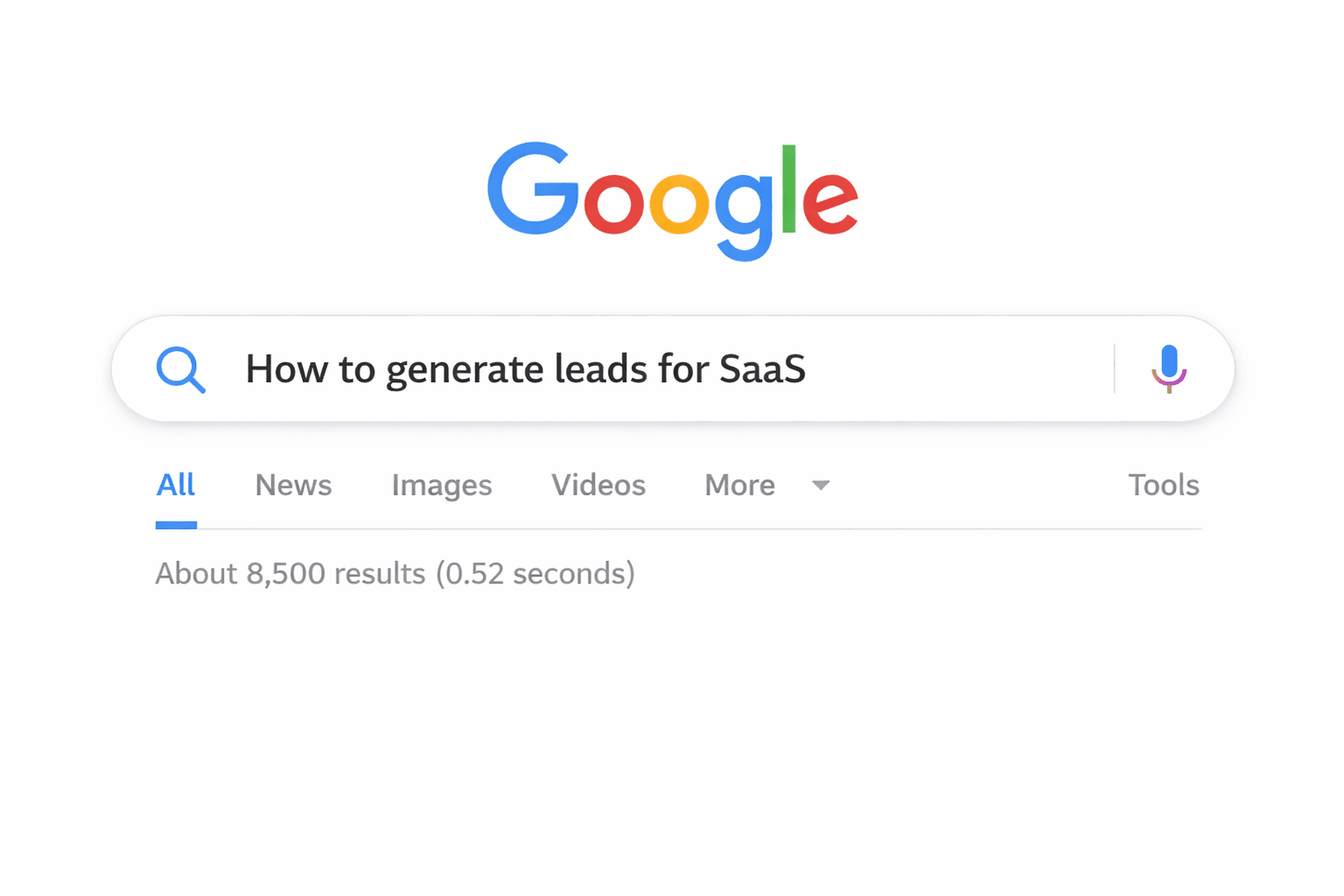
Right now, educational and informative content works best.
2. Consideration
Now the user is evaluating options.
Their searches look like this:

This is where comparisons and case studies win.
3. Decision
Now the user is ready to act.
Their search is more proactive, and this is exactly where you convert:
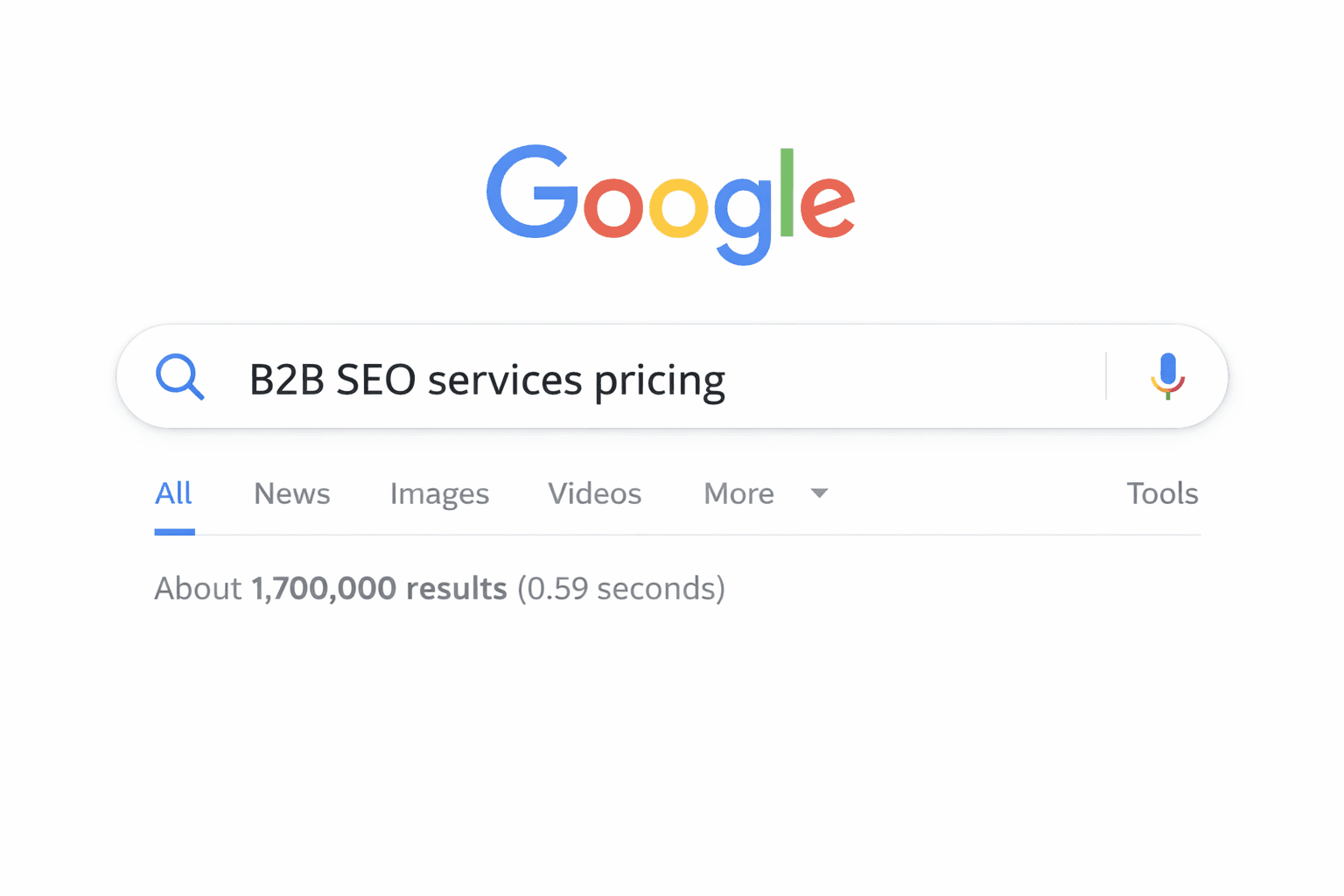
According to Gartner, B2B buyers spend only 17% of their time meeting with suppliers. The rest is spent researching independently.
Your SEO content needs to support all three stages.
Step 1: Define Your Audience and Decision-Makers
If your SEO is not bringing in the right kind of leads, this is usually where things are breaking.
In B2B, you are targeting a very specific group of people who are trying to solve a very specific problem inside a company. And those people do not all think the same way.
Take something as simple as a search like “B2B SEO tools.”
A marketing manager typing that is likely thinking about execution. They want something their team can use, something that fits into their workflow, something that shows results quickly.
A founder or CEO searching the same thing is thinking very differently. They are trying to understand whether investing in SEO even makes sense, how long it will take, and whether it will impact revenue.
A product or growth lead might care about completely different things: integrations, data accuracy, and how the tool connects with their existing stack.
Just understand the differences. It’s the same keyword, just a different intent behind it.
This is why most B2B SEO strategies feel disconnected. They assume one piece of content can speak to everyone. In reality, if you do not account for these differences, your content ends up being too generic to convince anyone.
And tools will not solve this for you.
For example, you can use something like HubSpot to structure personas or pull data from your CRM. You can look at Google Analytics to see which pages people are landing on. But none of that tells you why someone is searching or what they are actually trying to figure out.

That only comes from getting closer to the source.
Listening to sales calls where prospects explain their problems in their own words. Look at the problems they face again and again. Review all the CRM notes to see what actually pushed someone to convert.
This is where the real insight is.
For example, if you notice that prospects keep asking about timelines or ROI during sales conversations, that is not just a sales insight. That is an SEO opportunity. It means your content is not answering those questions early enough in the journey.
And once you start looking at it this way, your entire strategy changes.
You stop thinking in terms of keywords and start thinking in terms of what each decision-maker needs to feel confident moving forward.
That is what you need to capture. Not just pain points on a document, but:
- What triggers someone to start searching
- What questions do they need answered before they trust you
- What information actually moves them closer to a decision
Because if you get this part right, everything else, from keyword research to content strategy, and even conversions, starts to fall into place.
If you do not, you will keep creating content that looks right on the surface but never really lands.
Step 2: B2B Keyword Research That Actually Drives Revenue
Once you understand who you are targeting, keyword research becomes less about finding keywords and more about deciding where revenue is going to come from.
You don’t want to rank on every keyword. You simply want to show up in the few moments that actually influence a decision. And those moments are smaller than most teams think.
Only about 5% of your market is actively in a buying state at any given time, which means most of your content is not even speaking to people who are ready to act. And that changes how you approach keyword research completely.
Start Thinking in Terms of “Pages That Make Money”
Instead of building a list of keywords, start by identifying the pages that actually drive pipeline.
These are usually not blog posts. They are pages like:
- pricing
- comparisons
- alternatives
- use-case pages
If you look at any strong B2B site, these pages quietly do most of the conversion work. And yet, most teams spend their effort on top-of-funnel content. That mismatch is where a lot of SEO fails.
Use Tools to Reverse Engineer Buying Behavior
This is where tools like Ahrefs and Semrush become useful, but not in the way most people use them. You don’t want to use them to generate new content ideas. Instead, you want to reverse engineer decisions.
For example, look into:
- Which competitor pages are ranking for pricing-related queries?
- What keywords trigger comparison-heavy SERPs instead of blog-heavy ones?
- Where are product pages outranking content pages?
That tells you where Google itself is signaling buying intent.
Google Analytics adds the second layer by showing you:
- Which pages people land on before converting
- Which pages they visit before a demo request
- Where they drop off
To understand the problem better, imagine your “SEO guide” is getting traffic but no movement toward pipeline. You will be bothered by it, right? This is clearly not a success. The difference between traffic and pipeline is a sign that you are attracting the wrong stage of intent.
Where AI Actually Changes Keyword Research
LinkedIn is especially bombarded with posts about Claude. And not to jump on the bandwagon, but there’s scope there.
Tools like Claude are not just helping with content. They are changing how you scale and structure keyword research.
For example, you can connect Claude with your internal docs, CRM notes, or product positioning and ask:
- “What would a CFO need to see before approving SEO budget?”
- “What concerns would a SaaS founder have before hiring an agency?”
- “What questions come up right before someone asks for pricing?”
This is powerful. You are literally using Claude to map out decision friction.
And from there, you can turn those into actionable insights:
- Create dedicated landing pages
- Produce comparison content
- Design objection-handling pages
This is also where integrations matter.
When Claude is used alongside your internal data (CRM, Notion docs, sales transcripts), it stops being generic AI tools. It becomes context-aware research assistant. They literally help you see patterns that keyword tools alone cannot surface.
Why This Matters More Than Ever
SEO is still one of the strongest revenue channels in B2B.
Organic search drives a significant portion of pipeline, with average conversion rates around 5%, which is higher than many paid channels.
And in many SaaS companies, it delivers lower cost per lead compared to paid acquisition. But that only happens when keyword research is tied to revenue, not just traffic.
Step 3: Map Search Intent to Content
Once you have your keywords, the real question is not “what should we write?”
It is: what kind of page does this search actually need? Because not every keyword should lead to a blog post. And this is where a lot of B2B SEO breaks down.
Think About What the Person Is Trying to Do
Take these three searches:
- “What is B2B SEO”
- “Best SEO tools”
- “B2B SEO services pricing”
They might all sit in the same category in a keyword tool. But in reality, they come from completely different states of mind.
The first person is just trying to understand something. They are early. They are learning. The second person is evaluating options. They already know the problem. Now they want to compare solutions. The third person is much closer to making a decision. They are looking for specifics. Pricing. Scope. What it actually costs. If you send all three of these people to the same type of page, you lose them.
Match the Page to the Moment
If someone is searching to understand something, they need a page that explains clearly without trying to sell too early. A strong blog post works here.
If someone is comparing options, they are not looking for a generic article. They want structure. Lists. Trade-offs. What is better and why. That is where comparison or “best tools” pages come in.
If someone is searching for pricing, they do not want a guide. They want direct answers. What it costs. What they get. What the next step looks like. That is a landing page or pricing page.
The mistake most companies make is trying to make one page do all of this.
You will see a blog post trying to educate, compare, and sell at the same time. It ends up doing none of them well.
Use the SERP as Your Guide
You do not have to guess intent. Google already shows it.
Search for your keyword and look at what is ranking:
- If you see mostly blog posts → it is an educational query
- If you see listicles and comparisons → it is evaluation
- If you see product pages or pricing pages → it is decision-stage
Google is already telling you what kind of page works. Your job is to match it, not fight it.
Where This Becomes Strategic
Once you start mapping intent properly, your content stops competing with itself.
Instead of:
→ one page trying to rank for everything
You get:
→ multiple pages, each designed for a specific stage
Someone might land on your blog first. Then move to a comparison page. Then to your pricing or demo page. That is how B2B SEO actually drives pipeline.
Step 4: Build a Content Strategy That Actually Moves Someone Forward
At this point, you already know who you are targeting and what they are searching for.
Now the question becomes: what do they need to see, in what order, to feel confident enough to take the next step?
Because content in B2B is not just about answering questions. It is about reducing uncertainty over time.
Someone does not go from reading a blog post to booking a demo in one step. There is a gap in between. And your content is responsible for closing that gap.
This is where most strategies break.
Teams create content in isolation. A blog here. A case study there. A landing page somewhere else. But none of it is connected. A strong B2B content strategy feels more like a system.
For example, someone might land on your site through a guide like “how to generate leads for SaaS.” That helps them understand the problem. But now they have a new question: what actually works?
This is where a case study becomes relevant. Not as a separate asset, but as the next logical step. Then comes comparison. Then pricing. Then a demo. And the list goes on and on. Each piece of content is not just “for SEO.” It exists to move someone one step closer to a decision.
That is what people mean when they talk about the funnel, but in practice, it is less about labels like awareness or consideration, and more about sequencing information in a way that builds confidence.
Topic clusters help here, but not because of internal linking or rankings.
They work because they force you to organize your thinking.
Instead of publishing random content, you start asking:
- what is the core problem we solve
- what are all the questions around it
- and how do these questions connect
Once you structure content this way, SEO improves as a side effect. But more importantly, conversion improves.
Step 5: On-Page SEO That Matches How People Actually Read
Most advice around on-page SEO still focuses on keywords. In reality, the bigger problem is that most pages are hard to read. Even if they rank, they lose people within seconds. Because when someone lands on a page, they are not reading it line by line. They are scanning and trying to answer three things quickly:
- am I in the right place
- does this page understand my problem
- is it worth my time
If your page does not answer those within a few seconds, they leave. And that is exactly why structure matters more than people think.
A strong page does not just include headings. It uses them to guide attention. For example, instead of vague headings like “Benefits of SEO,” you see more direct ones like “How B2B SEO Actually Drives Pipeline.” That immediately signals relevance.
Internal linking plays a similar role. Not for SEO alone, but for navigation. If someone is reading a guide and you naturally point them to a comparison page or a case study, you are helping them continue their journey without friction.
Google rewards this because users stay longer and engage more. But the real win is not rankings. It is that your content starts behaving like a guided experience, not a static page.
Step 6: Technical SEO as a Growth Lever, Not a Checklist
Technical SEO is often treated like a one-time audit. You fix the errors, improve page speed, and move on. But in B2B, it plays a bigger role.
Because as your content grows, your site structure starts to determine what actually gets discovered. If your pages are buried, poorly linked, or hard to crawl, it does not matter how good they are. They will not perform.
Think about it this way: If you publish 50 high-quality pages but only 10 are easily accessible through your structure, those 10 will carry most of the weight. The remaining will be invisible.
This is where site architecture becomes critical.
Your most important pages are pricing, comparisons, and high-intent guides and they should never be more than a few clicks away.
Page speed also matters, but not just because Google says so. In B2B, slower pages tend to break momentum. If someone clicks from a comparison query and the page takes too long to load, they go back and choose the next result. That is lost intent.
Technical SEO is not just about satisfying Google. It is about removing friction from discovery and access.
Step 7: Link Building That Actually Builds Authority
Backlinks are still one of the strongest signals in SEO. But in B2B, not all links are equal. A single mention from a trusted industry publication can be more valuable than dozens of generic links because it does two things at once:
- it signals authority to Google
- it builds credibility with your audience
This is where many strategies go wrong. They are more focused on volume. So, they outreach at scale and guest posts everywhere. But that rarely builds real authority.
A better approach is to think in terms of where your audience already pays attention.
If your target customers read specific blogs, follow certain newsletters, or trust certain communities, those are the places that matter. Getting featured there does more than improve rankings. It puts you in the same context as other trusted voices. And over time, that compounds.
Step 8: Build Trust Before You Ask for Action
By the time someone is considering your solution, they are not just looking for information. They are looking for reassurance. This is where concepts like E-E-A-T become real. Not as a framework, but as a question:
Look at it from your point of view. What’s the first question that you think of when buying a product or opting for a service? You think to yourself: “Do I trust this company enough to take the next step?” That trust does not come from claims. It comes from proof. And case studies are one of the strongest assets here, but only when they are specific.
And this does not mean vague success stories. Genuine buyers are searching for clear breakdowns:
- what the problem was
- what was done
- what changed
Real data plays a similar role. If you can show outcomes, benchmarks, or even limitations honestly, it makes your content more believable. And in B2B, credibility is often the deciding factor.
Step 9: Conversion Optimization Is Where SEO Pays Off
You can do everything right in SEO and still fail here. Because traffic alone does not create revenue. What matters is what happens after someone lands on your page. Most B2B websites attract the right people, but do not give them a clear next step.
Sometimes the offer is unclear. Sometimes the messaging is too vague. Sometimes the page asks for too much too early. Improving conversion is often about small things.
- Being clear about what happens after someone clicks.
- Reducing unnecessary form fields.
- Making the value of the next step obvious.
Following strong landing page best practices helps, but more importantly, you need to align the page with intent. Someone reading a high-level guide is not ready for a hard sell. But someone searching for pricing is. Matching that expectation is what drives results.
Step 10: Measure What Actually Connects to Revenue
Traffic is easy to measure. Revenue is harder. And that is why many SEO efforts look successful on paper but do not translate into business impact. In B2B, you need to look beyond surface metrics. It is not just about how many people visited your site, but:
- how many turned into leads
- how many moved into pipeline
- how many eventually converted
This is where alignment between marketing and sales becomes critical.
According to Forrester, companies that align these functions see significantly faster revenue growth. Because they are not just generating leads. They are tracking what happens after. Tools like Google Analytics and HubSpot help here, but only if you connect the data. You want to see:
- which pages influence conversions
- how long it takes someone to convert
- what paths they take before making a decision
That is what tells you whether your SEO is actually working.
Step 11: The Role of Tools in Execution
Tools do not make your strategy better. They make execution easier.
- Google Analytics helps you understand behavior.
- HubSpot connects that behavior to pipeline.
- SEO tools help you identify opportunities and track performance.
But the real value comes from how you use them together. For example, if you see that a specific page consistently brings in high-quality leads, that is not just a reporting insight.
That is a signal to:
- build more content around that topic
- strengthen internal links to that page
- or expand it into a deeper asset
The tools are there to surface patterns. Your job is to turn those patterns into insights, and eventually decisions.
Advanced B2B SEO Strategies
In B2B, scaling SEO is less about publishing more content and more about compounding what already works.
At a certain point, adding more blog posts stops moving the needle.
The real leverage comes from:
- expanding high-performing topics
- systemizing content creation
- aligning SEO with demand generation
Here’s how that plays out in practice:
[table]
Strategy | What It Actually Means | Where It Works Best
Topic Clustering | Building depth around one core problem instead of spreading across topics | SaaS, service businesses
Programmatic SEO | Creating scalable pages using structured data (e.g., location, use-case, integrations) | Marketplaces, SaaS tools
Personalization | Adjusting content based on industry, role, or use case | Enterprise / high-ticket B2B
[/table]
Topic Clustering
Most teams misunderstand topic clusters as an internal linking tactic. That is not where the value comes from. The real advantage is depth of coverage.
For example, instead of writing one article on “B2B SEO,” you build an ecosystem:
- B2B SEO strategy
- SEO for SaaS companies
- B2B SEO tools
- B2B SEO case studies
- B2B SEO pricing
Now you are not just ranking for one keyword. You are owning the conversation around that topic. This is exactly how Google understands authority.
Programmatic SEO
Programmatic SEO is often associated with marketplaces, but it is becoming increasingly relevant in SaaS. Think about pages like:
- “SEO tools for SaaS startups”
- “SEO tools for fintech companies”
- “SEO tools with HubSpot integration”
These are not written one by one. They are built using structured templates + data.
Companies like Zapier and Wise have used this approach to generate thousands of pages targeting very specific queries. Programmatic SEO has helped companies scale to hundreds of thousands of pages with consistent traffic growth.
But it only works when each page still provides real value. Otherwise, it becomes thin content very quickly.
Personalization
In B2B, one page rarely fits all. This is where personalization starts to matter. Not in a complex, over-engineered way. But in simple ways like:
- industry-specific landing pages
- role-based messaging
- use-case driven content
For example:
- “SEO for SaaS companies”
- “SEO for fintech startups”
Same service. Different framing.
And that difference often determines whether someone converts.
Where SEO and Demand Generation Meet
This is one of the biggest shifts happening right now. SEO is no longer just an inbound channel. It is becoming part of a broader demand generation system.
Your content:
- educates
- builds awareness
- supports outbound efforts
- reinforces brand
Instead of thinking:
→ SEO brings traffic
You start thinking:
→ SEO supports the entire buying process
That is when it starts compounding.
AI and the Future of B2B SEO
AI is not replacing SEO. But it is changing how visibility works. Search is no longer limited to blue links.
Between Google’s AI Overviews and tools like ChatGPT and Claude, users are increasingly getting direct answers instead of clicking through multiple pages.
[table]
Shift | What It Means for SEO
Answer-first search | Users get summaries instead of browsing multiple links
Fewer clicks | Traffic may decrease, but intent quality increases
Higher competition for visibility | Only the most relevant content gets surfaced
[/table]
According to McKinsey, AI adoption has more than doubled over the past five years. This is already changing how people research tools, compare vendors, and validate decisions.
Where AEO and GEO Come In
You will hear terms like:
- AEO (Answer Engine Optimization)
- GEO (Generative Engine Optimization)
But in practice, they come down to one thing: Can your content be easily understood, extracted, and trusted by AI systems?
That changes how you create content.
You need:
- clearer structure
- direct answers to specific questions
- well-organized sections
- depth, not fluff
This is why generic content is already losing visibility. AI systems are better at filtering it out.
How Tools Like Claude Change the SEO Workflow
This is where things get interesting from an execution standpoint.
Claude is not just writing assistants. It is becoming research and synthesis layers. When connected with internal data (Notion docs, CRM notes, internal documentation), they can:
- identify patterns in customer questions
- surface recurring objections
- help structure content around real decision points
For example, instead of guessing what to write, you can:
- feed sales transcripts into Claude
- ask it to extract recurring concerns
- map those concerns into content topics
This is not replacing SEO. It is making it more aligned with how decisions actually happen. And of course, it’s speeding things up.
The Real Impact of AI on B2B SEO
AI is raising the bar for SEO. You will likely see:
- fewer clicks on generic content
- more visibility for high-quality, structured content
- stronger competition for decision-stage queries
Companies that adapt early will not just rank on Google. They will show up across:
- search engines
- AI tools
- answer-driven interfaces
Common B2B SEO Mistakes to Avoid
To sum up most of the things we discussed, I have created a short list to highlight the common mistakes we make in SEO for B2B.
- Chasing traffic instead of revenue: Ranking for high-volume keywords that never convert into pipeline
- Targeting the wrong stage of intent: Creating mostly top-of-the-funnel content while ignoring decision-stage pages
- Trying to make one page do everything: Mixing education, comparison, and sales into a single page → weak performance
- Over-investing in blogs, under-investing in money pages: Neglecting pricing, comparison, and use-case pages that drive actual conversions
- Ignoring what the SERP is telling you: Creating blog content for queries where Google clearly favors product or comparison pages
- Treating SEO as a content calendar, not a system: Publishing disconnected pieces instead of building a structured content ecosystem
- Relying only on keyword tools: Missing real opportunities that come from sales conversations and customer behavior
- Publishing generic, interchangeable content: No differentiation, no authority, easy to ignore (by both users and AI systems)
- Not connecting SEO to pipeline data: Measuring traffic and rankings without knowing what actually drives revenue
- Over-relying on agencies without internal alignment: Even the best SEO agencies in the US cannot fix unclear positioning or weak strategy
- Ignoring technical discoverability at scale: Important pages buried too deep, poorly linked, or not crawled effectively
- Treating AI as a shortcut instead of a tool: Using AI to produce more content instead of better, more structured content
The Complete B2B SEO Strategy Framework
Here is your complete B2B SEO strategy framework:

The Bottom Line
A high -performing B2B SEO strategy is about building a system that aligns with how real buying decisions happen, across search engines, AI tools, and every stage in between.
At Scalix AI, we understand that SEO is evolving fast. We see AI not as a disruption, but as a lever to make SEO smarter, more precise, and more aligned with how B2B buyers actually research and decide.
That is why we focus on strategies that work today and adapt for what is coming next.
As one of the top SEO agencies in the US, we help you uncover what is holding your growth back and where the real opportunities are.
Book a free audit today and see exactly where your SEO is leaving revenue on the table.


