





Key takeaways
SaaS paid ads ROI collapses when campaigns are optimised for clicks instead of MRR and cost per conversion.
$70K wasted wasn't a budget problem. It was a structural problem built on the wrong metrics from day one.
Structure before scale, signals before spend, revenue before reports — in that exact order.
Optimising for surface metrics trains the algorithm to find more traffic, not more customers.
A 43% MRR increase in one month came from rebuilding the measurement model, not increasing the budget.
Paid advertising can be one of the most confusing parts of growth for B2B SaaS companies.
Many founders and marketers know that paid channels can bring new customers, but they also know how easy it is to spend a lot of money without seeing meaningful revenue growth.
One of our SaaS clients experienced exactly that: they had spent $70,000 with another agency and seen almost no return. Despite similar budgets, the previous campaigns had spent the money ineffectively and were barely breaking even.
What they needed wasn’t surface‑level metrics or vanity numbers. They needed real growth that showed up in revenue itself.
Industry research confirms that SaaS companies often pay a high price just to acquire leads. According to Statista, the average customer acquisition cost (CAC) in B2B SaaS can exceed $250. This makes it clear why every dollar spent must be intentional and aligned with measurable outcomes.
TL;DR
A B2B SaaS company spent $70K with no results before adopting a revenue-focused ad system. By restructuring campaigns to prioritize MRR growth, cost per conversion, and revenue per dollar spent, they achieved a 43% MRR increase in one month, lowered cost per conversion by 60–80%, and tripled ad spend safely. This blog explains how structured systems beat generic campaigns, why metrics matter, and lessons for B2B founders scaling paid acquisition.
Understanding the Product, Market, and the Real Problem
The company provides a subscription-based SaaS platform that helps businesses automate email infrastructure for B2B cold outreach. Teams can manage domains, create multiple inboxes, and monitor deliverability all reducing errors and saving time.
The product itself was solid, and the market was receptive. The real problem wasn’t the product or the market. The campaigns were not structured to maximize revenue. Without aligning paid campaigns to business outcomes, even significant ad budgets can result in flat ROI.
When Ad Spend Was There but Growth Wasn’t
Existing campaigns were live but underperforming. Key issues included:
- A large portion of the ad budget was underutilized
- ROI was flat
- Scaling seemed impossible without risking performance
The previous agency relied on cookie-cutter strategies that didn’t reflect the company’s unit economics or sales cycle. Simply increasing ad spend would not have solved the problem.
A Better Way: Metrics That Actually Matter
Instead of chasing clicks and impressions, we built a system around revenue-focused metrics. That meant campaigns were optimized for:
- Cost per conversion, rather than just clicks
- Monthly recurring revenue (MRR) growth
- Revenue per dollar spent
Most Google ads campaigns fail because they are optimized for surface metrics rather than real growth. In B2B SaaS, paid acquisition should be treated as a growth engine, not just a traffic generator.
Our strategy was built around these three principles:
- Structure before scale
- Signals before spend
- Revenue before reports
This approach aligns closely with a forward-looking Google ads strategy in 2026, where campaigns are designed to maximize revenue rather than vanity metrics.
Implementing the System in Practice
Every part of the paid strategy was aligned with subscription economics:
- Conversion events that led to paying users were prioritized
- Budgets were allocated toward campaigns that consistently drove revenue
- Bids and targeting were adjusted based on revenue signals, not engagement metrics
- Spend was scaled only after performance was validated
This differs from most agencies, even the top 10 Google ads agencies in the US, which often rely on templates rather than tailored, revenue-driven systems.
The Results: Real Growth in Just One Month
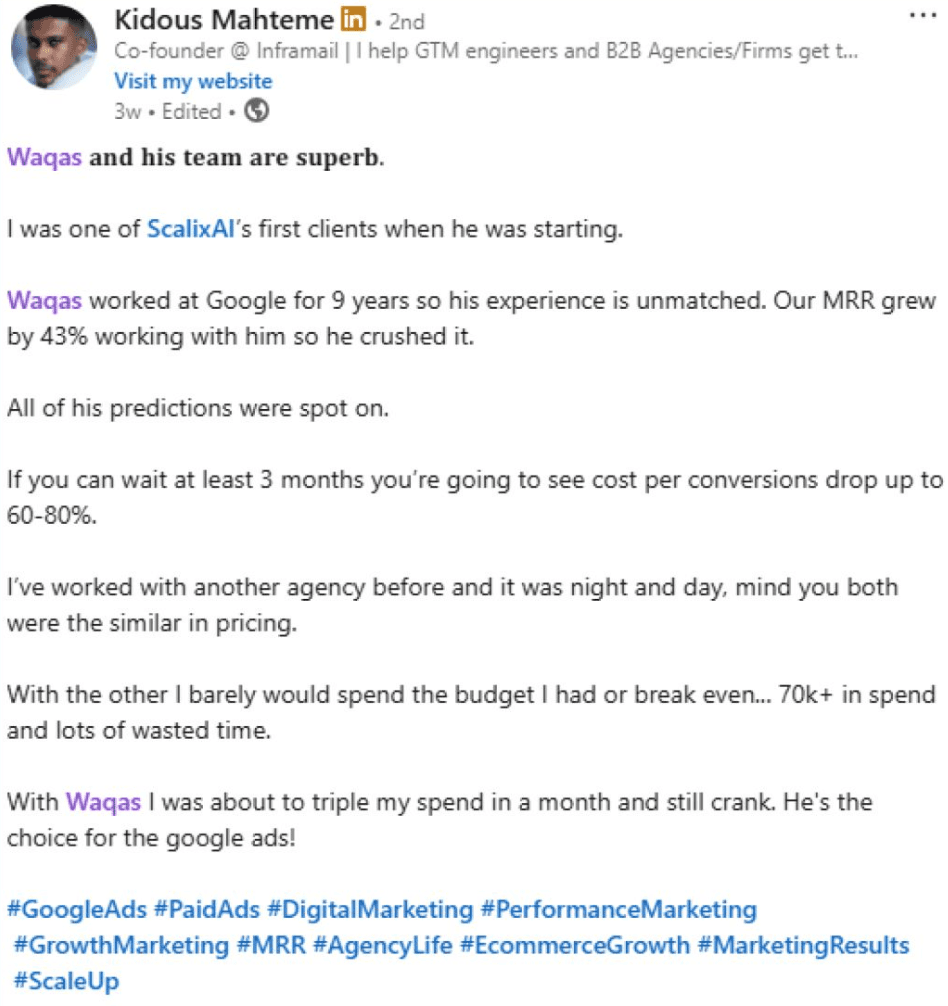
The outcomes were measurable and significant:
- MRR grew by 43%
- Cost per conversion dropped 60–80%
- Ad spend tripled without breaking performance
This shows that scaling doesn’t have to break campaigns. With a revenue-focused system and proper Google ads optimization, growth becomes predictable and sustainable.
Why This Approach Works for SaaS
The key difference was the system, not the product. Most agencies optimize for vanity metrics because they are easier to measure. Our approach focused on aligning campaigns with unit economics and revenue metrics, enabling safe and scalable growth.
This approach also benefits founders directly. Google Ads for founders is most effective when campaigns are built to generate measurable revenue, not just clicks or impressions.
Key Lessons for SaaS Teams Looking to Scale Paid Ads
- More ad spend without structure amplifies inefficiencies.
- Focus on revenue metrics, not vanity metrics like clicks or impressions.
- Align campaigns to your unit economics and subscription model.
- Scale strategically: validate signals first, then increase spend gradually.
Benchmark reports show that SaaS companies with strong recurring revenue growth focus on aligning marketing spend to revenue outcomes rather than surface‑level metrics.
For example, this research suggests that mid‑market SaaS companies typically achieve net revenue retention (NRR) between approximately 105‑110%, with healthier unit economics supporting predictable recurring revenue growth. These figures reflect consensus data from several reputable SaaS market surveys.
Conclusion: Customized Systems Beat Templates Every Time
This case study shows that scaling paid acquisition is not about spending more money, it’s about spending wisely. When campaigns are aligned with revenue-focused metrics and structured correctly, paid ads can become predictable engines of growth.
If you want to achieve similar results, our team specializes in Google Ads management and custom growth systems designed for SaaS. Book a free audit today to see how your campaigns can start delivering measurable MRR growth.


