The Prompts Are a Start. Strategy Moves Pipeline.
Waqas reviews your Google Ads account, tells you exactly what is broken, and builds the system that fixes it.
Share this Article



Key takeaways
ChatGPT for Google Ads drafts copy fast, but it cannot diagnose broken campaigns.
Negative keyword lists from ChatGPT are starting points, not finished account hygiene.
Intent classification by ChatGPT is directional. However, search term reports show ground truth.
RSA headline angles must be distinct because repetition kills Ad Strength and performance.
ChatGPT has no auction data. Operator judgment is what makes prompts produce a pipeline.
Yes, you can use ChatGPT for Google Ads work. It saves real time on copy drafts, keyword organization, and performance summaries. What it cannot do is diagnose why your campaigns are not producing pipeline or make the structural decisions that actually move CAC.
I spent nine years inside Google. The 11 prompts below are the ones we use on real B2B SaaS client accounts at ScalixAI, refined through hundreds of campaigns, not pulled from a Twitter thread. Use them. But read the operator notes. That is where the difference between useful output and expensive mistakes lives.
74% of marketers now use AI tools in their paid media workflow. Most of them are using generic prompts and getting generic output. This post fixes that.
How Do I Use ChatGPT to Write Google Search Ad Copy That Actually Converts?
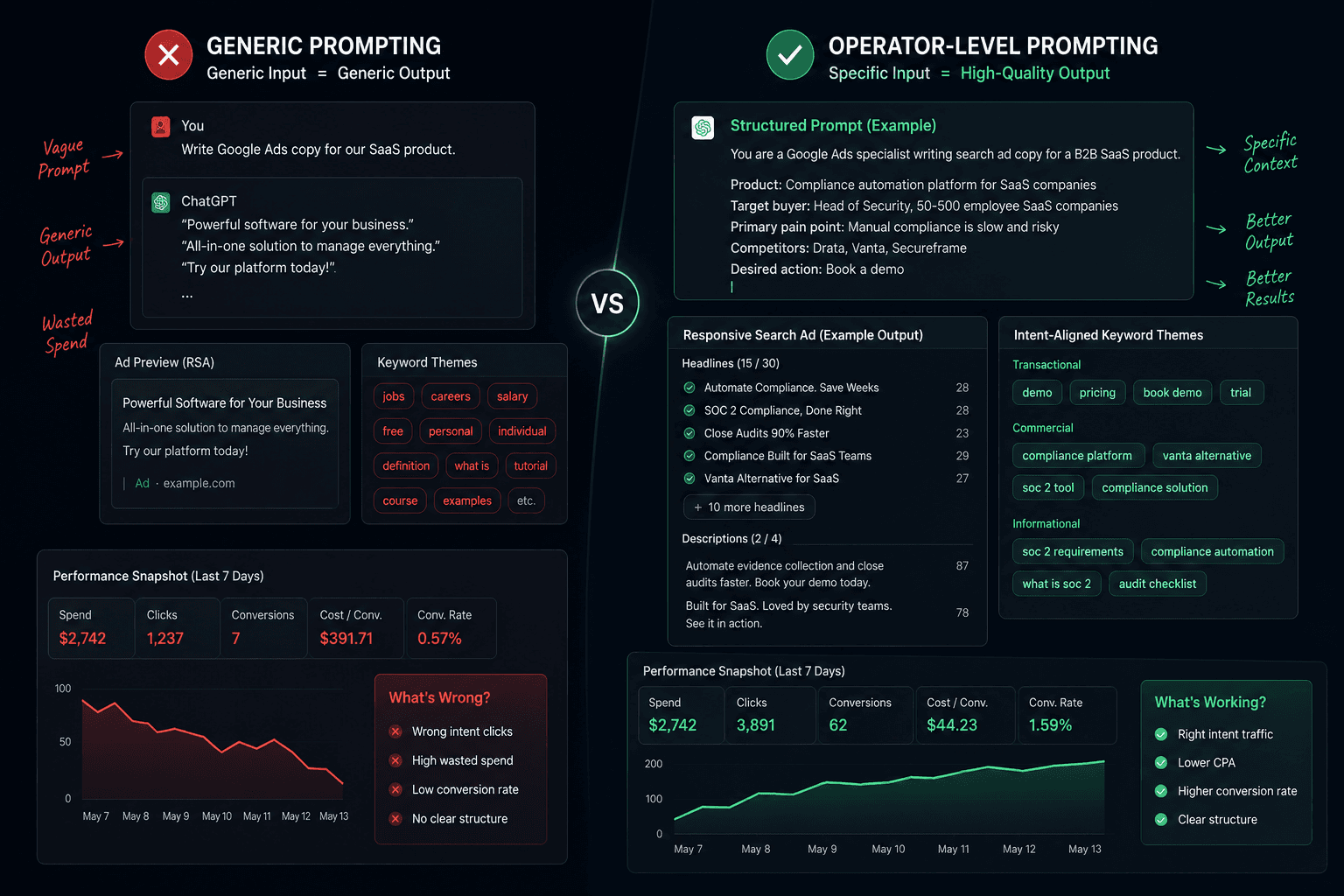
Using ChatGPT for Google Ads copy works when you give it the specific ingredients a conversion-focused ad needs: ICP, search intent, value proposition, and competitor context.
Most founders give it a product description and wonder why the output sounds like every other ad in the auction. Specificity is the input that determines the quality of the output.
Here is the prompt:
You are a Google Ads specialist writing search ad copy for a B2B SaaS product.
Product: [describe in one sentence]
Target buyer: [job title, company size, industry]
Primary pain point: [the problem they are searching to solve]
Competitors: [name 2 to 3]
Desired action: [demo booking / free trial / contact]
Write 5 headline variations (max 30 characters each) and 2 description variations (max 90 characters each). Focus on the buyer's pain, not product features. Include one headline that addresses a competitor differentiator.
Why this prompt works:
The character constraints force the output to match Google's RSA format exactly. Framing around pain rather than features aligns the copy with Google search ad quality signals, where relevance to search intent directly impacts Quality Score and cost per click.
Operator note:
ChatGPT cannot access your Quality Score data, search term reports, or historical CTR by headline combination. It can draft, but a specialist reviews which variants actually match your auction-level intent.
How Do I Generate a Negative Keyword List Using ChatGPT?
Negative keyword hygiene is one of the highest-leverage weekly tasks in any B2B Google Ads account. ChatGPT can build a starting negative list fast from your target keywords, saving 30 to 60 minutes of manual brainstorming per account. The output still needs to be reviewed against your actual search term report before it is production-ready.
Here is the prompt:
Here is a list of my target keywords for a B2B SaaS Google Ads campaign: [paste your keyword list]
Generate a negative keyword list covering the following categories:
- Job seeker queries (e.g. jobs, careers, salary, hiring)
- Student and research queries (e.g. what is, definition, examples, free course)
- Consumer or wrong-tier queries (e.g. free, personal, individual)
- Competitor brand names (list them: [your competitors])
- Irrelevant industry terms that share vocabulary with your category
Format as a flat list, one keyword per line, lower case.
Why this prompt works:
Structuring the output by exclusion category forces ChatGPT to think systematically rather than produce a random list. Each category maps to a real budget leak pattern we see in B2B accounts, where 15 to 30 percent of spend goes to non-ICP queries before a negative list is built.
Operator note:
This prompt gives you a starting list. Your actual search term report from the last 90 days is where the real waste is hiding. ChatGPT has not seen your account data.
How Do I Use ChatGPT to Organize Keywords by Search Intent?
Sorting a raw keyword list by commercial, transactional, and informational intent is foundational to campaign structure. Mixing intent tiers in a single ad group is one of the most common structural mistakes in B2B Google Ads. ChatGPT handles this classification task quickly and accurately.
Here is the prompt:
Here is a raw list of keywords for a B2B SaaS company: [paste keyword list]
Classify each keyword into one of three intent categories:
- Informational: buyer is researching a problem or topic
- Commercial: buyer is comparing solutions or evaluating options
- Transactional: buyer is ready to act (demo, trial, buy, pricing)
Return a table with three columns: Keyword / Intent / Reasoning (one sentence).
Why this prompt works:
Intent classification directly informs campaign architecture. Transactional keywords belong in high-bid, conversion-optimized campaigns with demo-booking landing pages. Informational keywords, if you bid on them, need different ad copy, different landing pages, and different conversion goals.
Operator note:
Intent classification is directional, not definitive. A keyword like "compliance software" sits at commercial intent for one buyer and informational for another. The search term report shows you what intent is actually triggering your ads.
How Do I Write RSA Headlines and Descriptions With ChatGPT?
Writing 15 RSA headlines that are genuinely distinct from each other, each under 30 characters, while covering multiple messaging angles, is tedious manual work. ChatGPT does this well when the ICP and value proposition are clearly specified upfront.
Here is the prompt:
Write RSA components for a Google Ads campaign targeting [job title] at [company size] companies in [industry].
Product: [one sentence description]
Core value proposition: [what makes it different]
Primary keyword to include: [your target keyword]
Produce:
- 15 headlines (max 30 characters each). Cover these angles: pain relief, speed/efficiency, social proof, competitor comparison, feature benefit, and CTA. Label each angle.
- 4 descriptions (max 90 characters each). Each should be standalone and complete a different message.
Do not repeat the same phrase across headlines.
Why this prompt works:
Labelling headlines by angle prevents the repetition that tanks RSA Ad Strength. Google assembles headline combinations dynamically, so having distinct angles gives the algorithm more useful combinations to test rather than five variations of the same claim.
Operator note:
Ad Strength is a signal, not a performance guarantee. We regularly see "Good" strength ads outperform "Excellent" strength ads. The combination of data in your account tells you what is actually working.
How Can ChatGPT Help Me Audit a Search Term Report?
Pasting a search term report into ChatGPT and asking it to flag wasted spend patterns is one of the most practical time-savers in account management. A report that would take 45 minutes to manually categorize takes five minutes with the right prompt.
Here is the prompt:
Here is a Google Ads search term report for a B2B SaaS campaign. Each row includes: search term / clicks / impressions / cost / conversions.
[paste report data]
Analyse this data and:
1. Flag search terms with high spend and zero conversions that should be added as negatives
2. Identify search terms with strong conversion rates worth promoting to exact match keywords
3. Highlight any patterns suggesting the campaign is reaching the wrong audience
4. Note any search terms that suggest the wrong intent tier is being triggered
Format findings as a prioritized action list.
Why this prompt works:
Structuring the output as a prioritized action list rather than an analysis paragraph makes the output immediately usable. The four analysis categories map directly to the decisions a Google Ads manager makes when reviewing a search term report.
Operator note:
ChatGPT sees the data you paste. It does not see your bidding strategy, your conversion tracking setup, or whether your attribution model is counting the right events. The diagnosis depends on the quality of data you give it.
How Do I Use ChatGPT to Generate Competitor Ad Copy Hypothesis?
Before running an A/B test on competitor angle copy, you need hypotheses worth testing. ChatGPT generates competitive angle frameworks faster than manual brainstorming, and the output improves significantly when you include real competitor ad copy as context.
Here is the prompt:
I run Google Ads for a B2B SaaS company competing against [Competitor A], [Competitor B], and [Competitor C].
Here is what I know about each competitor: [brief description of their positioning, pricing, or common objections from sales]
Generate 8 competitor angle hypothesis for ad copy. Each hypothesis should:
- Name the specific competitor weakness or objection to exploit
- Provide a draft headline (max 30 characters) that addresses it
- Include a one-sentence rationale for why this angle would resonate with a buyer mid-evaluation
Focus on buyers who are actively comparing options, not brand-new to the category.
Why this prompt works:
Competitor campaigns targeting "[competitor] alternative" and "[competitor] pricing" searches reach buyers who already have a budget approved and are mid-decision. These are consistently the highest-converting clicks in B2B search, and the copy needs to match that evaluation mindset exactly.
Operator note:
ChatGPT generates hypotheses. Only your auction data tells you which competitors are actually appearing in your search terms and how aggressively they are bidding against you.
How Do I Build a Google Ads Account Structure With ChatGPT for a New B2B SaaS Launch?
Account structure is where most new B2B SaaS campaigns go wrong from day one. ChatGPT can produce a logical starting structure quickly, but the output needs an operator's judgment to translate it into something that actually matches how B2B buyers search and how Google's algorithm rewards campaign organization.
Here is the prompt:
I am launching Google Ads for a B2B SaaS product in [category]. The product solves [problem] for [ICP]. Competitors include [names].
Build an initial Google Ads account structure with the following:
- Campaign breakdown by intent tier (branded, competitor, solution-aware, problem-aware)
- Recommended match types per campaign type and rationale
- Ad group structure within each campaign (list themes, not individual keywords)
- Suggested daily budget split across campaigns as a percentage
- Primary conversion goal per campaign type
Format as a structured outline.
Why this prompt works:
Organizing campaigns by intent tier from the start prevents the most expensive structural mistake in B2B Google Ads: mixing branded and non-branded performance in blended reporting. This structure also gives Smart Bidding distinct conversion signals per intent level.
For deeper context on what a well-structured account looks like, the Google Ads for SaaS guide covers this in full.
Operator note:
Structure is the starting point. Bid strategy, negative keyword lists, and landing page assignment are the decisions that make the structure perform. ChatGPT gives you the architecture. The operator makes it work.
How Do I Write Retargeting Ad Copy With ChatGPT for Pricing Page Visitors?
Pricing page visitors are the highest-intent audience in your remarketing pool. They saw the price, did not convert, and left. The copy that brings them back needs to address the specific objection that stopped them, not repeat the awareness message they already saw.
Here is the prompt:
Write retargeting ad copy for visitors who reached our pricing page but did not convert.
Product: [description]
Pricing structure: [describe tiers or starting price]
Most common sales objections: [list 2 to 3 from your sales calls]
Write:
- 3 headline variations that address the top objection directly (max 30 characters each)
- 2 description variations focused on reducing risk (trial, demo, guarantee, social proof)
- 1 variation using urgency or scarcity if applicable
Avoid generic retargeting copy. Write as if you know they saw the price and hesitated.
Why this prompt works:
Generic retargeting copy, such as "Come back and try us," converts poorly because it ignores the specific moment of hesitation. Objection-specific copy performs because it meets the buyer at the exact point where they stopped. This is one of the conversion rate strategies that consistently moves the needle for B2B SaaS accounts we manage.
Operator note:
The objections in this prompt should come from your sales team's call notes, not assumptions. ChatGPT cannot access your CRM. You can.
How Do I Use ChatGPT to Write YouTube Demand Gen Video Script Hooks?
Demand Gen campaigns on YouTube reach cold audiences who are not yet searching for your product. The hook is the only thing that determines whether they watch past five seconds. ChatGPT generates hook variations quickly across different emotional angles, which makes creative testing faster before production spend is committed.
Here is the prompt:
Write 10 YouTube video ad hooks for a B2B SaaS product targeting [ICP] on cold audiences.
Product: [description]
Core pain point: [what the ICP struggles with]
Tone: direct and conversational, not corporate
Each hook must:
- Be under 8 seconds when spoken aloud (approximately 20 to 25 words)
- Create a pattern interrupt in the first 3 words
- Avoid starting with "Are you" or "Do you"
- Cover at least 3 different emotional angles: frustration, curiosity, and aspiration
Label each hook by emotional angle.
Why this prompt works:
The 8-second constraint is not arbitrary. YouTube's skippable ad format means the hook must work before the skip button appears. Labelling by emotional angle makes creative testing systematic rather than random, so you learn which angle resonates with your ICP faster.
Operator note:
Hook testing at scale requires budget and a structured creative testing framework. ChatGPT writes the hooks. Knowing which to prioritise based on your ICP's actual pain hierarchy comes from sales conversations and account data.
How Do I Translate a Feature List Into Benefit-Led Ad Copy Using ChatGPT?
Feature-led ad copy is one of the most common mistakes in B2B Google Ads. Buyers do not search for features. They search for outcomes. ChatGPT is fast at reframing feature language into benefit language when given clear buyer personas to work from.
Here is the prompt:
Here is a feature list for our B2B SaaS product: [paste features]
Rewrite each feature as a benefit-led statement for each of these three buyer personas:
- Persona 1: [job title, primary goal, top frustration]
- Persona 2: [job title, primary goal, top frustration]
- Persona 3: [job title, primary goal, top frustration]
Format as a table: Feature / Persona 1 Benefit / Persona 2 Benefit / Persona 3 Benefit.
Keep each benefit statement under 10 words. Focus on the outcome the buyer gets, not the mechanism that delivers it.
Why this prompt works:
Different personas care about the same feature for different reasons. A compliance officer and a developer both care about SOC 2 automation, but for completely different outcomes. Persona-specific benefit statements improve ad relevance scores and landing page conversion rates simultaneously.
Operator note:
The personas in this prompt should come from real ICP research and sales call data. Generic persona descriptions produce generic benefit statements. Garbage in, garbage out applies here directly.
How Do I Draft a Weekly Google Ads Performance Summary With ChatGPT?
Weekly performance summaries for non-technical founders take time to write because translating platform metrics into business language requires deliberate reframing. ChatGPT handles the formatting work quickly when given structured data.
Here is the prompt:
Here is raw Google Ads performance data for the past 7 days: [paste data: spend, impressions, clicks, CTR, conversions, CPL, and any CRM data on demo quality]
Write a weekly performance summary for a non-technical founder. Format:
1. Three-sentence executive summary (what happened, why it matters, what we are doing about it)
2. Key metric snapshot (table: this week vs last week vs target)
3. Top 3 observations with plain-English explanations
4. Recommended actions for next week with rationale
5. One risk or concern to flag
Write at a level a founder without paid media experience can understand. No jargon without explanation.
Why this prompt works:
Structured sections force the output to separate observation from recommendation, which is the difference between a useful summary and a data dump. The risk flag section ensures that good news does not bury a problem that needs attention.
Operator note:
ChatGPT summarizes the data you give it. Knowing whether the conversion numbers reflect real pipeline or broken tracking requires account-level context that it does not have. We verify tracking integrity before interpreting any performance data.
ChatGPT vs a Google Ads Operator: What Each Does Best
[table]
Task | ChatGPT | Google Ads Operator
Ad copy drafts | Fast, high volume, needs editing | Writes with auction context and intent data
Negative keyword lists | Good starting point | Built from real search term reports
Account structure | Logical framework | Matches real buyer search behaviour
Performance diagnosis | Cannot access account data | Reads signals across structure, tracking, and bidding
Conversion tracking setup | Cannot do this | CRM integration, offline conversion import
Bid strategy decisions | No access to auction signals | Based on conversion data and CAC targets
Weekly summaries | Formats the data you paste | Interprets data in a business context
Competitor research | Generates hypotheses | Uses auction insights and real search term data
[/table]
ChatGPT is an execution support. The operator is the strategy. The prompts above save hours on drafting and organisation. They do not replace the judgment that determines which campaigns produce pipeline and which waste budget.
The Operator Behind the Prompts
The prompts in this guide are useful. What makes them produce results rather than output is the account structure, conversion tracking setup, and bidding strategy that sits underneath them.
I spent nine years inside Google before building ScalixAI. The way campaign architecture decisions get made at ScalixAI is grounded in how Google's systems actually reward accounts, not in how they are documented from the outside. That is a different kind of knowledge from what any AI tool can replicate.
Before choosing an agency, read how to evaluate a Google Ads agency for B2B SaaS.
Then book a free audit from us. We will tell you exactly what your account needs, not what sounds right in a generic prompt.
.gif)