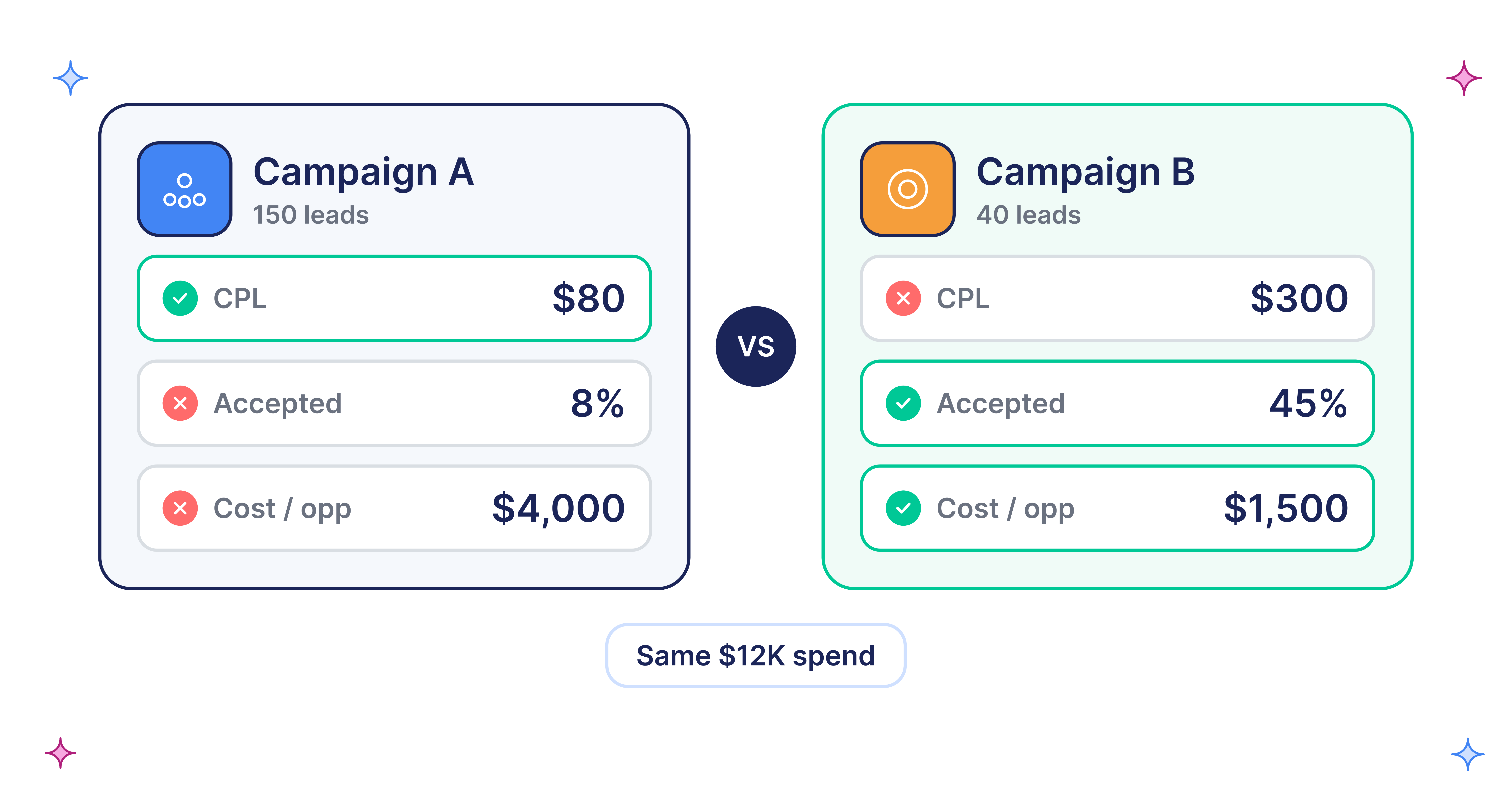

Key takeaways
Evaluating a Google Ads agency starts with one question: Do they optimize for leads or revenue?
Up to 57% of B2B ad spend is wasted on irrelevant searches. The right agency fixes that first.
If an agency can't close the loop from Google Ads to the CRM pipeline, they're guessing.
The gap between agency pitch and actual account performance is wider than most founders expect.
Ask who runs the account daily, not who presents on the kickoff call.
If you're figuring out how to evaluate a Google Ads agency for B2B SaaS, you're probably already feeling the risk: it’s easy to hire the wrong agency and very hard (and expensive) to undo it.
I’ve seen this from both sides.
I’ve worked inside Google, and now I work closely with B2B SaaS companies, managing their ad spend. For example, I helped PAM rebuild a fragmented account into a structured growth engine that delivered 3.25x return on ad spend and over $200K in annual contract value.
The gap between what agencies say they do and what actually drives revenue is bigger than most founders expect.
On paper, everything looks great: dashboards, reports, rising lead numbers. But when you trace it back to the pipeline, things fall apart.
This is precisely where most companies get stuck. It’s not a “lazy” problem; the issue is more directional.
Most companies lack the right questions to ask a Google Ads agency before signing the contract. And by the time they realize it, they’re locked into a 6–12 month agreement, working with a junior account manager, optimizing campaigns that look good but don’t convert into revenue.
This is exactly why I have created this guide: to show you how I would approach agency vetting if I were in your position today.
I’m not here to waste your time and give you generic advice. So, don’t expect the usual checklist fluff.
These are the exact questions I’d ask an agency before hiring them to do my Google Ads. Of course, all of the questions are shaped by what actually matters in B2B SaaS, and what I’ve learned from the ex-googler advantage of seeing how high-performing accounts are really run.
TL;DR
In this blog, I break down how to evaluate a Google Ads agency for B2B SaaS using real, practical questions that go beyond generic pitches. It helps you identify red flags, understand how agencies actually think, and avoid wasting budget on lead-focused strategies that don’t drive revenue. If you’re investing in Google Ads, this gives you a clear, no-fluff way to choose the right agency with confidence.
Why Running Google Ads Is More Nuanced in B2B SaaS
Running Google ads for startups, specifically for B2B SaaS companies, isn’t just about generating leads; it’s about generating the right leads consistently, over long sales cycles. Again, this is something we helped Portless fix.
And that’s the catch: we know how to run Google Ads for B2B SaaS because we’ve been doing this for a long time, but this is exactly where most agencies struggle.
Most founders underestimate this reality:
- Google Ads often takes 50%+ of the paid acquisition budget in B2B companies
- The average conversion rate for Google Ads is only around 2.4%
- And in many accounts, up to 57% of ad spend is wasted on irrelevant searches
Put that together, and you get a simple truth:
You’re spending a lot of money, converting a small percentage of users, and potentially wasting a large chunk of your budget without realizing it.
This is why surface-level metrics like CPC, CTR, or even cost per lead can be misleading. Many agencies show “improving performance,” while your actual CAC is getting worse.
And you may fall prey to these tactics not because you don’t care but because you don’t know the right questions to ask when choosing a Google Ads agency for B2B SaaS.
The only way to secure your position is by asking the kind of questions that reveal how they actually think, not how they pitch.
1. How do you define a good lead, and where does revenue actually start for you?
This is always the first question I’d ask because keywords, bidding, and creatives don’t matter if you’re optimizing for the wrong outcome.
Most agencies will tell you they “drive leads.” And it may sound fancy to startups and people who’ve just started using Google Ads. But in B2B SaaS, not all leads are equal. Some turn into the pipeline. And most don’t.
So the real question is: what exactly are they optimizing for?
What you’re really testing
You’re trying to understand whether the agency thinks in terms of:
- Form fills
- Or actual revenue
And trust me when I tell you, there’s a big difference.
In most Google Ads for SaaS accounts, the gap between a lead and a qualified opportunity is massive. If an agency isn’t accounting for that, they’re just making the numbers look better, not the business.
What you want to hear is how they:
- Define a qualified lead (not just any conversion)
- Separate junk from real intent
- Connect ad performance to downstream outcomes like SQLs, pipeline, and closed revenue
If they can’t clearly explain where revenue actually starts in your funnel, they’re guessing.
What a good answer looks like
A strong agency will go beyond surface metrics and say something like:
- “We don’t optimize for all leads; we optimize for qualified leads based on your ICP.”
- “We map conversion actions to stages: demo booked, sales-qualified, opportunity created.”
- “We feed CRM data (HubSpot/Salesforce) back into Google Ads using offline conversions.”
- “We regularly look at which campaigns actually drive pipeline, not just conversions.”
Some of them would ask you questions.
- What does a qualified lead look like?
- What % of leads become opportunities?
- What’s your sales cycle like?
And that’s a good sign. Because it means they’re not just running ads, they’re trying to understand your business model.
Google Ads Agency Red flags:
- They define success purely as increasing lead volume, without mentioning qualification or revenue.
- They cannot explain how they distinguish between high-quality and low-quality leads.
- They have no clear method for tracking what happens after a lead is generated.
- They don’t reference CRM data or any feedback loop from sales.
2. Walk me through how you connect Google Ads to CRM revenue (not just form fills)
This is a question that most agencies will you a generic answer for. Most of them wil say they “track conversions.” And when you aks them to go deeper, you figure out what they are really tracking is form fills, not revenue.
And in B2B SaaS, that’s a problem. A form fill doesn’t tell you anything about whether that lead turned into pipeline, closed revenue, or churned after one call.
What you’re really testing
You’re testing whether the agency has built a closed-loop system or if they’re just relying on Google Ads’ default tracking.
This is the difference between:
- Measuring activity
- And measuring outcomes
If an agency can’t connect ad spend to actual revenue in your CRM, then any claim around performance is incomplete.
You’re also testing for ROAS accountability.
And no, this is not “platform ROAS,” or “estimated value,” but actual revenue tied back to campaigns, keywords, and queries. Because without that, optimization becomes guesswork.
What a good answer looks like
A strong agency will walk you through a clear, practical setup, not just theory. It should sound something like:
- “We integrate Google Ads with your CRM (HubSpot, Salesforce, etc.) using offline conversion tracking.”
- “We pass back key events, like qualified leads, opportunities, and closed deals, into Google Ads.”
- “We assign values based on pipeline stages, not just form submissions.”
- “We regularly audit tracking to make sure attribution is accurate and not broken.”
They should also explain to you how they use this data. For example, they should be able to answer:
- Which campaigns drive actual revenue, not just leads
- Which keywords attract high-quality opportunities
- Where in the funnel drop-offs happen
And importantly, they should be comfortable saying:
“Sometimes a campaign looks good in Google Ads but underperforms in the CRM, and we optimize based on the CRM.”
That’s the level of clarity you’re looking for.
Google Ads Agency Red flags
- They rely only on Google Ads conversion tracking without integrating any CRM data.
- They cannot explain how revenue is attributed back to campaigns or keywords.
- They talk about ROAS based only on platform-reported numbers, not actual closed deals.
- They treat all conversions as equal without assigning different values to different funnel stages.
If an agency can’t answer this clearly, you’re not measuring performance, you’re just observing activity.
And in B2B SaaS, that’s how budget gets wasted without anyone realizing it.
3. When performance drops, how do you diagnose the problem?
At some point, performance will drop. It happens to every account. You’ll see CPCs go up, conversion rates dip, pipeline slows down.
What matters is not if it happens. It’s how the agency reacts when it does. Because this is where you separate high-performing Google Ads agencies from guessers.
What you’re really testing
You’re testing whether the agency has a structured way to diagnose problems or if they just start making random changes. Any drop in performance usually comes down to one of three areas:
- Traffic problem: The wrong people are clicking
- Conversion problem: The right people aren’t converting
- Sales problem: Leads aren’t turning into revenue
A good agency doesn’t jump to conclusions. They start by isolating variables.
For example:
- If traffic quality drops → look at search terms, keywords, audience signals
- If conversion rate drops → look at landing pages, offer, intent mismatch
- If pipeline drops → look at lead quality, ICP alignment, sales feedback
Most importantly, they don’t just try to improve conversion rate blindly without understanding where the actual bottleneck is.
What a good answer looks like
A strong agency will walk you through a clear, simplified approach. This is what you’ll most likely hear:
- “First, we break down the funnel.”
- “We identify where the drop actually happened instead of assuming it’s a top-of-funnel issue.”
- “We check search term reports and audience signals to validate traffic quality.”
- “We review landing page performance and intent match before making CRO changes.”
- “We align with sales to understand if lead quality or close rates have changed.”
It’s important that they emphasize looking at trends over time, not just short-term fluctuations. They should be confident in making controlled changes instead of overreacting. And lastly, if they really know what they are doing, you’ll see them using data to isolate the root cause before optimizing.
The key thing you’re listening for is process. Instead of “let’s see” or “we’ll start testing.”
Google Ads Agency Red flags
- They immediately suggest changing bids or budgets without diagnosing where the issue actually is.
- They assume every performance drop is a conversion rate problem without checking traffic quality or sales outcomes.
- They cannot clearly explain how they separate traffic, conversion, and sales issues.
- They rely on gut feeling instead of walking through a structured analysis.
When an agency can’t figure out the problems properly, they don’t fix issues, they just move them around. And over time, that’s what quietly kills performance.
4. How do you decide which keywords are actually worth paying for?
Every agency will say they target “high-intent keywords.” But in B2B SaaS, intent isn’t always obvious, and if you only go after bottom-of-funnel terms, you hit a ceiling very quickly.
So the real question isn’t just what keywords they target. It’s how they think about demand.
What you’re really testing
You’re testing whether the agency understands the balance between:
- Demand capture: Keywords where buyers are already searching (e.g. “X software”, “best Y tool”)
- Demand creation: Keywords where buyers don’t know your solution yet (e.g. problem-based or alternative searches)
Most agencies focus on demand capture because it’s easier. You have clear intent, higher conversion rates, and faster wins. But in real accounts, that pool is limited.
And they don’t expand beyond it, so you end up competing harder, paying more per click and stalling growth opportunities.
You want to see if the Google Ads agency can identify where real buying intent actually exists, expand into adjacent keywords without killing efficiency, and prioritize based on business impact.
What a good answer looks like
A strong agency will walk you through a more nuanced keyword strategy. Their responses would look something like:
- “We start with core high-intent terms; competitor, category, and solution-based keywords.”
- “Then we expand into problem-aware searches where users don’t know your product yet.”
- “We evaluate keywords based on downstream performance, not just CTR or conversion rate.”
- “We regularly cut keywords that drive leads but don’t convert into pipeline.”
They’ll be comfortable talking about real issues. So, they will be straight-forward in telling you that some keywords convert well but don’t scale, look weak early but drive better long-term pipeline, and that some high-volume keywords are simply not worth the cost.
What is important is for them to keep testing new keyword themes systematically. Ideally, you want these agencies to keep using search term data to refine and expand, and align keywords with ICP, not just intent.
Honestly, this is exactly what actual account management looks like.
Google Ads Agency Red flags
- They only focus on high-intent keywords and have no strategy for expanding beyond them.
- They choose keywords based purely on search volume or CPC, without considering business relevance.
- They cannot explain why certain keywords are prioritized over others.
- They continue investing in keywords that generate leads but no meaningful pipeline.
If an agency gets keyword strategy wrong, everything downstream suffers. In B2B SaaS, growth doesn’t come from just capturing demand. It comes from knowing where to find it and where to create it.
5. How do you structure campaigns for a complex B2B funnel?
Most agencies structure accounts around keywords. That works if you’re selling something simple. It breaks down quickly in B2B SaaS.
Because you’re not dealing with one type of buyer. You’ve got different personas, different use cases, and people coming in at completely different stages of awareness. Someone searching “best X software” is not the same as someone trying to understand the problem in the first place.
If your campaign structure doesn’t reflect that, you end up mixing everything together and that’s when performance becomes hard to control.
What you’re really testing
What you’re trying to understand is whether the agency thinks in terms of keywords, or in terms of how your buyers actually move through the funnel.
A strong setup usually separates things by intent. That means thinking about who the user is, what they’re looking for, and where they are in the journey; not just what they typed into Google.
If everything is grouped too broadly, you lose visibility. You can’t tell what’s working, what’s not, or where to push budget.
What a good answer looks like
They’ll explain how they separate campaigns based on intent.
For example, keeping demo-driven searches separate from problem-based or research-driven ones. They’ll talk about aligning messaging and landing pages with specific use cases, instead of sending everyone to the same place.
They’ll also talk about having control. Being able to shift budget toward what’s actually driving results, without different segments interfering with each other.
And importantly, they won’t overcomplicate it. The goal isn’t to build a perfect structure on day one, but to build something that can evolve as real data comes in.
Google Ads Agency Red flags
- They describe a structure that’s purely based on keyword groupings, without any mention of personas or funnel stages.
- They send all traffic to the same landing page regardless of intent.
- They struggle to explain how they would separate or prioritize different types of users.
- They default to a very simple setup that limits visibility and control once the account starts scaling.
If the structure isn’t thought through properly, everything else becomes harder. Because then you’re stuck trying to optimize inside a system that doesn’t reflect how your buyers actually behave.
6. What’s your process for search term mining and negative keywords?
This is one of those things that sounds basic, but in reality, it’s where a lot of budget quietly gets wasted.
What you target is only half the story. What actually matters is what people end up searching before they click your ad. And that’s constantly changing.
What you’re really testing
You’re trying to understand whether the agency treats this as a one-time setup or an ongoing discipline. In real accounts, search term mining is how you find new opportunities, cut wasted spend, and refine targeting over time.
This is where most of the real optimization happens. It’s also where good agencies consistently uncover new PPC keyword ideas that don’t show up in standard keyword tools.
If they’re not actively working at this level, they’re missing what’s actually happening inside the account.
What a good answer looks like
You should look for an answer that is highly operational.
High-performing agencies talk about reviewing search terms regularly, not just occasionally, and using that data to both expand and refine the account.
They should explain how they identify irrelevant queries that need to be excluded, high-quality queries that can be broken out into their own keywords, and patterns in how users are actually searching for your solution.
They’ll also mention consistency. Not “we check it sometimes.” It should be a weekly, ongoing practice tied to performance.
And another important thing; they’ll talk about trade-offs. Being aggressive with negatives without cutting off valuable traffic, and knowing when to let data accumulate before making decisions.
Google Ads Agency Red flags
- They treat negative keywords as a one-time setup during onboarding.
- They rarely review search term reports or only check them when performance drops.
- They cannot explain how they identify new opportunities from actual user searches.
- They allow irrelevant queries to continue spending budget without clear action.
This is one of the clearest indicators of how hands-on an agency really is because good accounts aren’t built once. They’re refined continuously.
7. Who is actually managing my account day-to-day?
This is the question most founders don’t ask and regret later. And you don’t even think of asking this question because the pitch is usually done by someone senior. But once you sign, the actual work often gets handed off to someone much more junior. And that’s where the gap shows up.
What you’re really testing
You’re trying to see who is actually making decisions on your account and how much attention your account is realistically getting.
In B2B SaaS, this matters a lot. Because managing campaigns isn’t just about execution.. It also extend to judgment and experience.
At the same time, even a strong operator won’t be effective if they’re stretched across too many accounts.
What a good answer looks like
Ideally you want the angency to tell you beforehand about whowill be handling your account on a day-to-day basis. And, no, you are not asking who will have access. You want clarity and a name who will be “accountable.”
They’ll explain that person’s experience, what kind of accounts they’ve handled, and how involved they are in decision-making.
They’ll also be transparent about bandwidth. How many accounts that person manages, how often they review performance, and how hands-on they are with optimizations.
Google Ads Agency Red flags
- They introduce a senior strategist during sales but cannot clearly confirm who will manage the account after onboarding.
- They assign your account to a junior team member without meaningful oversight or involvement from experienced operators.
- They are vague about how many accounts each manager handles or avoid answering the question directly.
- They rely heavily on templates and standard processes because the team is stretched too thin to customize strategy.
8. What’s something you tested recently that didn’t work?
This is one of my favorite questions. Because everyone talks about what’s working. But very few agencies are comfortable talking about what didn’t.
And that’s usually where you learn the most about how they actually operate.
What you’re really testing
This is where you want to see how they handle failure and whether or not they use it as a means to learn. So, you want to see if they:
- Form hypotheses
- Test them
- Learn from results
- Apply those learnings back into the account
In reality, Google Ads management is a constant cycle of testing and refinement. So if an agency isn’t regularly running experiments, they’re not improving.
What a good answer looks like
Google Ads agency that regularly experiment and learn can help you walk through failures and how they worked around it. They will have clear answers about what they tested and what results they got from their testing. Agencies that are open about their learnings are also transparent about reporting.
Google Ads Agency Red flags
- They struggle to give a concrete example of a recent test that didn’t work.
- They only talk about successful campaigns and avoid discussing failures.
- They describe testing in vague terms without explaining the hypothesis or outcome.
- They treat performance as something to “manage” rather than actively improve through experimentation.
If an agency isn’t testing and learning consistently, performance will plateau. Because in paid acquisition, the advantage doesn’t come from what you already know. It comes from how quickly you learn what doesn’t work.
9. If CAC spikes next month, what’s your step-by-step plan?
The moment CAC spikes, which it will at some point, you see how an agency actually thinks under pressure.
And this is where most agencies will give you generic responses like “we’ll optimize campaigns” or “we’ll test new creatives.”
What you’re really testing
You want to see if they have a clear, step-by-step way of evaluating and stabilizing performance. And yes, clarity is key here because CAC doesn’t spike randomly.
A high-performing agency knows how to break down performance issues quickly and with clarity.
What a good answer looks like
A high-performing agency will walk you through a sequence:
First, they validate the data. Making sure the spike is real and not caused by tracking issues or short-term noise.
Then they isolate where the change happened. Looking at whether it’s coming from higher CPCs, lower conversion rates, or weaker lead quality.
From there, they go deeper:
- Checking search terms to see if traffic quality has shifted
- Reviewing campaign-level performance to identify where the spike is concentrated
- Looking at landing pages and conversion paths
- Aligning with sales to confirm if lead quality or close rates have changed
Only after that do they take action.
And even then, it’s controlled. They will take the next steps, like adjusting budgets, refining targeting, or pausing underperforming segments calmly, all based on what the data actually shows.
Google Ads Agency Red flags
- They jump straight into making changes without validating where the problem is coming from.
- They give generic answers and aren’t explaining how.
- They don’t mention checking tracking, attribution, or external factors before reacting.
When CAC spikes, you don’t need more activity.
You need clarity, something that comes with eperience. Because the faster you understand what changed, the faster you can fix it without making the problem worse.
How We Approach Google Ads at ScalixAI
Honestly, the way we approach this is pretty straightforward. At Scalix AI, we don’t think in terms of “managing ads.” We think in terms of what’s actually driving revenue and we build everything around that.
So the first thing we care about is: what’s a real customer for you? We figure out what actually turns into pipeline and closes. Once that’s clear, everything else, from targeting to structure, and Google Ads optimization follows.
We always connect Google Ads back to CRM data. We don’t like guessing. We don’t like to think something is working because it’s generating leads only to look closer at actual deals and find a completely different picture. We’ve seen that happen a lot.
For example, with Delve, the focus wasn’t just on generating more leads, it was about driving real enterprise pipeline. That meant aligning closely with sales, prioritizing high-value opportunities, and making sure campaigns were actually influencing revenue, not just activity. That’s how we ended up influencing over $7M in pipeline and $1.2M in closed-won revenue within six months.
From there, it’s really about how the account is set up. We don’t just group things by keywords and call it a day. We look at who the buyer is, what they’re searching for, and where they are in the funnel. That’s what gives you control. Otherwise everything gets mixed together and it’s hard to know what’s actually working.
A lot of the real work also happens in the details. Search terms, negatives, refining targeting, all of that is ongoing. Not something you do once and forget. That’s where you cut wasted spend and find new opportunities.
And when performance drops, which it does at some point, we don’t jump into making changes right away. We figure out what actually changed first. Is it the traffic? Is it the conversion rate? Is it something on the sales side? Once that’s clear, fixing it is usually pretty straightforward.
We also test a lot, but not in a random way. There’s always a reason behind what we’re trying. Of course, some things don’t work, that’s normal, but the goal is to learn quickly and keep improving from there.
One final point, the person you talk to is the person working on your account. We don’t have layers where things get handed off. That’s usually where things start to break. And that’s really it.
Bad Agency vs Scalix AI
[table]
Area | Typical Agency | ScalixAI
What they optimize for | Leads and CPL | Qualified pipeline and revenue
Tracking setup | Basic conversion tracking, like form fills | Full CRM integration with revenue feedback loop
Keyword strategy | High intent only | Full-funnel: demand capture + expansion based on pipeline data
Campaign structure | Keyword-based grouping | Intent-driven (persona, stage, entry point)
Search term optimization | Occasional cleanup | Ongoing, hands-on mining and refinement
Performance diagnosis | Reactive changes | Structured breakdown (traffic → conversion → sales)
Testing approach | Inconsistent or surface-level | Continuous, hypothesis-driven testing
Account management | Junior AMs, multiple accounts | Senior operators, directly involved
Reporting | CTR, CPC, CPL | Pipeline, CAC, revenue impact
Response to CAC spikes | Adjust bids and budgets | Diagnose root cause before acting
[/table]
The Bottom Line
At the end of the day, choosing the right Google Ads agency comes down to one thing: You’re not hiring to run ads. You’re hiring to drive revenue.
And the only way to know if they can actually do that is by asking the right questions upfront and paying attention to how they think, not just what they say.
If you’re evaluating agencies or unsure about your current setup, I’m happy to take a look.
Get a free audit and I’ll show you exactly what’s working, what’s not, and where the opportunities are.