Is your ABM missing the rest of the buying committee?
Understand if you’re missing key decision-makers in your target accounts.
Share this Article


Key takeaways
LinkedIn ABM works best when marketing and sales are focused on the same accounts.
LinkedIn's minimum audience size is 300, but most ABM programs need closer to 500 to gain traction.
Targeting the economic buyer alone misses 80 percent of B2B SaaS buying committee influence on deal velocity.
1:1 ABM rarely makes sense below $100K average contract value because the per-account effort exceeds the return.
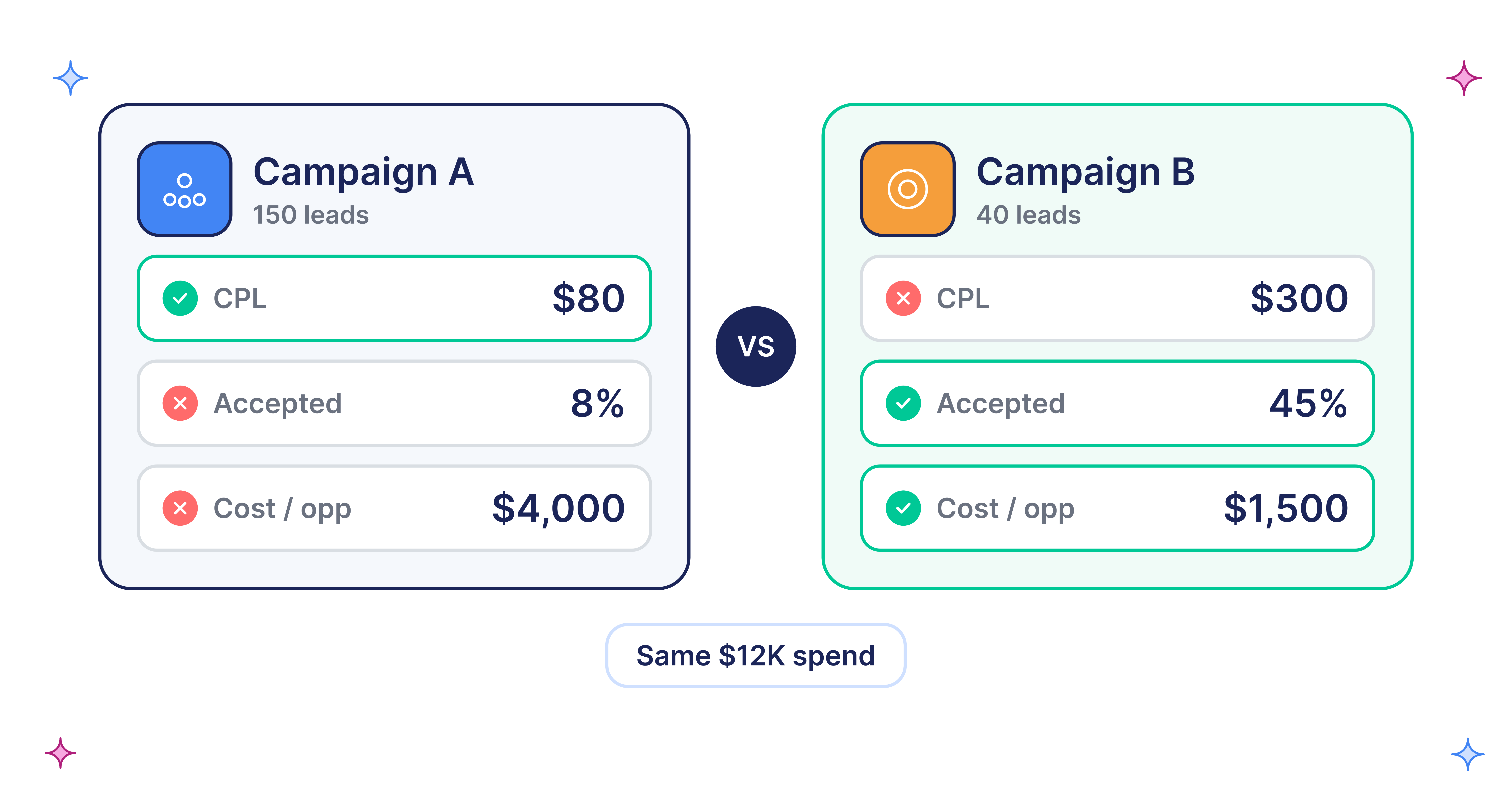
If you're only measuring engagement, you're missing what ABM is actually supposed to achieve.
LinkedIn ABM is one of the few paid acquisition strategies where you already know who you want to reach before the campaign begins.
The challenge isn't finding more prospects. It's getting in front of the right companies and the right people within those companies, and doing it consistently enough to influence a buying decision.
For B2B SaaS companies with a defined ICP and a clear target account list, LinkedIn offers a level of precision that no other channel can match. You can reach specific companies, target the stakeholders involved in the buying process, and align marketing activity directly with sales priorities.
When it works, the impact is obvious. Sales cycles shorten, conversations start earlier, and more pipeline comes from accounts that were already on the team's radar.
When it doesn't, the problem is rarely the budget. Most LinkedIn ABM campaigns fail because they're aimed at the wrong people inside target accounts, built around audiences that are too small to gain momentum, or measured in ways that have little connection to revenue.
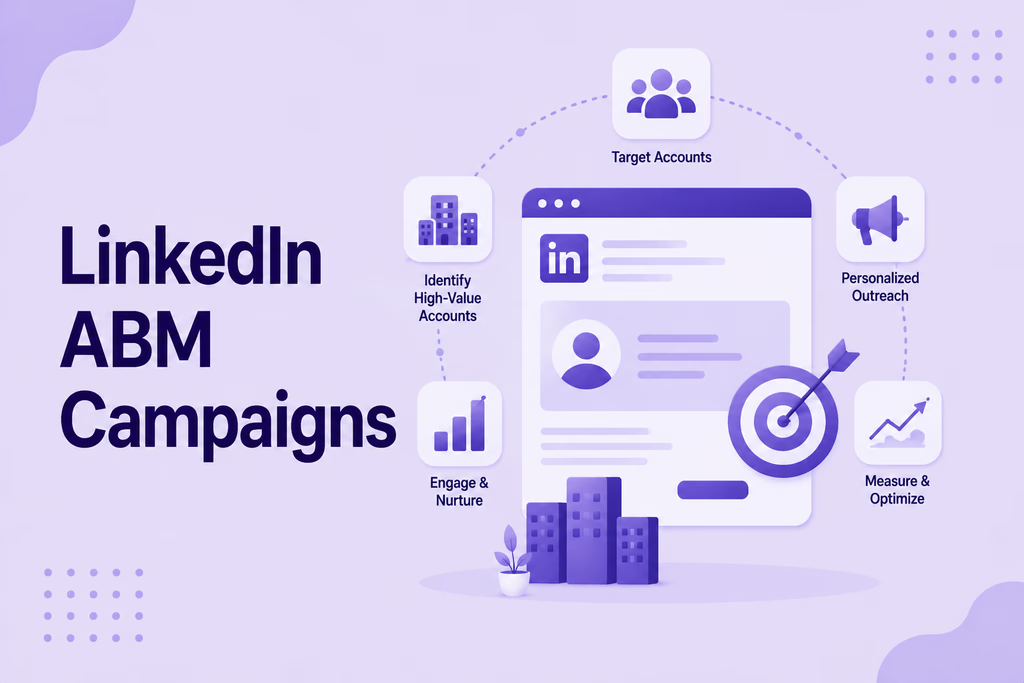
This guide breaks down how LinkedIn ABM actually works, from building matched audiences and reaching buying committees to choosing between 1:1 and 1:many programs.
It also discusses how to scale campaigns without losing the precision that makes ABM valuable in the first place.
Let’s get started.
What is LinkedIn ABM?
LinkedIn ABM (Account-Based Marketing) is a paid media strategy where the targeting is built around specific companies you want as customers rather than broad professional demographics.
Basically, instead of telling LinkedIn to show your ads to "VPs of Engineering at SaaS companies with 50 to 200 employees," you upload a list of the specific 500 SaaS companies your sales team is pursuing and target the people involved in the buying decision directly.
The strategic value is precision. We all know that LinkedIn targeting helps us reach the right people. What makes ABM targeting even better is its ability to reach the right people, at the right companies, and at the right moment.
For B2B SaaS companies with defined ICPs and a sales team already focused on specific accounts, ABM creates a much clearer connection between marketing activity and revenue than most paid channels can.
LinkedIn is the natural home for ABM because of how the platform's targeting works. Other paid channels target intent (Google) or interest (Meta). LinkedIn targets the buyer directly: their job title, their company, their seniority, their industry, and their function. For account-based programs, that level of targeting is what makes the channel viable. Without it, ABM on paid channels mostly doesn't work.
For a broader context on how this fits into a complete LinkedIn Ads for B2B SaaS strategy, that pillar covers the channel as a whole before getting into ABM-specific mechanics.
How to build an ABM audience on LinkedIn
LinkedIn ABM audiences are built using Matched Audiences, a feature that lets you upload a list of target companies and then layer additional targeting (job title, seniority, function) on top.
The setup determines everything that follows, and most ABM programs that underperform have the issue in the audience setup, not the creative or budget. Here are the four steps to build an ABM audience:
Step 1: Build the target account list.
This list should come from your sales team, your existing pipeline, or your CRM's segmentation. It should not be a list you build inside LinkedIn from scratch using filters. The accounts on the list are the companies you've already decided you want as customers. LinkedIn's job is to help you reach them, not to define them for you.
Step 2: Upload the list as a Matched Audience.
Inside Campaign Manager, upload the company list as a CSV. LinkedIn will match the companies on your list against its own database of LinkedIn pages. Expect a match rate of roughly 60 to 80 percent on most lists. If the match rate drops below 50 percent, the list usually has a data quality issue (misspelled names, missing domain information, or companies that don't have a LinkedIn presence).
Step 3: Layer in role targeting.
Once the company list is matched, fill in the job titles, functions, or seniorities you want to reach inside those accounts. The combination of "this specific list of companies" + "these specific people inside them" is the foundation of every LinkedIn ABM campaign.
Step 4: Verify audience size.
LinkedIn requires a minimum of 300 people in any campaign audience. For ABM specifically, the practical minimum is closer to 500 to 1,000 people because below that, the algorithm doesn't generate enough engagement data to optimize properly. If your matched audience comes back smaller than 500 people, you either need a longer account list or broader role targeting.
For B2B SaaS companies with sales teams running structured outbound, the best place to start is usually the account list that sales is already working on. ABM performs best when marketing and sales are focused on the same companies, reinforcing each other's efforts instead of working in parallel.
1:1 LinkedIn ABM vs 1:few vs 1:many
The three ABM tiers describe how many accounts you target at once and how personalized each campaign is. Choosing the right tier is one of the highest-leverage decisions in an ABM program because the wrong choice burns budget on personalization that doesn't return.
[table]
Tier | Account count | Personalization level | Best for
1:1 | 5 to 25 accounts | High (custom creative, messaging, sometimes landing pages per account) | Enterprise deals, $100K+ ACV
1:few | 25 to 100 accounts | Medium (creative tailored to a cluster grouped by industry, use case, or stage) | Mid-market deals, $25K to $100K ACV
1:many | 100 to 1,000+ accounts | Lower (creative tailored to the broader ICP, not individual clusters) | Volume programs, $10K to $50K ACV
[/table]
1:1 ABM is the highest-touch version. The campaign is built around a small list of named accounts, often with custom creative, account-specific messaging, and sometimes personalized landing pages.
The per-account effort is significant. This means 1:1 only makes economic sense when the deal sizes justify it. For most B2B SaaS companies below $100K average contract value, 1:1 ABM is more effort than the math supports.
1: Few ABM is where most B2B SaaS programs actually live. You group your target accounts into 3 to 6 clusters (often by industry, use case, or deal stage) and build creative tailored to each cluster.
The personalization is still meaningful, but the per-account effort is manageable. For mid-market SaaS with $25K to $100K ACV, this is usually the right tier.
1: Many ABMs treat account targeting as a precision layer on top of broader campaigns. The creative is tailored to the ICP rather than to specific accounts, but the targeting is still account-based rather than purely persona-based.
For SaaS companies running volume programs with lower per-deal ACV, 1:many is the most realistic ABM tier.
The mistake most companies make is running 1:1 ABM when their economics support 1: Few, or running 1: Many when they should be running 1: Few. The idea is to match the tier to the deal economics.
How to Target the buying committee on LinkedIn
Most B2B SaaS deals above $25K ACV involve multiple stakeholders. While the exact mix varies by company and product, the buying committee usually includes several people who influence the decision in different ways. Focusing on just the budget owner is one of the most common reasons ABM campaigns underperform.
[table]
Role | What They Care About | Why They Matter
Economic Buyer | Budget, business impact, ROI | Usually approves purchases and signs off on ad spend.
Technical Buyer | Integration, implementation, security, and technical fit | Often has veto power if the product doesn't meet requirements.
End User | Ease of use, workflow impact, day-to-day value | May not approve the purchase, but can strongly influence adoption.
Champion | Internal advocacy, problem-solving, and team success | Helps build consensus and push the deal forward internally.
Blocker | Risk, compliance, procurement, and budget controls | Can delay or stop deals late in the buying process if concerns are not addressed.
[/table]
The goal isn't to reach every stakeholder with the same message. It's to make sure each role sees content that answers the questions they're most likely to have. A CFO and a security lead may be evaluating the same product, but they're rarely evaluating it for the same reasons.
Targeting the full committee on LinkedIn means building separate campaign segments for each role, with creative tailored to each one's concerns. The economic buyer cares about business outcomes. The technical buyer cares about how the product works. The end user cares about what their workflow looks like after implementation. The same campaign sent to all of them will resonate with none.
The accounts that close fastest are the ones where every committee member has been exposed to relevant content from your company multiple times before the deal even enters the pipeline. That's the strategic point of ABM. Surface-level coverage of the economic buyer doesn't get you there.
How to scale LinkedIn ABM without losing precision
Scaling LinkedIn ABM means growing the program in a way that produces more pipeline without diluting the precision that makes ABM work in the first place. The most common scaling failure is companies that add more accounts to the list without rethinking the structure, ending up with a 5,000-account "ABM" program that's essentially indistinguishable from standard ICP targeting.
The four levers that scale ABM without diluting it:
- Expand the buying committee, not just the account count.
Adding more roles per account (going from targeting 3 people per account to 7 people per account) often produces more pipeline impact than adding more accounts to the list. The compound effect of multi-touchpoint coverage inside known target accounts is what makes ABM work.
- Tier your accounts and run different tiers in parallel.
A real scaled program runs 1:1 on the top 20 accounts, 1:few on the next 100, and 1:many on the broader 500. Each tier has its own creative strategy, budget, and measurement. Scaling means doing all three well simultaneously, not picking one and stretching it.
- Refresh creative on schedule, separately per tier.
Creative fatigue is faster in ABM than in standard LinkedIn campaigns because the audiences are smaller. 1:1 creative might need to be refreshed every 2 to 3 weeks.
- 1: Few might refresh every 3 to 4 weeks.
- 1: Many tracks with standard Sponsored Content cadence at 3 to 5 weeks.
Letting fatigued creatives run is one of the fastest ways to lose ABM efficiency.
- Connect ABM to your sales team's actual motion.
ABM works best when paid targeting maps directly to the accounts sales are pursuing. If marketing's ABM list and sales's outbound list don't overlap meaningfully, the channel produces awareness without the sales follow-through that turns awareness into pipeline. The accounts where both teams are aligned are the ones that close fastest.
For a broader context on how ABM fits into top-of-the-funnel marketing versus middle and bottom of funnel work, that breakdown covers the structural logic of how account-based programs integrate with broader demand generation.
How LinkedIn ABM connects to closed revenue
The goal of LinkedIn ABM is not more impressions, clicks, or even form fills. The goal is to create more pipeline and revenue from the accounts you actually want to win.
That's why ABM should be measured differently from most paid campaigns. Looking at engagement tells you whether people noticed your ads. It doesn't tell you whether target accounts moved closer to becoming customers.
A better approach is to track how target accounts progress through the pipeline over time. Are more of them becoming opportunities? Are they moving through the sales process faster? Are they closing at a higher rate than accounts that weren't part of the program?
Those are the questions that determine whether an ABM campaign is working.
The measurement model that actually matters:
Account-level exposure tracking.
Track which companies on your target list were exposed to LinkedIn ABM impressions, how many of those companies engaged (clicked, watched video, downloaded content), and how engagement correlates with pipeline movement over time.
Pipeline lift measurement.
Compare the rate at which exposed accounts enter the pipeline against the rate for non-exposed accounts. If exposed accounts enter the pipeline at 30 percent and non-exposed accounts enter at 12 percent, the lift is the ABM impact.
Velocity comparison.
Track how long it takes exposed accounts to move from first engagement to closed deal versus non-exposed accounts. Faster cycles in exposed accounts indicate ABM is compressing sales velocity, which is one of the program's highest-value outcomes.
Influenced revenue attribution.
Track revenue from accounts that were exposed to LinkedIn ABM versus accounts that weren't. This is the closed revenue number that matters, and it's also the number most companies don't have because they're measuring at the lead level instead of the account level.
Delve's program with ScalixAI is one of the clearest examples of proper ABM measurement. The campaign generated $1.2M in attributed pipeline in 90 days and contributed directly to closing their $32M Series A. The pipeline number was measured by the number of accounts that entered the pipeline after LinkedIn exposure, and how those accounts moved compared to non-exposed accounts.
For the full mechanics of how that measurement works, LinkedIn ads attribution covers the setup in detail.
ABM pricing and budget reality
LinkedIn ABM requires a meaningful budget to produce meaningful results. The minimum monthly spend for a real ABM program is $10,000, with most programs sitting at $15,000 to $30,000 per month. Below the $10K threshold, the budget either spreads too thin across too many accounts or concentrates too heavily on too few, and either way, the program doesn't generate enough data to optimize.
For agency support, ScalixAI's flat-fee management runs $3,000 to $5,000 per month for LinkedIn Ads alone, or $6,000 to $7,000 per month for LinkedIn and Google Ads combined. ABM-specific work typically falls within those bands because the agency expertise required for ABM is the same expertise required for any LinkedIn program, just applied to account-based audiences instead of standard ICP targeting.
The cost-effectiveness of ABM only shows up at the deal level, not the click level. A $150 cost per click on an ABM campaign looks expensive compared to a $10 CPC on standard targeting. But if the ABM click came from an executive at one of your top 50 target accounts and the resulting deal is worth $80,000 in annual contract value, the math works out very differently. This is also why companies running demand generation vs lead generation programs with high ACV products lean heavily into ABM. The unit economics support the precision pricing.
For agencies experienced in running this kind of program, the best agencies for LinkedIn Ads in B2B cover the wider landscape.
The Bottom Line
LinkedIn ABM works because it brings marketing and sales around the same accounts. When the right companies, the right stakeholders, and the right measurement framework come together, the result is more pipeline from the accounts that matter most.
Most underperforming programs don't have a targeting problem. They have an alignment problem. Sales and marketing are focused on different accounts, different people, or different goals.
Get that alignment right, and LinkedIn becomes one of the most effective ABM channels available to B2B SaaS companies.
If your ABM program isn't delivering the pipeline impact it should, that's exactly what ScalixAI was built to help solve.
Explore our services as LinkedIn Ads Agency for more information.