

IN THIS ARTICLE:
Key Takeaways
1
OpenClaw AI is free to install but costs $25–$200/month in real operational expenses.
2
247,000+ GitHub stars doesn't mean plug-and-play. The technical setup is genuinely steep.
3
Skills run automatically on schedule, which is the most powerful thing OpenClaw does for paid media.
4
Token costs spike silently when skills run loops or the heartbeat function isn't configured correctly.
5
OpenClaw finds what's wrong in your ad account, not why, and not what to do next.
OpenClaw AI is the most talked-about open-source agent framework of 2026.
247,000+ GitHub stars in a matter of months, a community-driven skills registry, and a promise of full autonomy over your AI infrastructure.
For paid media teams, the pitch is compelling: connect it to Google Ads and Meta Ads via MCP, run structured audits via WhatsApp or Telegram, and automate the reporting that currently eats up hours every week.
I've run it across live accounts. Here's the honest version.
What OpenClaw AI Actually Is (And What It's Not)
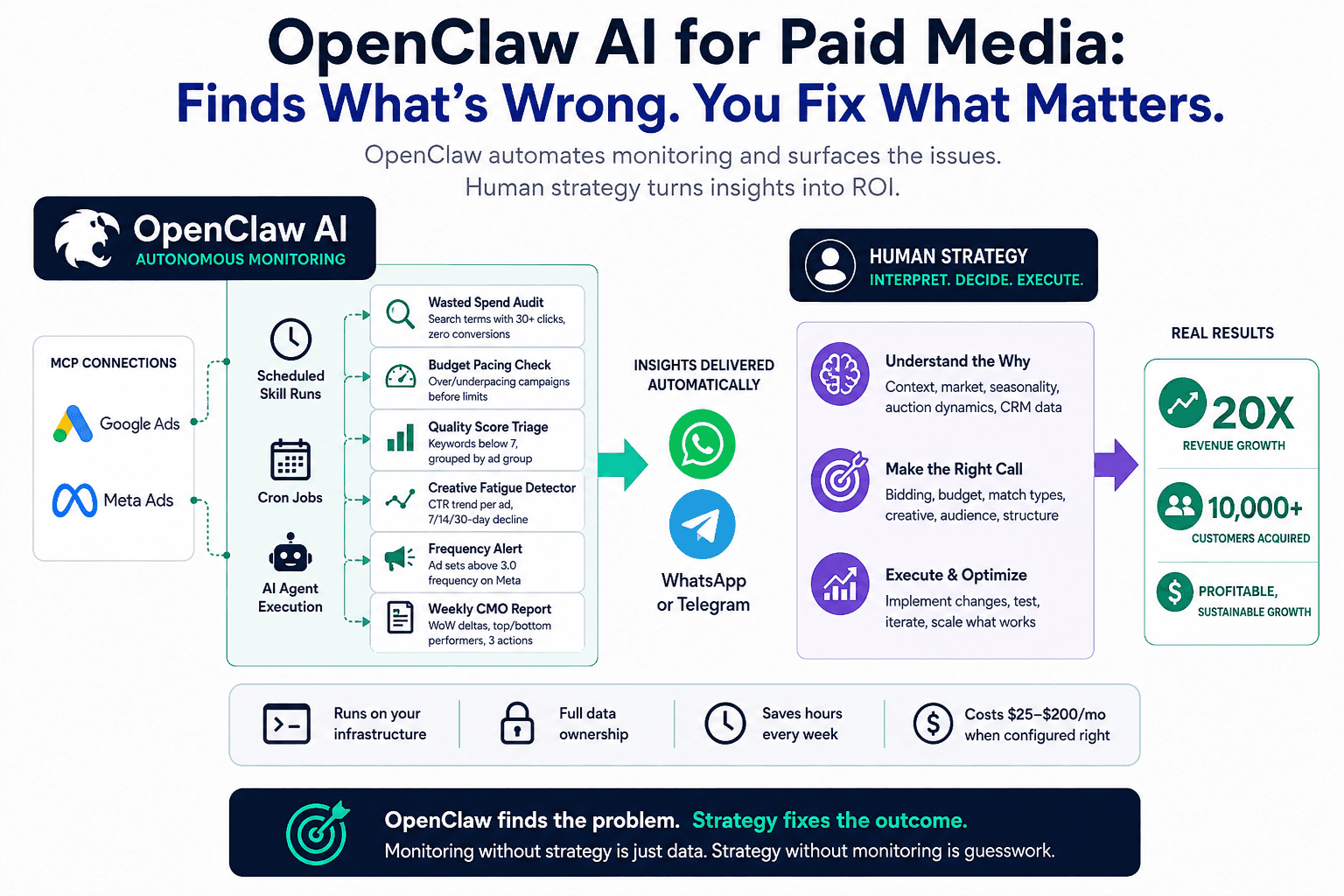
OpenClaw AI is an open-source autonomous agent framework. It is not a SaaS tool, not a dashboard, or a managed service.
It's essentially a software you run on your own machine or a VPS that connects to external platforms through MCP (Model Context Protocol) and executes tasks based on instructions called Skills.
For paid media specifically, this means: you configure a skill that tells OpenClaw to pull your Google Ads wasted spend report every Monday morning, analyze it, and send the results to your Telegram.
You set it once. It runs without you touching it. That's the genuine operational value; scheduled, autonomous monitoring that fires reliably without requiring you to prompt anything.
The setup reality is different from the marketing.
OpenClaw requires Node.js 22+, which means Windows users need to install WSL2 first. The configuration lives in JSON files edited in a terminal. API credentials for Google Ads and Meta need to be acquired, formatted correctly, and pasted in the right places.
Also, when a platform updates its API endpoint, your skills break, and fixing them is your responsibility.
The detailed setup walkthroughs for Google Ads and Meta Ads cover the step-by-step process for each platform.
And the OpenClaw skills for paid media guide covers the full skill library with copy-paste prompt formats.
Real OpenClaw AI Pricing: What You'll Actually Pay
The software is 100% free under the MIT license. The infrastructure and AI model consumption are not.
Here's what a realistic monthly bill looks like across different usage levels.
Setup Type | VPS Hosting | AI Token Cost | Monthly Total |
Light personal use (manual queries only, heartbeat disabled) | $5–8 | $1–5 | $6–13 |
Small team (scheduled skills, mixed model routing) | $10–15 | $15–35 | $25–50 |
Heavy automation (multiple accounts, premium models) | $15–25 | $35–175 | $50–200+ |
Unmonitored loops (skills stuck in reasoning loops) | $10–15 | $50–200+ | Unpredictable |
The heartbeat function, OpenClaw's always-on context polling, is the biggest cost variable most guides don't address.
On default settings with full context every 30 minutes, it costs approximately $52/month on Claude Sonnet alone. Switching to light context mode drops that to under $6. Disabling it entirely brings it to zero, with the trade-off that the agent only acts when manually triggered.
For paid media monitoring, light context mode is the right default.
What OpenClaw Does Well for Paid Media
Scheduled skill runs.
This is OpenClaw's clearest advantage over manual workflows and even some MCP-based tools like Claude Cowork. Configure a cron job and the audit fires automatically; budget pacing at 9 am, wasted spend report on Monday, frequency alert on Thursday. There is absolutely no prompting required.
Multi-platform coverage.
One OpenClaw instance handles Google Ads and Meta Ads simultaneously through separate MCP connections. The best Claude connectors comparison covers how this stacks up against Zapier and Composio for teams managing both platforms.
The skills that deliver real value in paid media:
Skill | What It Returns | When to Run |
Wasted Spend Audit | Search terms with 30+ clicks, zero conversions, ranked by spend | Weekly |
Budget Pacing Check | Over/underpacing campaigns before they hit daily limits | Daily |
Quality Score Triage | Keywords below 7, grouped by ad group, with likely cause | Weekly |
Creative Fatigue Detector | CTR trend per ad, 7/14/30-day decline flags | Every 3 days |
Frequency Alert | Ad sets above 3.0 frequency on Meta | Daily |
Weekly CMO Report | WoW deltas, top/bottom performers, three recommended actions | Monday morning |
Running these consistently is the difference between catching problems early and discovering them after three weeks of compounding waste.
If your current setup isn't auditing this regularly, the time you'd spend on that manually is worth calculating.
You can run your numbers through the Google Ads ROI calculator to get a sense of what weekly oversight is actually worth against your spend level.
Where OpenClaw AI Falls Short
It's not built for non-technical teams. The reviews are consistent on this: developers and DevOps engineers appreciate the flexibility, but everyone else finds the setup genuinely steep.
If your paid media team doesn't have someone comfortable editing JSON and troubleshooting Node version conflicts, the maintenance cost exceeds the operational benefit.
Token costs spike without warning. A skill stuck in a reasoning loop can generate a $50+ API bill overnight. Without token limits explicitly set in openclaw.json, there's no ceiling on what a runaway job costs. This is fixable, but you have to know how to fix it before it happens.
It breaks when platforms change. Meta updated its Marketing API in Q1 2026. Google rolled out AI Max for Search in May. Every significant platform change requires skill updates. There's no automatic maintenance. The skills you built in January may not work correctly today without someone checking them.
It surfaces data, not decisions. This is the most important limitation for paid media specifically. OpenClaw can tell you a campaign is overpacing at 140% of the daily budget. It cannot tell you whether that's a bidding misconfiguration, a competitor dropping out of the auction making spend easier to win, or an unusually high conversion rate day where the additional spend is profitable.
Three situations, three completely different responses. OpenClaw gives you the same output regardless.
This is the gap that produced the Fyxer result. When ScalixAI took over the account, the data was accessible, audits were running, and performance looked reasonable in aggregate.
What wasn't visible was that branded and non-branded traffic were running through the same bidding logic, masking non-branded underperformance and feeding Smart Bidding the wrong signal. No skill surfaced it.
When we fixed the architecture, the conversion signal configuration produced 20x revenue growth and 10,000+ customers acquired. The tool got us to the diagnosis faster. The strategy produced the outcome.
OpenClaw AI vs. ScalixAI: What You're Actually Choosing Between
OpenClaw AI (Self-Hosted) | ScalixAI Managed | |
Monthly cost | $25–200 infrastructure + tokens | Managed service fee |
Setup | Technical — Node.js, JSON, VPS | Same day |
Scheduled monitoring | ✔ Cron-based | ✔ Active + human oversight |
Diagnostic speed | 30–60 seconds per skill | Same + interpretation |
CRM attribution | ✘ | ✔ Built in |
Account restructuring | ✘ | ✔ |
Maintenance | Yours — API changes, token rotation | Handled entirely |
Strategy layer | ✘ | ✔ 9 years of Google expertise |
Best for | Technical operators, developers, agencies | B2B SaaS teams wanting a pipeline |
For teams running the B2B Google Ads strategy framework and using AI agents for paid media, OpenClaw fits as the monitoring layer. It doesn't replace the strategic layer above it.
The Bottom Line
OpenClaw AI is a legitimate paid media tool. It is specifically for teams that have the technical capability to set it up, maintain it, and act on what it surfaces. The scheduled monitoring is genuinely useful. The skill library is solid. The cost is reasonable when configured correctly.
But it isn’t a strategy replacement, a CRM attribution system, or a solution for the judgment calls that determine whether an ad account produces revenue. Those gaps are real, and they show up in results.
ScalixAI manages Google Ads and Meta Ads end-to-end for B2B SaaS and AI companies, using agent tooling, which accelerates the work. However, what gives us an edge is having spent nine years inside Google. This expertise where it determines the outcome.
If your account needs more than faster diagnostics, our B2B PPC management service is where that conversation starts.
OpenClaw found the problem. Now let's fix it.
We'll show you exactly what it's costing you.
Book a Free Audit →
Is OpenClaw AI actually free?
Does OpenClaw work for non-technical teams?
Can OpenClaw make changes to Google Ads campaigns?
How do I stop OpenClaw from running up unexpected token costs?
What's the difference between OpenClaw and Claude Cowork for Google Ads?