
Key takeaways
A Google Ads audit for SaaS should start with one question: where does revenue break down?
Ads looking fine while pipeline stays flat is a tracking problem, not a campaign problem.
Blending high- and low-intent keywords in the same campaign is where most budget leaks start.
Bidding toward lead volume trains Google to find the wrong conversions at scale.
Keyword cannibalization and Quality Score gaps raise your CAC without triggering any visible alert.
If you’re running paid ads for a B2B SaaS company, there’s a good chance you’ve had this conversation internally more than once.
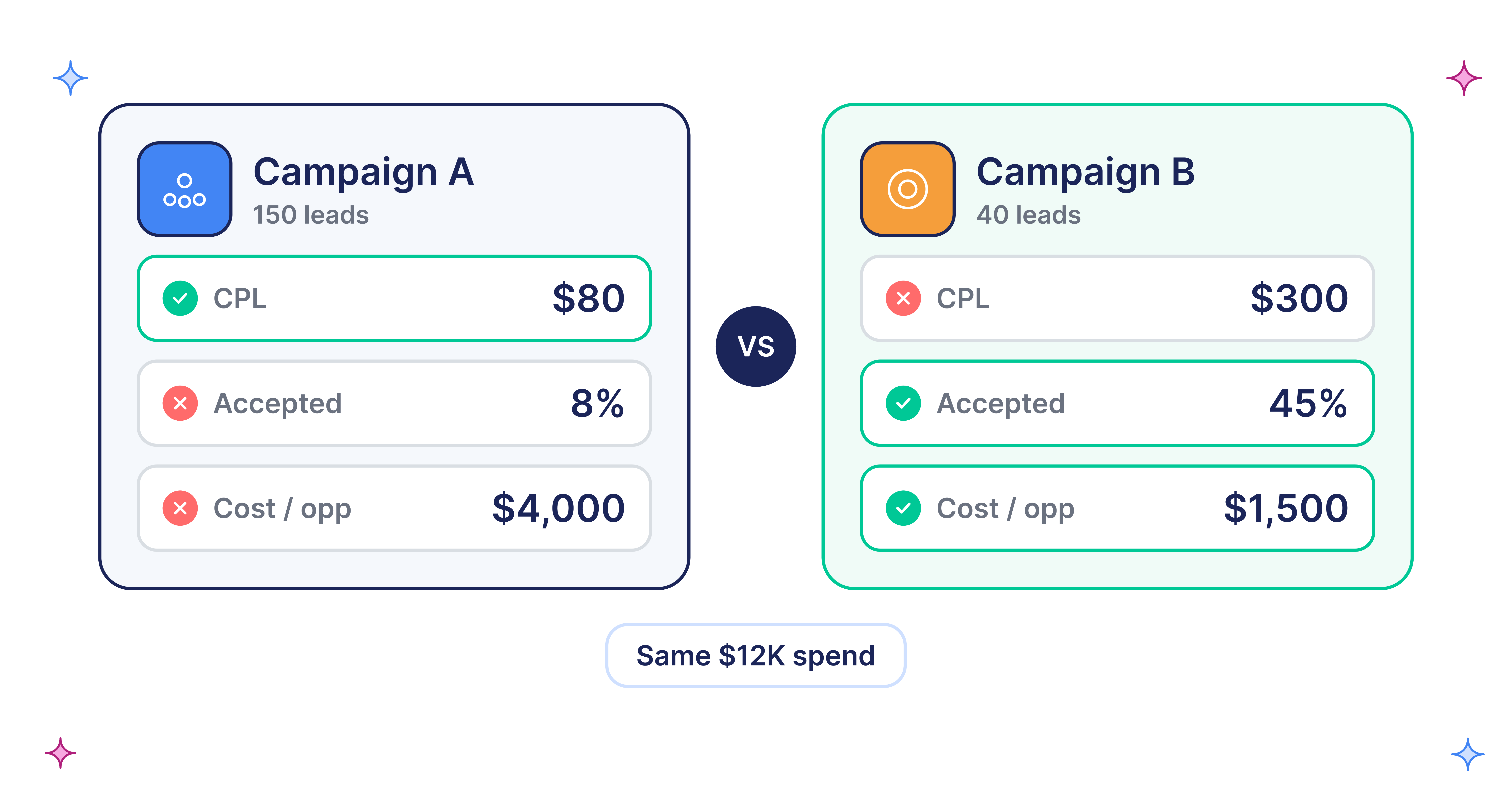
Marketing says performance is solid because leads are coming in at a reasonable cost. Sales pushes back because those leads are not converting into real opportunities. Leadership sits somewhere in the middle, trying to figure out whether to increase the budget or pull back entirely.
Nothing is clearly broken, but nothing feels reliable either.
This is exactly the situation most B2B SaaS companies are in when they start looking for a Google Ads account audit. They are not looking for someone to tell them their click-through rate is low or that their ads need new headlines. They are trying to understand why the ad spend is not translating into pipeline in a way they can trust.
At Scalix AI, this is the starting point for almost every conversation we have. The campaigns are running, the dashboards look acceptable, and yet the business impact is unclear. Let’s discuss.
TL;DR
In this blog, we cover why your ads can look okay but still not bring in real customers or pipeline. We talk about the actual problems that B2B SaaS companies experience; expensive issues that continue to drain from your budget, like wrong targeting or bad tracking. And we explain why you should book a free audit with Scalix AI to see what’s actually going wrong and what to fix first.
The Core Issue Most B2B SaaS Teams Miss
The problem is not that your ads are underperforming in isolation. The real issue is that your ad account is not aligned with how your business actually makes money.
Most SaaS companies are still working on leads or conversions, even though those metrics do not reflect whether someone becomes a paying customer.
That disconnect creates a situation where everything appears to be working, while revenue tells a completely different story.
A proper Google Ads performance audit should not start with campaigns or keywords. It should start with one question: how does this account connect to pipeline and revenue, and where is that connection breaking down?
Where We Consistently See Things Go Wrong
Once you start looking at accounts through that lens, patterns become very clear. These are not edge cases. They show up in early-stage SaaS teams and in companies well past Series B.
- You Are Spending Money on Traffic That Was Never Going to Convert
This is almost always the first place we start because it’s where the biggest inefficiencies usually sit. Campaigns often generate volume, but the intent behind that traffic does not match the product or the buyer.
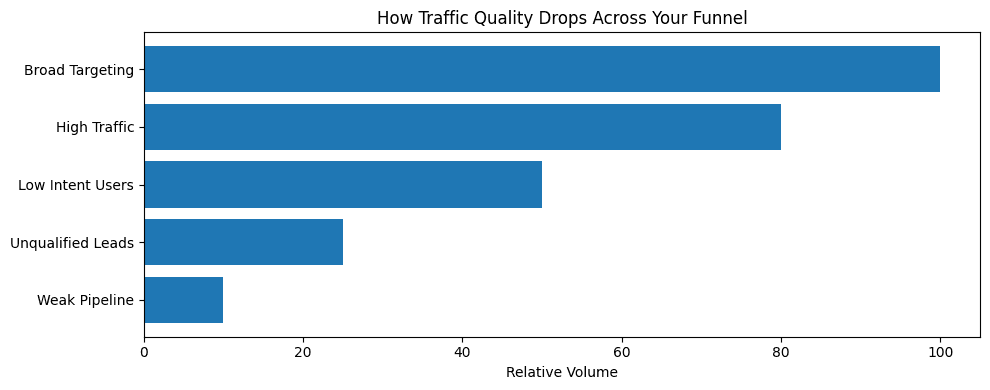
On Google, this typically comes from broad or loosely matched keywords that pull in top-of-funnel users or completely irrelevant queries. On LinkedIn, it shows up in targeting that looks correct on paper, but is far too wide in practice, bringing in users who were never going to become qualified buyers.
When we go through accounts, this is where wasted spend identification becomes real, not theoretical. It is very common to find a significant portion of the budget being allocated to traffic that was never a fit in the first place.
You can see this clearly in our engagement with Pam. When we audited their account, a large share of spend was going toward low-intent traffic that wasn’t converting into a meaningful pipeline. After tightening targeting, refining keyword intent, and eliminating irrelevant queries, the account shifted from chasing volume to attracting qualified demand.
The result was not just lower cost per lead, but a noticeable improvement in lead quality and downstream conversion into the pipeline.
If your campaigns are generating activity but not driving real opportunities, this is usually where the disconnect starts.
- Your Data Is Not Telling You the Truth
Most teams believe their tracking is set up, but when we look closely, it rarely reflects how the business actually evaluates success.
We often see form submissions treated as conversions without any connection to what happens after that lead enters the CRM. There is no visibility into which campaigns generate qualified opportunities, and no feedback loop that allows platforms to optimize toward real outcomes.
These conversion tracking gaps are one of the biggest reasons for performance plateaus. If the system is optimizing toward the wrong signal, even well-structured campaigns will drift over time.
- The Way Your Account Is Structured Limits Your Ability to Scale
A lot of SaaS ad accounts look organized at first glance, but the structure underneath makes it difficult to control performance.
High-intent and low-intent queries are often grouped together. Different personas are not separated. Funnel stages are blended into the same campaigns.
When that happens, it becomes difficult to understand what is actually working, and even harder to allocate budget with any level of confidence. A thorough campaign structure review is not about tidying things up; it is about giving you control over how spend translates into outcomes.
- Your Keywords Are Working Against Each Other
Another issue that comes up frequently is internal competition within the account. Multiple campaigns or ad groups end up targeting overlapping queries, which leads to inefficiencies that are not immediately obvious.
This kind of keyword cannibalisation increases costs and makes performance harder to manage because your own campaigns are competing in the same auctions.
- You Are Not Filtering Out Enough Noise
Over time, every account accumulates irrelevant traffic. If search terms are not reviewed consistently and exclusions are not added, the budget starts leaking into areas that do not contribute to the pipeline.
These negative keyword gaps are one of the simplest problems to fix, but they are often overlooked because they do not feel strategic. In reality, they have a direct impact on efficiency.
- Your Bidding Strategy Is Based on the Wrong Goal
Automated bidding works well when it is aligned with meaningful data. The issue is that many SaaS accounts are still optimizing for lead volume instead of pipeline or revenue.
When that happens, the system is effectively trained to find more of the wrong kind of conversions. A proper bidding strategy review should look at whether your current setup is reinforcing the outcomes you actually care about.
- You Are Paying More Than You Need To
Finally, there are structural inefficiencies that quietly increase your cost of acquisition, even when everything appears to be working on the surface. One of the biggest contributors is misalignment between keywords, ads, and landing pages.
When these elements are not tightly connected, Google struggles to understand relevance. That leads to higher CPCs, lower ad visibility, and less efficient spend overall.
These Quality Score issues rarely stand out as a single obvious problem. Instead, they show up gradually through rising costs and stagnating performance, which is why many teams overlook them.
We saw this clearly in our work with Fyxer. Their campaigns were active and generating results, but costs were higher than they should have been. After analyzing the account, we identified gaps in how keywords, ad messaging, and landing page experience were aligned.
By tightening that alignment and improving overall relevance, we were able to reduce inefficiencies and bring down acquisition costs while maintaining performance.
This is the kind of issue that does not always feel urgent, but over time, it has a direct impact on how much you pay to acquire each customer.
What a Scalix Audit Actually Focuses On
Most audits are built as checklists. They cover a wide range of areas but do not go deep enough to influence decisions.
Our approach is different because we are not trying to evaluate your account in isolation. We understand how it connects to revenue and where that connection is breaking.
A proper PPC audit service should leave you with a clear understanding of three things:
- Where your budget is being wasted
- Where your pipeline is breaking down
- What changes will have the highest impact
What This Looks Like in Practice
If you go through our case studies, you will notice that the biggest improvements did not come from rewriting ads or making small optimizations.
They came from fixing underlying issues.
In some cases, that meant correcting tracking so the platform could finally optimize toward qualified leads. In others, it meant restructuring campaigns so that intent and personas were properly separated. In many situations, it involved removing inefficiencies that had been quietly draining the budget for months.
The common thread is that once those foundational problems were addressed, performance improved in a way that was both measurable and scalable.
What You Should Expect From a Proper Audit
A real Google Ads health check by our Google Ads management service will not overwhelm you with observations. It will simplify decision-making.
By the end of it, you will know where your ad spend is going, what is not working, and what needs to be fixed first. You will also have a clear sense of the potential impact of those changes.
That is what makes the difference between an audit that sits in a document and one that actually drives action.
When It Makes Sense to Get A Google Ads Free Audit
There is a point where continuing to run ads without clarity becomes expensive.
If you are consistently investing in paid channels but cannot confidently tie that spend to pipeline, or if your lead quality does not match your expectations, it is worth stepping back and looking at the account more holistically.
A proper Google Ads expert review is not about finding small tweaks. It is about understanding whether your current setup is capable of supporting growth.
The Bottom line
Most SaaS teams do not need more activity in their ad accounts. They need better alignment between what they are doing and what the business actually cares about.
Once that alignment is in place, performance tends to improve naturally because decisions are based on the right signals.
So, are you spending and still unsure what is truly driving results? Address the issue by booking our free Google Ads audit today!