
Key takeaways
In-house Google Ads hires often cost $160K–$280K in year one once salary, tools, and hiring costs are fully accounted for.
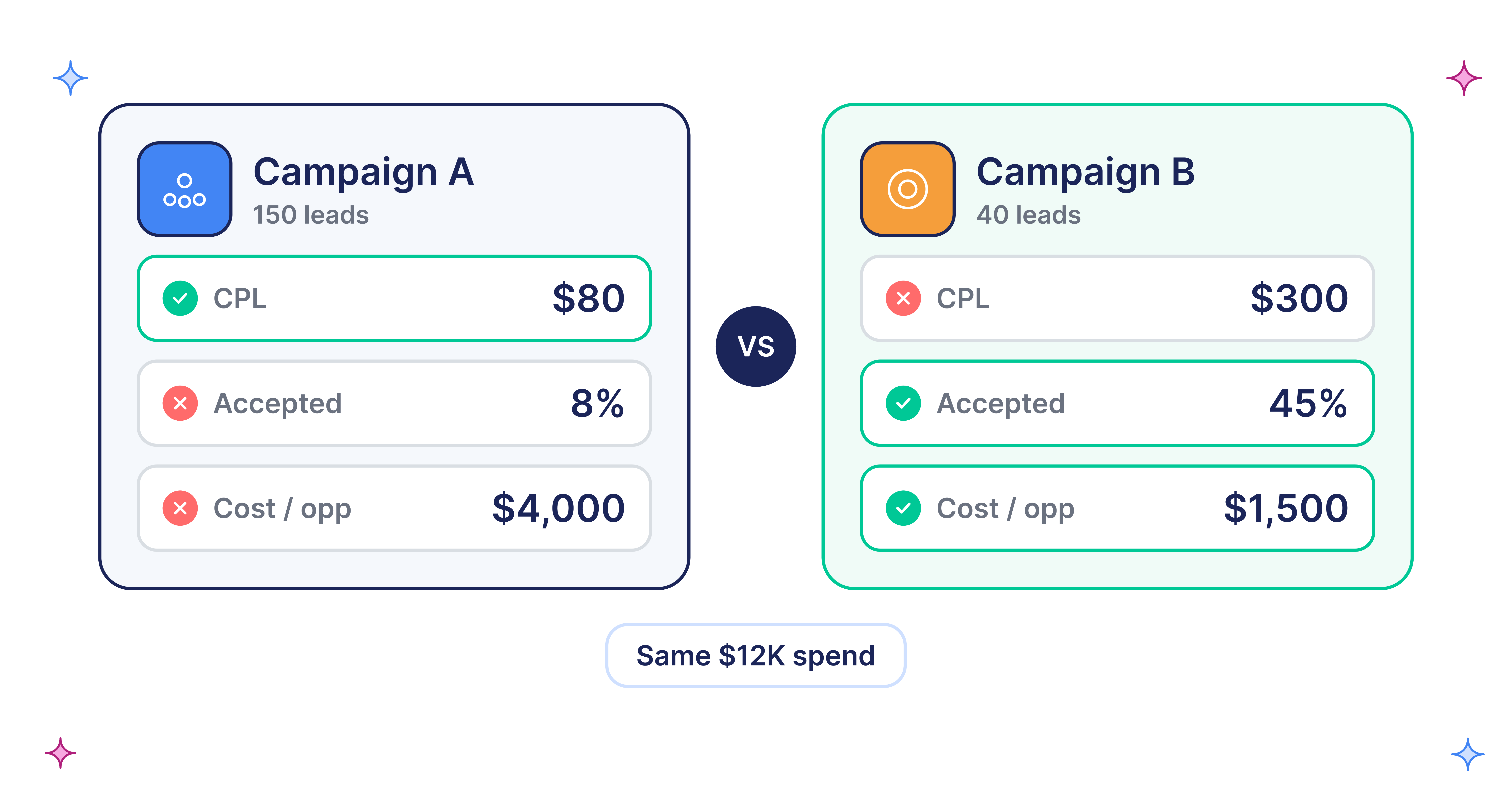
The real decision isn’t cost—it’s how fast you can achieve efficient CAC, since delays directly hurt pipeline growth.
In-house managers are limited by learning on a single account, lacking cross-company insights that agencies naturally gain.
Agencies and newer models provide faster time-to-results and broader expertise, often outperforming early-stage in-house setups.
In-house only makes sense when you have scale, budget, and time to absorb ramp-up inefficiencies—otherwise outsourcing wins early.
If you're a Seed to Series B founder, you’ve probably gone back and forth on this: Should we hire someone in-house to run Google Ads, or should we outsource it?
At first glance, hiring in-house feels like the obvious move. It sounds cheaper, more controlled, and more aligned with your team.
But once you actually map out the numbers, and more importantly, the time it takes to get results, the picture changes.
This guide breaks down the real cost of in-house Google Ads vs agency for B2B SaaS in 2026, with actual numbers and what we consistently see across SaaS companies scaling from $1M to $20M ARR.
The Short Answer (Before We Go Deep)
Most founders don’t need a 2,000-word breakdown to sense the direction this goes.
- An in-house hire typically ends up costing somewhere between $160K and $280K in year one when you factor everything in.
- A freelancer might cost you between $36K and $96K annually, but usually lacks ownership.
- A traditional agency can range from $72K to well over $150K, depending on structure.
- And then there are newer models like ScalixAI at a flat $5K per month.
But the decision is not really about cost in isolation. It comes down to how quickly you can reach efficient CAC because delays in paid acquisition show up directly in your pipeline.
Option 1: Hiring an In-House Google Ads Manager
Let’s walk through this the way it actually plays out inside a growing SaaS company.
Salary Is Just the Starting Point
If you are hiring someone capable of managing meaningful spend, you are not hiring junior talent. Most companies in your stage end up looking for mid-level to senior candidates.
A realistic salary range today sits between $100K and $120K. That sounds straightforward until you layer everything else in.
The Fully-Loaded Cost
Once you account for benefits, taxes, and insurance, you are typically adding another 20–30% on top of salary. Then there is the cost of actually hiring the person, which often lands between $10K and $25K, depending on whether you use a recruiter or internal resources.
By the time the person joins, you are already significantly above the base salary you initially budgeted.
Tools Don’t Come Free
A Google Ads manager rarely operates in isolation. They need attribution visibility, testing infrastructure, analytics tooling, and competitive intelligence.
Across most SaaS teams, this stack ends up costing anywhere from $500 to $2,000 per month, which adds another $6K to $24K annually.
Ramp Time Is Where the Real Cost Sits
This is the part that almost never makes it into hiring discussions.
You will likely spend four to ten weeks just finding the right candidate. After that, onboarding takes another month or two. And even once they are “in,” there is still a campaign learning curve where they are figuring out your ICP, messaging, funnel friction, and conversion dynamics.
In reality, it takes three to six months before you start seeing meaningful performance.
During that time, you are spending money on campaigns that are still learning.
Total In-House PPC Cost (Year One)
[table]
Cost Component | Estimate
Salary | $100K–$120K
Benefits & taxes | $25K–$40K
Hiring costs | $10K–$25K
Tools | $6K–$24K
Ramp inefficiency (CAC impact) | $20K–$80K+
Total Year 1 Cost | $160K–$289K+
[/table]
When founders say in-house is cheaper, they are usually only thinking about the first row in this table.
The Structural Limitation of In-House
Even if you hire someone strong, there is a constraint that is hard to get around. They are only exposed to your account.
Waqas, the founder of ScalixAI, puts it bluntly: Most in-house Google Ads managers are learning on your budget because they don’t have access to cross-industry pattern recognition.
That means they are not seeing what is working across other SaaS funnels, other pricing models, or other buyer journeys. They are figuring things out in isolation. Over time, that slows down how quickly you get to efficient CAC.
Option 2: Hiring a Freelancer
Freelancers are often the first alternative founders consider. They are easier to hire, require less long-term commitment, and cost less on paper.
Most freelancers charge between $3K and $8K per month, which puts them at $36K to $96K annually.
The issue is not cost, it is scope.
In most cases, freelancers are focused on execution. They will launch campaigns, manage bids, and handle optimizations, but they are not typically responsible for pipeline outcomes or broader growth strategy.
If you already have strong internal marketing leadership, a freelancer can work well. But if you are expecting them to drive growth independently, there is usually a gap.
Option 3: Traditional PPC Agencies
PPC Agencies bring more structure and experience into the picture.
Most operate on a monthly retainer that ranges from $6K to $15K, and in some cases, they layer in a percentage of ad spend. That puts annual costs somewhere between $72K and $180K or more.
The benefit is that agencies ramp faster because they have seen multiple accounts. They bring both strategy and execution, and they are not starting from zero.
However, quality varies widely. Some agencies are excellent, while others rely on templated playbooks that do not translate well to B2B SaaS growth.
If you are trying to figure out how to evaluate Google Ads agency partners, one of the most important signals is whether they can clearly explain how they improve CAC, not just how they increase spend.
Option 4: ScalixAI ($5K/month Flat)
ScalixAI is built specifically for B2B SaaS companies that want performance without the overhead of building internally.
The pricing is simple at $5K per month, which comes out to $60K annually, with no percentage of ad spend.
But the actual difference is not just cost, it is focus.
Instead of optimizing for spend growth, the model is built around CAC efficiency and faster learning cycles across multiple SaaS accounts.
Side-by-Side Cost Comparison
[table]
Option | Annual Cost | Ramp Time | Expertise | CAC Risk
In-house hire | $160K–$289K+ | 3–6 months | Single-account | High early-stage
Freelancer | $36K–$96K | 1–2 months | Limited | Medium
Agency | $72K–$180K+ | 1–3 months | Multi-account | Medium
ScalixAI | $60K | Fast | SaaS-specialized | Lower
[/table]
This is the same comparison logic you will see reflected across top Google Ads agencies in the US, but the structure and incentives vary more than most founders expect.
Why Not Just Hire In-House?
This is the most common pushback, and it is a fair one. The idea of having someone fully dedicated to your company is appealing. But the tradeoff is between focus and exposure.
You are choosing between one person who is deeply focused on your account and a team that is learning across multiple SaaS companies simultaneously.
Control is another reason founders lean toward in-house. It feels safer. But control does not necessarily translate into better outcomes.
What actually drives results is how quickly you learn, how quickly you test, and how quickly you reduce CAC.
The Opportunity Cost Most Teams Miss
The biggest cost is usually not salary, it is the delay.
If it takes you four extra months to reach efficient campaigns, and your CAC is inflated during that time, the impact compounds quickly.
It is not unusual for that gap to translate into $50K to $150K in lost efficiency, especially if paid acquisition is a primary growth channel.
This is why some teams choose to first audit your B2B SaaS accounts with an external partner before committing to a full hiring decision.
When In-House Actually Makes Sense
There are situations where building internally is the right move.
If you are already spending over $100K per month, have clear playbooks, and need tight integration with product and data teams, an in-house hire can become a strong multiplier.
But before that point, it often slows you down more than it helps.
A Better Way to Think About the Decision
Instead of asking which option is cheaper, it is more useful to ask which option gets you to predictable CAC faster.
Because once you reach that point, everything else becomes easier. Scaling budgets, forecasting pipeline, and improving conversion rates all build on top of that foundation.
The Bottom Line
For most Seed to Series B SaaS companies in 2026, the assumption that in-house is cheaper does not hold up when you look at the full picture.
Freelancers can support execution but rarely own outcomes. Agencies bring experience but vary in quality. And newer specialized models are trying to close the gap between cost and performance.
The real advantage comes from the speed of learning and the ability to apply insights across accounts.
Calculate Your Real ROI
If you want to understand what this looks like for your specific numbers, you can run it through ScalixAI’s ROI calculator.
It helps you break down your current CAC, estimate efficiency gains, and see how long it takes to reach meaningful impact under different models.
If you are deciding between hiring a Google Ads specialist vs outsource options, the answer is rarely about preference.
It is about how fast you can get to outcomes that actually move revenue. Book a free audit to see the difference.