Most LinkedIn Ad Budgets Are Not Failing in the Ads
They fail in the gap between click and pipeline. That is what we diagnose and fix.
Share this Article



Key takeaways
LinkedIn CPC for B2B SaaS averages $7 to $15 in 2026, with high-value job titles pushing past $25.
Cost per lead drops 40 to 60 percent when you switch from sponsored content to thought leader ads.
LinkedIn's minimum effective budget is $4K monthly, below which the algorithm cannot optimize anything.
Lead Gen Forms produce cheaper leads but lower quality, which often costs more than off-platform forms.
LinkedIn pricing only makes sense when your average contract value is above $15K annually.
LinkedIn Ads cost more than any other major B2B paid channel in 2026, and there is a real reason for it.
But the question most founders are actually asking when they look at the cost is not “how much is it” but “is this worth it for my company?”
That is a different conversation, and most cost breakdowns do not really answer it.
This guide breaks down what LinkedIn Ads for B2B SaaS actually cost in 2026, what those costs translate to in the qualified pipeline for B2B SaaS, when the economics work, and when they do not.
The benchmarks are based on current market data and what we consistently see running campaigns across SaaS companies.
Let’s get started.
How Much Are LinkedIn Ads in 2026?
LinkedIn Ads cost between $7 and $15 per click for most B2B SaaS audiences in 2026, with CPMs ranging from $30 to $80 depending on how narrow or competitive the targeting is.

These numbers are 5 to 10 times higher than Meta and roughly 2 to 3 times higher than Google Ads, which is usually the first thing founders react to when they open the platform. It is also the main reason many of them dismiss it before they actually map those costs to the downstream pipeline.
The pricing itself is not arbitrary. It reflects what you are actually buying inside the auction.
LinkedIn is not just selling traffic. It is selling access to a defined professional layer of the internet that other platforms approximate but do not consistently isolate.
On Meta, you are working with inferred intent and behavioural signals built around interests and activity patterns. On Google, you are aligning with active intent through search terms, but you are still competing in a mixed environment where the same query can represent very different levels of commercial readiness.
On LinkedIn, the targeting is anchored in declared professional identity. Job title, company, seniority, function, industry, and company size are not inferred signals. They are profile attributes that let you define who is eligible to see the ad before any behaviour happens.
The practical implication is that campaign design changes.
Instead of thinking in terms of “audience size and CPC efficiency,” you are usually deciding how tightly you want to define the buying committee for a specific offer, and how much inefficiency you are willing to accept in exchange for that precision.
For example, a campaign targeting Heads of Engineering or CTOs inside Series B to Series D SaaS companies behaves very differently from a broader “software decision makers” audience. Not just in cost, but in how the leads distribute across company size, deal complexity, and sales cycle length.
So when you see a $10 to $12 click, it is not just a traffic cost. It is the price of consistently filtering for a specific decision-maker profile inside a specific company stage, without relying on intent signals or behavioural guesswork.
That is why the comparison most founders make breaks down early.
They look at LinkedIn CPC versus Meta or Google CPC as if they represent the same unit of value. They do not.
A more accurate comparison is what each click turns into once it enters the sales process, where LinkedIn often behaves less like a traffic channel and more like a structured input into outbound-quality opportunity creation.
And on that metric, economics can look completely different.
LinkedIn Ads Cost Per Click and What it Actually Buys You
LinkedIn ads cost per click breaks down across three rough tiers in 2026, depending on how competitive the audience you're targeting is.
The data here is anchored in LinkedIn advertising benchmark ranges across the industry, combined with what we consistently see running campaigns across B2B SaaS accounts.
[table]
Audience type | CPC range | CPM range | Typical CTR
Standard B2B audience | $7–$10 | $30–$50 | 0.4–0.6%
High-value B2B titles (VPs, Directors, C-suite) | $10–$15 | $50–$80 | 0.5–0.8%
Premium executive titles in competitive industries | $15–$25+ | $80–$120 | 0.6–1.0%
[/table]
CTR on LinkedIn looks low compared to other platforms, and that's by design. LinkedIn users aren't in active browsing mode like they are on Meta or in active search mode like they are on Google. They're between meetings, scanning their feed for industry updates. A 0.5 per cent CTR on LinkedIn often produces a better pipeline than a 2 per cent CTR on Meta, because the half per cent who do click are exactly the buyers you wanted.
What changes the math significantly is the ad format. Thought Leader Ads consistently produce CTRs 2 to 3 times higher than standard Sponsored Content. The same audience seeing the same message gets dramatically different engagement when it comes from an individual's profile instead of a company page. This is one of the most reliable ways to lower your effective CPC without changing anything else.
LinkedIn Ads Cost Per Lead in B2B SaaS
LinkedIn ads cost per lead in B2B SaaS typically ranges between $50 and $200, with most accounts sitting somewhere in the $80 to $150 range.
Where you land in that range is usually not random. It comes down to three variables that consistently show up across campaigns:
- Whether you are using Lead Gen Forms or sending traffic to an external landing page
- How warm the audience is at the point of conversion
- And how strict the qualification bar is for what counts as a lead in the first place
Once you break it down this way, CPL stops being a single number and starts behaving more like a reflection of setup decisions inside the campaign.
Lead capture method is the biggest driver of that spread.
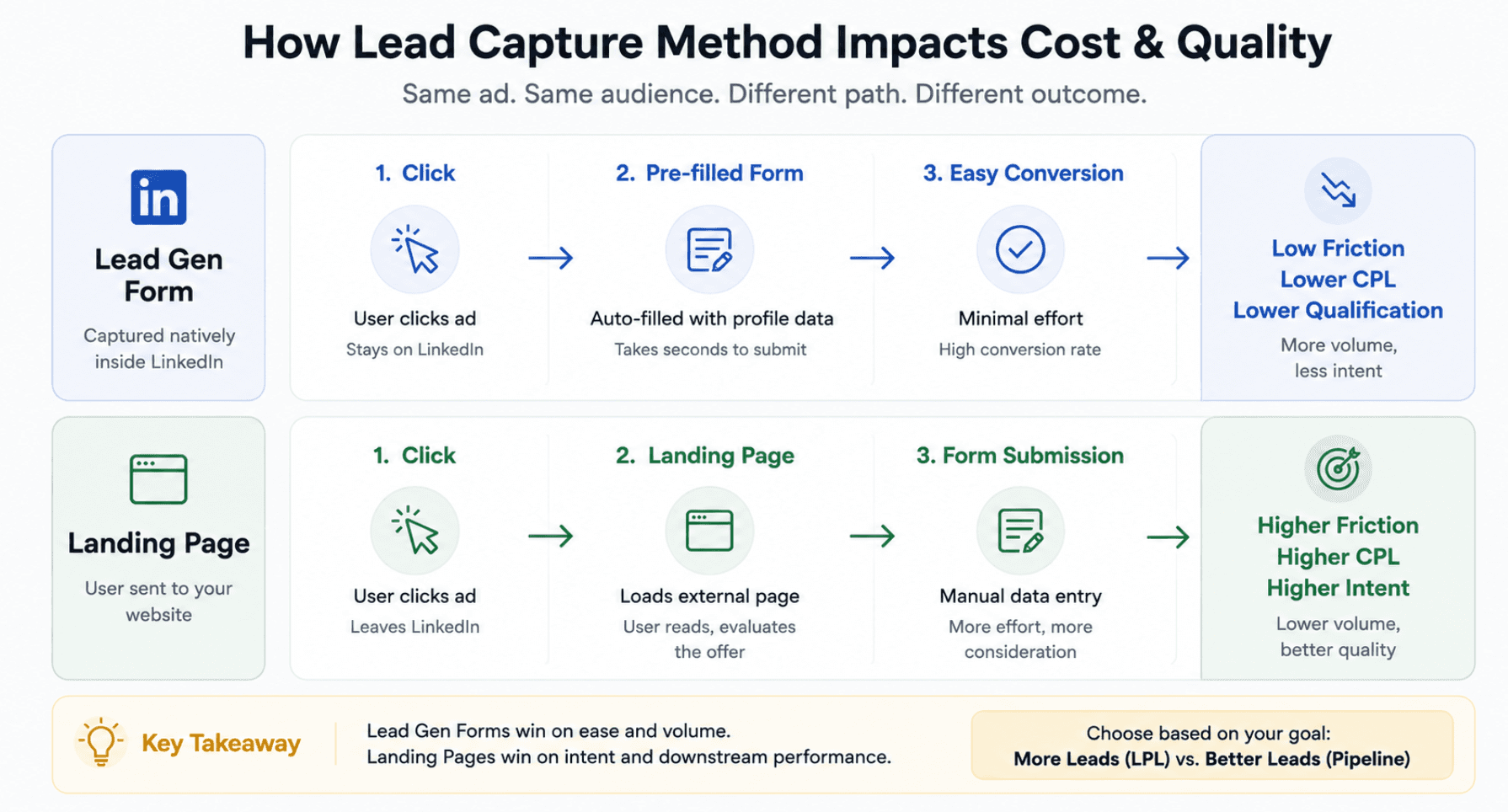
Lead Gen Forms tend to produce lower CPLs because there is very little friction in the process. The user does not leave LinkedIn, their details are pre-filled, and the action takes a few seconds. That simplicity increases volume, but it also means you are not filtering much at the point of capture.
Landing pages work the opposite way. They introduce friction immediately. The user has to leave the platform, wait for the page to load, read enough to understand the context, and then decide to submit a form. That naturally reduces conversion rate, which pushes CPL higher, but it also removes a portion of low-intent clicks that would otherwise enter your CRM.
When you put all of this into practice, you see two very different cost structures:
Lead capture method
Typical CPL
[table]
Lead capture method | Typical CPL | Lead quality
Lead Gen Forms (cold audience) | $50–$100 | Low to mid
Off-platform landing page (cold audience) | $120–$200 | Mid to high
Lead Gen Forms (warm/retargeting) | $30–$70 | Mid
Off-platform landing page (warm audience) | $80–$140 | High
[/table]

For most B2B SaaS companies, the mistake is evaluating these options purely through CPL.
On paper, Lead Gen Forms almost always look better. In reality, they often trade cost efficiency for weaker downstream conversion.
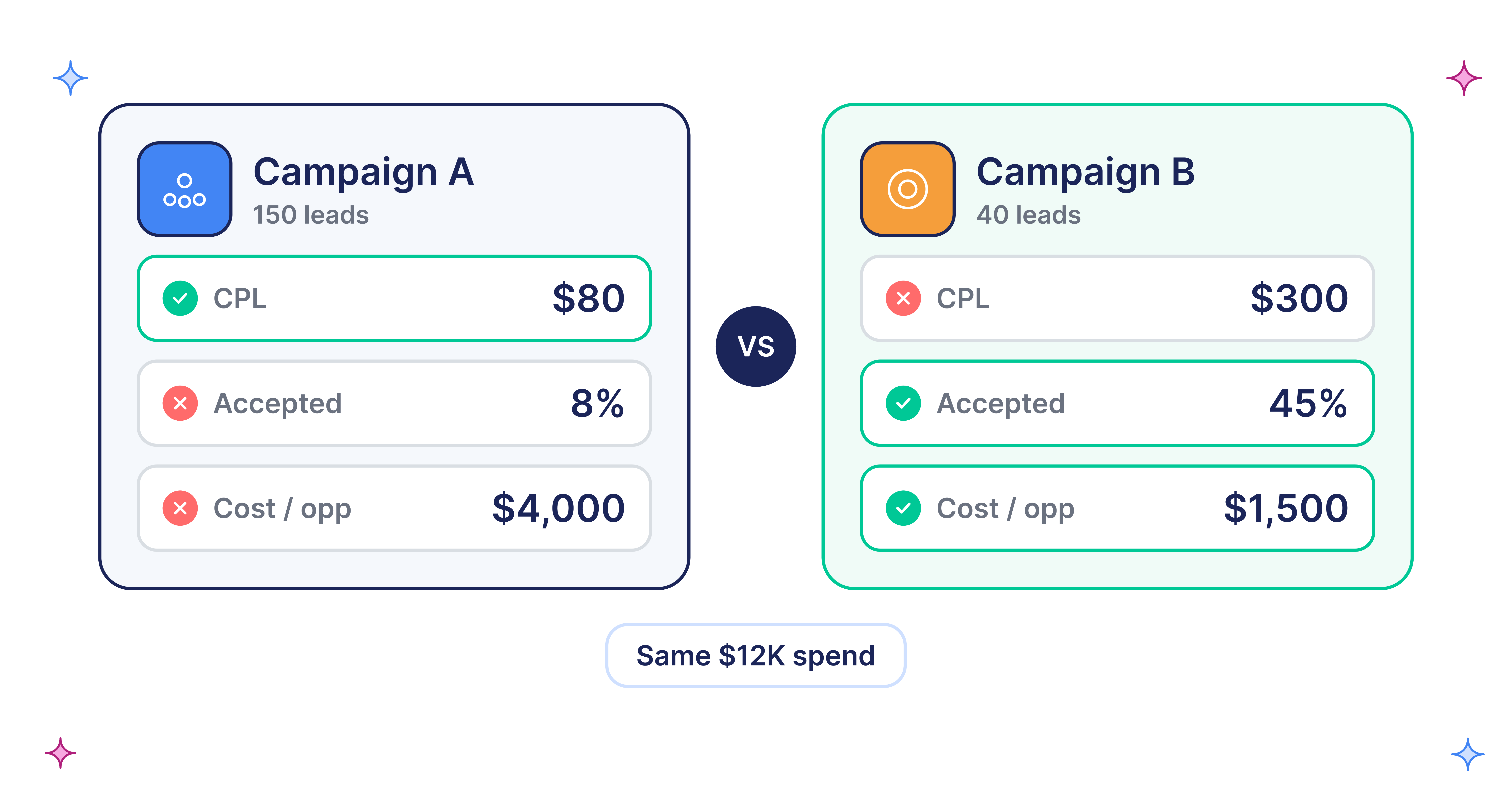
We regularly see cases where a $100 lead from a landing page outperforms a $60 Lead Gen Form lead once it reaches the pipeline, simply because the initial friction filtered for stronger intent.
For example, in Delve’s campaign, the objective was never to minimize CPL. The focus was on capturing the right buyer profile and letting the landing experience do part of the qualification work.
The leads were not the cheapest the platform could produce. But the system contributed to $1.2M in pipeline within 90 days and played a role in closing a $32M Series A.
That gap is the part most teams miss. Cheap leads are easy to optimize for. Qualified pipeline is not.
This is exactly where LinkedIn Ads attribution becomes important, because without it, you end up optimizing toward the lowest CPL instead of the highest downstream value.
What is the LinkedIn Ads Minimum Budget that Actually Works?
LinkedIn's technical minimum daily budget is $10 per campaign, which translates to roughly $300 per month. That's the minimum the platform allows. It's not the minimum that produces results.
The realistic minimum monthly budget for a LinkedIn campaign to actually optimize and produce a meaningful pipeline is $4,000. Below that threshold, the algorithm doesn't generate enough data to learn from, you can't test creative variations meaningfully, and you can't run more than one audience at a time. The campaign exists, but it's not really a campaign. It's a small experiment that won't tell you whether the channel works for your business.
Here's what different budget bands actually produce:
[table]
Monthly LinkedIn budget | What you can actually do
Under $4K | Limited testing, no meaningful optimization, hard to measure
$4K–$10K | One audience, one offer, basic creative rotation
$10K–$25K | Two to three audiences in parallel, creative testing, and real attribution
$25K–$50K | Multi-segment ABM, parallel creative testing, and full demand creation programs
$50K+ | Enterprise demand creation with significant pipeline goals
[/table]
For most growth-stage B2B SaaS companies, the sweet spot sits at $10K to $25K per month. This is enough budget to actually test what works without burning cash on under-optimized campaigns.
ScalixAI's flat-fee management runs $3K to $5K per month for LinkedIn Ads, or $6K to $7K for LinkedIn and Google Ads combined. That's the realistic agency cost on top of ad spend for B2B SaaS companies that want a specialist managing the channel.
Why are LinkedIn Ads So Expensive Compared to Meta and Google?
LinkedIn Ads are expensive because you are not just buying reach or intent. You are buying access to a specific professional layer of the market that does not exist at the same level of granularity anywhere else.
On Meta, targeting is built around behavior and interest signals. You might reach someone who engaged with marketing content, but you are still working with inferred relevance. The platform is optimizing for attention, not job function.
On Google, you are closer to demand, but only when it is explicitly expressed. The issue is that search volume is shared across many types of users. A high-intent keyword does not guarantee that the person behind the search is actually a decision maker, or even in a buying role.
LinkedIn works differently because the starting point is identity, not behavior.
You are not inferring who someone might be. You are selecting based on declared attributes like job title, company, seniority, industry, and company size. That shifts the value of the impression itself, because you are reducing uncertainty before the auction even starts.
The reason this pushes the cost higher is not just the scarcity of users. It is how that scarcity behaves inside the auction.
LinkedIn inventory in senior B2B roles is limited, but demand for those same roles is highly concentrated. You are not competing against random advertisers. You are competing against companies that are often selling into the same exact buyers, with similar ACVs, and similar expansion goals.
So when you target roles like VP Engineering, Head of IT, or Director of RevOps, you are entering auctions where multiple high-budget SaaS companies are willing to pay for the same single profile. That naturally raises the floor price over time.
This is also why comparing LinkedIn Ads directly to Google Ads breaks down quickly.
Google is optimized for capturing demand that already exists in the market. LinkedIn is used to shape demand before it shows up as search behavior. One is closer to conversion, the other is earlier in the decision cycle. They are priced differently because they are performing different roles inside the buying process.
This is also why LinkedIn Ads vs Google Ads isn't really an apples-to-apples comparison. Google captures buyers who already know they want a solution. LinkedIn reaches buyers before they know. Both platforms serve different jobs and have separate pricing and ROI models.
LinkedIn ads benchmarks 2026: CPC, CPM, CTR, CPL
LinkedIn ads benchmarks for B2B SaaS in 2026 sit in the following ranges, based on LinkedIn's published data, third-party benchmark reports, and what we observe running campaigns daily.
[table]
Metric | Standard B2B | High-Value B2B | Top Quartile
CPC | $7–$10 | $10–$15 | Under $7
CPM | $30–$50 | $50–$80 | Under $30
CTR (Sponsored Content) | 0.4–0.6% | 0.5–0.8% | Above 1.0%
CTR (Thought Leader Ads) | 0.8–1.5% | 1.2–2.0% | Above 2.0%
CPL (Lead Gen Forms) | $50–$100 | $80–$150 | Under $50
CPL (off-platform) | $120–$200 | $150–$250 | Under $100
[/table]
The top quartile numbers are achievable but require specific things: tight ICP-level targeting, thought leader ads instead of standard sponsored content, regular creative refresh (every 2 to 3 weeks for cold audiences), and attribution that goes beyond cost per lead. Most accounts don't get there because they're missing one or more of those.
The most important number on this table isn't the average, but the top quartile. That's what's achievable when the campaign is set up correctly. Most LinkedIn campaigns sit at the median because most are set up generically. The gap between median performance and top quartile performance is usually a setup problem, not a budget problem.
How to Lower Your LinkedIn Cost Per Lead
Lowering LinkedIn cost per lead comes down to four specific levers, in order of impact. None of them have anything to do with cutting bids or shrinking the budget. They're about getting more from the budget you're already spending.
- Switch from Sponsored Content to Thought Leader Ads where possible.
This is the highest-impact change available. Thought Leader Ads run from individual profiles and produce CTRs 2 to 3 times higher than standard Sponsored Content. Higher CTR drops your effective CPC, which drops CPL across the board. If you have a founder, executive, or subject matter expert with a credible voice, this format should be the first thing you test.
Click here to explore the impact of different types of LinkedIn ads.
- Tighten targeting until your audience is between 5,000 and 50,000 people.
Audiences larger than 50,000 are usually too broad and waste impressions. Audiences smaller than 5,000 fatigue too quickly and drive up frequency. The sweet spot is tight enough to be qualified, wide enough to scale.
- Refresh creative every 2 to 3 weeks for cold audiences.
Creative fatigue on LinkedIn happens fast because the audience is small. When CTR drops 20 percent from launch, the creative is fatigued. Replace it before performance flattens completely. Accounts that refresh on schedule see 30 to 40 percent better CPL over a quarter than accounts that don't.
- Use off-platform landing pages for high-intent offers.
Lead Gen Forms are cheap per lead but produce a lot of unqualified noise. For demos, free trials, or any offer that should produce real sales conversations, off-platform landing pages produce better quality leads even at higher CPL. The net cost per qualified opportunity is lower.
This is also where working with a specialist matters. The best agencies for LinkedIn Ads consistently produce better CPL because they're doing all four of these things by default. Most in-house teams do one or two and wonder why their numbers don't move.
When Does LinkedIn Ads Pricing Make Sense for B2B SaaS?
LinkedIn Ads pricing makes sense for B2B SaaS when your average contract value is high enough to justify a customer acquisition cost in the thousands of dollars. That usually means an ACV above $15K annually, though it depends on your sales cycle, close rate, and how well you measure pipeline impact.
The math works like this. If your average customer is worth $50K in first-year revenue, you can comfortably spend $5K to acquire them and still have healthy unit economics. At LinkedIn's CPL ranges of $80 to $150 and a 10 to 15 percent lead-to-customer conversion rate, that produces a customer acquisition cost of $800 to $2,000. That's strong economics.
If your average customer is worth $3K, the same math produces a CAC of $800 to $2,000 against a $3K revenue customer, which doesn't work. LinkedIn isn't the wrong channel because it's expensive. It's the wrong channel because your unit economics can't support it.
This is why LinkedIn Ads work brilliantly for mid-market B2B SaaS and enterprise SaaS, and struggle for low-ACV products. It's not a channel quality issue. It's a price-to-value alignment issue.
For B2B SaaS companies where LinkedIn does not work yet, the decision usually comes down to broader B2B SaaS growth strategies, such as product-led growth or organic channels, rather than the channel itself.
The Bottom Line
LinkedIn Ads cost more than every other B2B paid channel, and they should. The channel is selling something the others cannot: direct access to specific buyers at specific companies.
The question is not whether LinkedIn is expensive. It is.
The real question is whether your economics support buying that level of access, and for most growth-stage B2B SaaS companies above $15K ACV, the answer is yes.
When LinkedIn does not perform, it is rarely because the clicks are expensive. It is usually because the wrong people are still getting through the targeting, the ad is not aligned with buying intent, or performance is being evaluated only at lead level instead of pipeline.
Once those fundamentals are fixed, cost stops being the constraint. Signal quality becomes the focus.
If you are already running LinkedIn Ads and the pipeline is not matching spend, that is exactly the gap ScalixAI was built to close.