Is Your LinkedIn Running Thought Leader Ads?
Book your free 20-minute slot with us. We’ll identify if your current LinkedIn spend is missing the engagement and pipeline impact this format can unlock.
Share this Article



Key takeaways
Thought Leader Ads produce CTRs 2 to 3 times higher than Sponsored Content because users trust individual voices more than company pages.
The format works best when the spokesperson has a real point of view, not just a polished corporate message.
Effective cost per qualified lead drops 40 to 60 percent compared to Sponsored Content with the same audience.
Ad budget waste is highest when companies set up Thought Leader Ads without the spokesperson's input.
The format is most powerful when paired with a broader demand creation strategy, not run in isolation as a tactic.
LinkedIn Thought Leader Ads have quietly become one of the most effective demand-creation channels in B2B SaaS.
It’s not like LinkedIn has released some groundbreaking new ad format. Thought Leader Ads work because they align with one basic understanding of marketing: People trust people more than they trust brands.
In 2026, the performance gap between Thought Leader Ads and traditional Sponsored Content is large enough that most B2B SaaS companies should at least be testing them, and many should be building a significant portion of their LinkedIn strategy around them.
What is surprising is the fact that despite the data, a majority of B2B SaaS companies have been hesitant towards trying it out.
And the ones running Thought Leader Ads are using the same strategy they apply to basic company-page posts, only subtly changing the distribution mechanism, which misses the point entirely.
The companies seeing outsized results are approaching the format differently. They're using individual voices to create familiarity before demand exists, build credibility before a sales conversation starts, and stay present in the market without relying on direct-response tactics to do all the heavy lifting.
In other words, they're using Thought Leader Ads as a demand-creation channel rather than just another advertising placement.
This guide breaks down what LinkedIn Thought Leader Ads actually are, how they work, what they cost, why they consistently outperform other types of LinkedIn ads, and how B2B SaaS companies can use them to build a repeatable demand-creation engine that compounds over time.
What are LinkedIn thought leader ads?
LinkedIn Thought Leader Ads are paid promotions of organic posts published from an individual's LinkedIn profile rather than a company page.
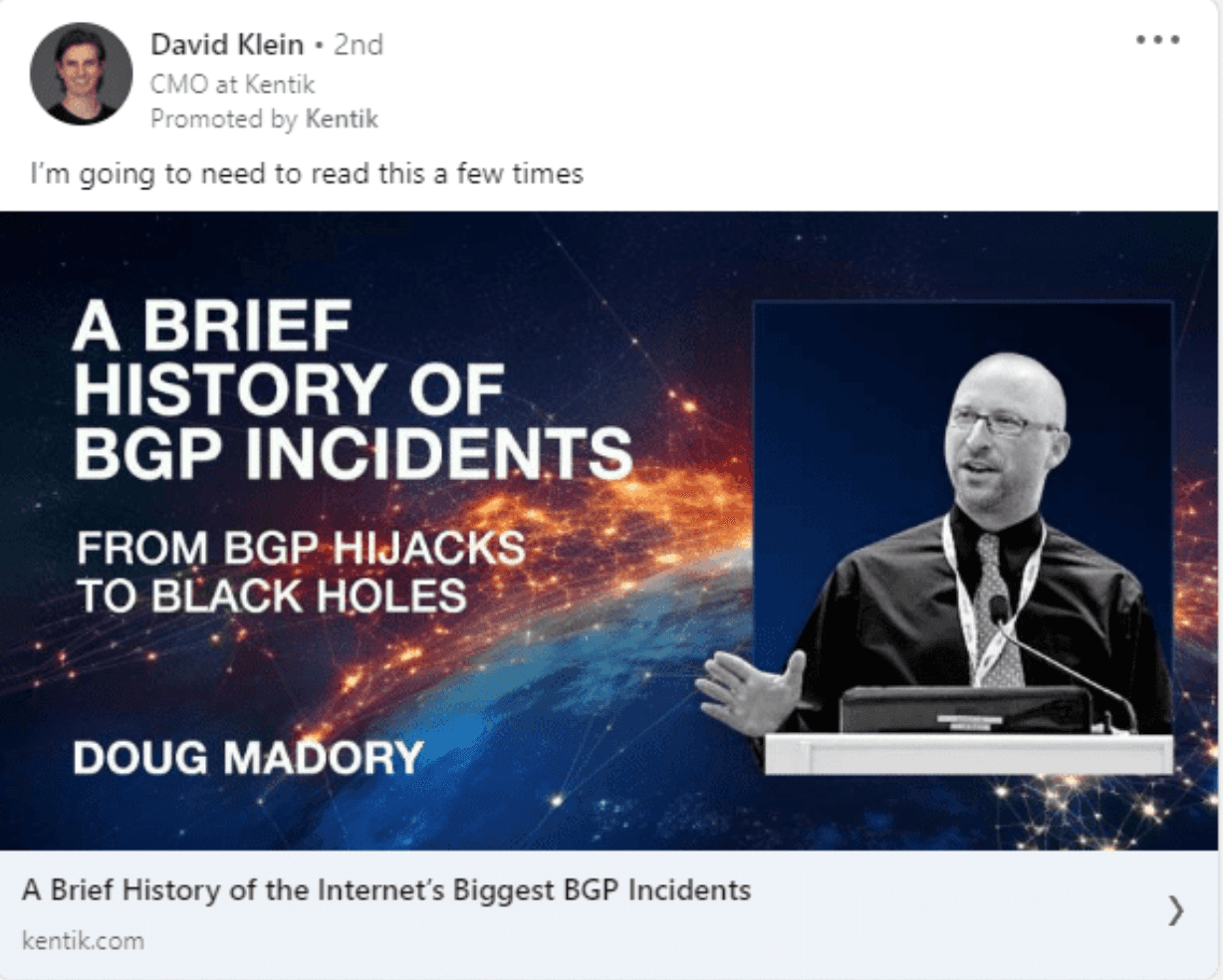
Instead of appearing as yet another company-sponsored post in the feed, Thought Leader Ads put an individual's voice front and center. The ad shows the person's headshot, profile details, and the engagement it has already earned through likes, comments, and reposts.
The format was launched by LinkedIn in 2023 and has steadily grown into the most effective ad type available on the platform for B2B SaaS demand creation. The reason is straightforward. LinkedIn users have become significantly better at recognizing and ignoring ads that look like ads.
Posts from real people, with real faces and real voices, get read. Posts from company pages get scrolled past. When the ad budget is paying to put a message in front of the right audience, the format that doesn't feel like advertising wins.
This is also why Thought Leader Ads work even when the spokesperson has a modest LinkedIn following. The performance lift doesn't depend on the individual being a LinkedIn influencer. It depends on the post looking and feeling native to the platform, which any well-written personal post does by default.
For founders new to the broader channel, the LinkedIn Ads for B2B SaaS guide covers how to think about LinkedIn as a whole before getting into format-level decisions.
How to set up thought leader ads (step by step)
Running Thought Leader Ads involves two parties: the individual whose profile will be featured in the ad and the company funding the campaign. Once the necessary permissions are in place, the setup itself is surprisingly simple.
Step 1: Identify the spokesperson.
The right person for a Thought Leader Ad is typically a founder, executive, or subject matter expert with a credible voice. This doesn't mean they need a massive following. It means they need to write or speak in a way that sounds like a real professional perspective, not corporate marketing copy.
Step 2: Publish the post organically first.
Thought Leader Ads can only promote posts that already exist on the spokesperson's profile. The post needs to be published organically before it can be sponsored. This is important because it means the post needs to be written as a real LinkedIn post, not as ad copy.
Step 3: Request permission inside LinkedIn Campaign Manager.
The company running the ad sends a permission request to the spokesperson through Campaign Manager. The spokesperson receives the request inside LinkedIn and approves it before the post can be promoted.
Step 4: Build the campaign.
In Campaign Manager, the company selects the spokesperson's approved post as the creative, then builds out the audience, budget, and targeting the same way they would for any other LinkedIn ad campaign.
Step 5: Launch and monitor.
Once live, the ad appears in the feeds of targeted audiences as a sponsored version of the original organic post. Engagement, such as likes, comments, and reposts, accrues to the spokesperson's profile, not the company page.
Common Mistakes to Avoid When Writing A Thought Leader Ad Copy
The most common mistake is treating the post as something the marketing team writes and then asks the spokesperson to approve. The post should be written by or with the spokesperson, in their voice, with their actual perspective. Posts that feel ghostwritten lose the format's primary advantage.
How much do LinkedIn thought leader ads cost?
Thought Leader Ads often deliver 2 to 3 times more clicks than standard Sponsored Content. That means the same budget goes further. Let’s expand this further for better understanding.
Instead of paying $10 for every click, you might see the cost of Thought Leader Ads fall closer to $4 to $6 simply because more people are engaging with this ad format. The same effect usually carries through to lead generation, with many campaigns seeing substantially lower costs per qualified lead.
You don't need an enormous budget to make Thought Leader Ads work, but you do need enough budget to give the campaign room to breathe. Around $4,000 per month is usually the practical floor.
For most growth-stage B2B SaaS companies, the sweet spot is between $10,000 and $25,000 per month, where there's enough volume to learn which messages, audiences, and content angles are actually driving results.
When budgets are lower, performance becomes harder to judge because there simply isn't enough data to separate patterns from noise.
For companies that prefer not to manage campaigns in-house, agency fees are part of the equation. At ScalixAI, LinkedIn Ads management falls between $3,000 and $5,000 per month, with higher fees when LinkedIn and Google Ads are managed together. While pricing varies across providers, specialist management is often a meaningful component of the total channel investment.
For deeper context on what budget bands actually produce results, the How Much Do LinkedIn Ads Cost breakdown covers the full pricing picture.
Thought leader ads vs sponsored content
Thought Leader Ads consistently outperform Sponsored Content for B2B SaaS in 2026, but the comparison isn't quite as simple as "use Thought Leader Ads instead." Each format has a specific role, and the strongest LinkedIn programs use both deliberately.
[table]
Metric | Sponsored Content | Thought Leader Ads
Typical CTR (B2B SaaS) | 0.4 to 0.6 percent | 0.8 to 1.5 percent
Cost per click | $7 to $15 | $7 to $15
Effective cost per qualified lead | Higher | 40 to 60 percent lower
Best for | Scale, broad reach | Engagement, demand creation
Limitation | Lower trust signal | Tied to individual availability
[/table]
Sponsored Content scales better because it's not tied to a single individual's voice. A company running a campaign across multiple market segments or geographies can scale Sponsored Content much more easily than Thought Leader Ads, which require a credible spokesperson for each segment.

Thought Leader Ads dominate in engagement and quality. The format's CTR advantage isn't a small lift. It's a fundamental shift in how the audience receives the content, and that shift translates directly to better unit economics across the funnel.

The best LinkedIn programs run both formats in parallel. Thought Leader Ads carry the highest-stakes content and the strongest points of view. Sponsored Content handles scale, retargeting, and any campaign where the message doesn't need to come from a specific individual to land.
Thought leader ad examples for B2B SaaS
The best-performing Thought Leader Ads don't look like ads. They look like posts that teach, challenge assumptions, or share something genuinely interesting.
Across B2B SaaS categories, a handful of content patterns consistently outperform everything else.
[table]
Content Type | Why It Works | Example Angle
Counterintuitive industry takes | Challenges conventional wisdom and creates curiosity. People stop scrolling because the conclusion isn’t what they expected. | "We shut down our top-of-funnel content program and growth accelerated."
Specific tactical breakdowns | Gives readers something concrete they can learn from or apply immediately. Specificity builds credibility. | "How we reduced onboarding time by 37% in 60 days."
Honest failure stories | Feels authentic in a feed full of success stories. Readers relate to mistakes more than polished wins. | "The product launch we spent six months on completely missed the mark."
Contrarian product narratives | Explains why the company chose a different path than everyone else. Educates while naturally introducing the product. | "Why we refused to add AI features to our platform for a year."
Behind-the-scenes operational content | Offers a glimpse into how real teams make decisions, solve problems, and operate. | "The framework we use to decide which product requests get built."
[/table]
What tends to underperform is exactly what you'd expect: feature announcements, product pitches, and broad industry commentary that doesn't really say anything new.
The moment a post feels like a company message dressed up as a personal opinion, engagement drops. People aren't responding to the format itself. They're responding to the perspective behind it.
Delve's campaign with ScalixAI is a strong example of what Thought Leader Ads can do when paired with a real demand generation strategy. The campaign generated $1.2M in attributed pipeline in 90 days and contributed directly to closing their $32M Series A.
The pipeline impact came from a combination of strong creative, sharp targeting, and attribution measured at the company level rather than the lead level.
For the full breakdown of how that attribution model works, LinkedIn ads attribution covers the setup in detail.
4 Best practices for thought leader ads
The best practices that separate Thought Leader Ad campaigns that produce pipeline from ones that don't come down to four things, in order of impact.
- The spokesperson has to genuinely participate
This is the most important best practice and the one most companies get wrong. Posts that are written by the marketing team and posted under an executive's name underperform consistently.
The spokesperson needs to either write the post themselves or work closely with whoever drafts it to shape the voice, the perspective, and the specific takes. Audiences can tell the difference between a real point of view and a ghostwritten one, and the format's primary advantage disappears when the post doesn't sound real.
- Refresh creative on a schedule
Thought Leader Ads fatigue at roughly the same rate as Sponsored Content. When CTR drops 20 to 25 percent from the launch baseline, the creative is fatigued and needs to be replaced.
Most accounts that run Thought Leader Ads successfully refresh creative every 2 to 3 weeks for cold audiences, slightly less often for warm audiences.
- Targeting needs to be tight
The format's CTR advantage compounds when the audience is well-defined. Targeting too broadly waters down the engagement signal and pushes effective cost per qualified lead back up.
The right audience size for most B2B SaaS Thought Leader Ad campaigns is 5,000 to 50,000 people.
- Measure beyond the click
One of the biggest mistakes companies make with Thought Leader Ads is evaluating them the same way they evaluate lead-generation campaigns.
A prospect might see a founder's post five times over two months, start recognizing the company, and only enter the pipeline weeks later through a branded search, a direct visit, or a referral. If you're only looking at form fills attributed to the ad, most of that impact disappears from view.
The better question isn't "How many leads did this ad generate?" It's "Did exposure to these ads increase the likelihood that target accounts entered our pipeline?"
That's why the most useful measurement happens at the account level. Look at which companies were consistently exposed to the campaign, how many of those accounts became opportunities over the following 30 to 90 days, and how that compares with similar accounts that weren't exposed.
Thought Leader Ads are often less about capturing existing demand and more about creating familiarity before demand exists.
Why thought leader ads matter for B2B SaaS specifically
For B2B SaaS companies, Thought Leader Ads aren't just a tactical advantage. They sit at the center of how the channel actually creates demand, and the strategic implications go well beyond the CTR lift.
B2B SaaS buying cycles are long, multi-stakeholder, and trust-driven. A VP of Engineering evaluating a developer tools company doesn't decide to buy because they saw a Sponsored Content ad in week one.
They decide to buy after weeks or months of seeing the company show up across multiple touchpoints, hearing from peers, reading content that resonates with how they think about the problem, and slowly building enough trust to consider a conversation.
Thought Leader Ads are one of the most efficient ways to participate in that trust-building process at scale.
The format also shifts the company's positioning in a way that's hard to replicate through other channels. When a founder or executive becomes a known voice in their category, the company benefits from a positioning advantage that compounds over time. Buyers come to associate the category with the company, which makes every other channel (Google Ads, organic search, partnerships, content) work harder.
Companies running LinkedIn ABM campaigns often pair Thought Leader Ads with their account-based programs to surface relevant content to target accounts in a way that feels native rather than promotional. The combination is one of the strongest plays available in B2B SaaS demand creation.
The LinkedIn vs Google question usually resolves itself once you think in terms of timing rather than channels. Google is where intent shows up. LinkedIn is where it’s shaped. Thought Leader Ads are particularly effective in that earlier stage because they put a point of view in front of people long before they start searching for solutions.
The Bottom Line
LinkedIn Thought Leader Ads are the most effective LinkedIn ad format for B2B SaaS in 2026. Companies should use them as a core part of their full-funnel strategy, rather than treating them as a side experiment.
The CTR advantage is real, the cost per qualified lead advantage is high, and the strategic positioning that comes from building credible individual voices in your category compounds over time in ways no other ad format can match.
The format only fails when companies treat it as a tactic disconnected from a real point of view. Ghostwritten posts, generic corporate messaging, and campaigns built around weak spokespeople will not perform regardless of the budget behind them. The format rewards genuine perspective, not performative thought leadership.
The companies that do this well don’t treat Thought Leader Ads as a standalone channel. They build them into a wider LinkedIn system. That is also where execution starts to matter, and where some teams bring in specialist support like ScalixAI to run LinkedIn Ads programs built specifically around this format rather than treating it like standard paid social.
.gif)