
Key takeaways
The Delve Google Ads case study proves that structure and attribution matter more than budget size.
Competitor keywords like "Drata alternative," "Vanta vs" are the highest-intent clicks most companies underinvest in.
Training Smart Bidding on demo bookings, not form fills, is what changes lead quality.
$1.2M closed-won is traceable because CRM attribution was built before campaigns went live.
An investor-grade pipeline requires attribution data, not just revenue, but proof of where it came from.
When you're approaching a Series A and your pipeline has a gap, you don't need more leads. You need revenue-qualified demos from the exact buyers that make investors confident. That's what Delve needed and that's what we built.
Delve is an AI-native compliance automation platform helping companies achieve SOC 2, HIPAA, ISO 27001, GDPR, and PCI DSS faster than any legacy tool on the market.
They were competing against Drata and Vanta — better-funded, more established, and already owning significant mindshare. The window to show commercial traction before their Series A close was narrow.
We generated $5.59M in Google Ads-attributed pipeline in the first 90 days. Total closed-won revenue hit $1.2M within six months. Delve raised a $32M Series A led by Insight Partners. Here's exactly how we did it.
$1.2M — Closed-Won Revenue $7M — Total Influenced Pipeline $32M — Series A Raised
What Was Delve's Situation Before ScalixAI?
Delve came to us with a real problem inside a real opportunity. The compliance automation market has strong search intent: CISOs, CTOs, and security leads are actively Googling for SOC 2 solutions, HIPAA compliance tools, and Drata alternatives.
So one thing was clear: The demand existed. The issue was that Delve's Google Ads account wasn't built to capture it.
When I audited their Google Ads account, I found what I see in roughly 80% of B2B SaaS accounts at this stage: campaigns structured for activity, not pipeline. There was spend going to broad intent searches that would never produce a qualified demo. Conversion tracking was configured around form fills instead of demo bookings. There was no separation between branded, competitor, and solution-aware campaigns. Basically, the algorithm had been trained on the wrong signal for months, optimizing toward volume that sales had no confidence in.
In a competitive market like compliance SaaS, that structural failure has a compounding cost. Every day the account runs on broken foundations, you're both wasting budget and handing intent-capture opportunities to Drata and Vanta.
The account didn't need optimization. It needed a rebuild.
🔍 Wondering if your Google Ads account has the same gaps Delve had?
Most B2B SaaS accounts we audit have at least three structural problems losing them pipeline. We'll tell you exactly what yours are — free. Book a Free Google Ads Audit →
How Did ScalixAI Build the Google Ads Demand Capture System for Delve?

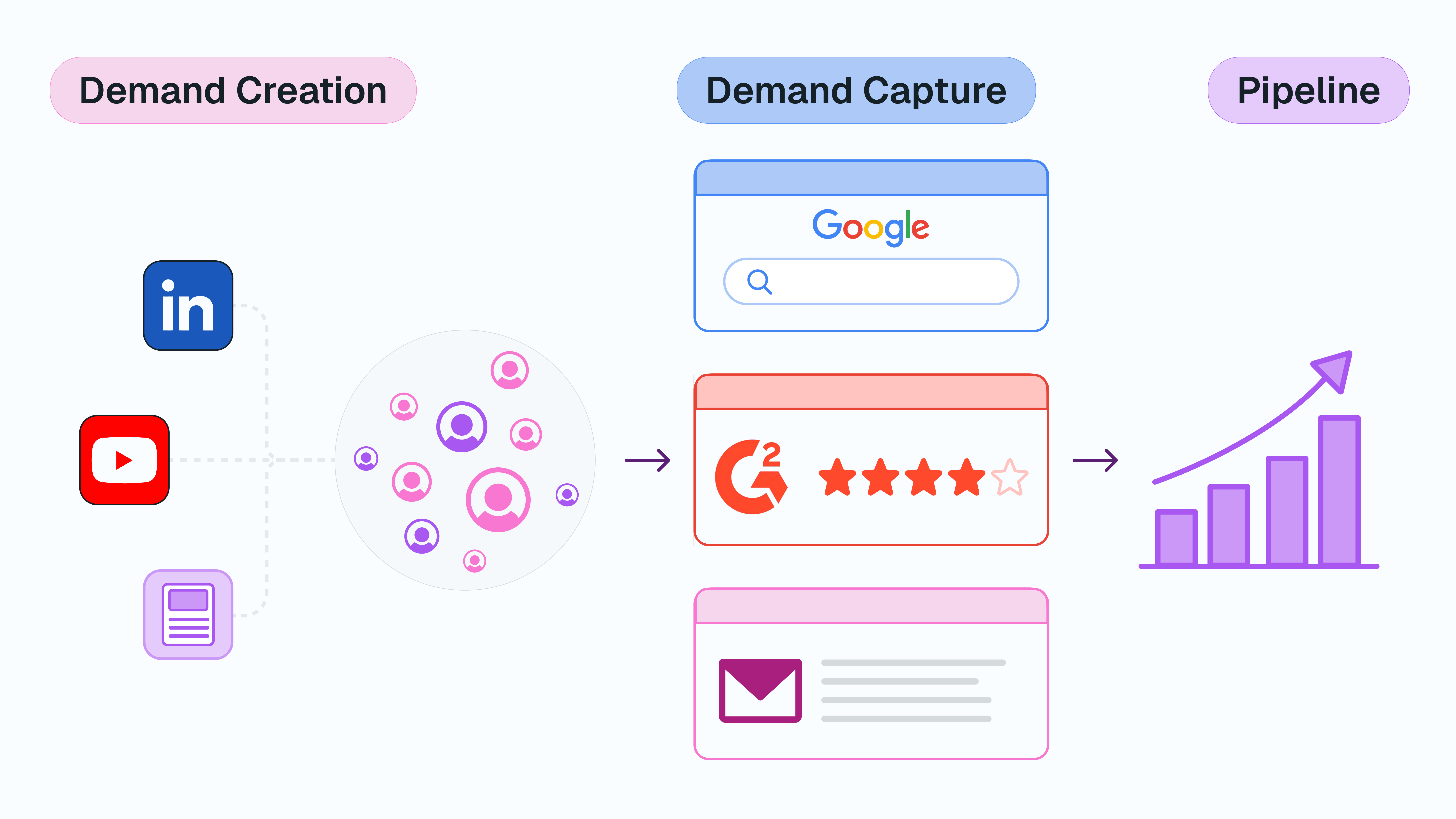
Demand capture is a specific paid media strategy. It means using Google Ads to intercept buyers who are already in-market, converting existing intent into qualified demos, rather than trying to create demand from scratch. Google is the demand capture channel. LinkedIn is where we create demand. For Delve, we ran both, but the Google Ads rebuild was the priority.
Nine years inside Google taught me one thing above all else: the algorithm performs exactly as well as the data you feed it. Fix the inputs. This includes the structure, conversion signals, and intent mapping. As soon as you fix these issues, performance follows. Here's the sequence we ran.
Step 1: ICP-First Keyword Strategy
Delve's ICP isn't every company that needs compliance. It's Series A–C companies with engineering teams, preparing for SOC 2 for the first time or scaling an existing compliance program ahead of enterprise sales. That specificity matters enormously for keyword selection.
We built the keyword architecture around four intent layers:
[table]
Intent Layer | Example Keywords | What It Does
Product keywords | "SOC 2 compliance software," "HIPAA compliance automation," "ISO 27001 tool" | Captures buyers who know what category they're in
Competitor keywords | "Drata alternative," "Vanta vs," "Secureframe pricing" | Intercepts buyers already mid-evaluation and comparing options — the highest-intent clicks in the entire account, and most companies underinvest here
Problem-aware searches | "How to prepare for SOC 2 audit," "automate security compliance" | Captures buyers earlier in the decision cycle when they're still forming a shortlist
Excluded terms | Broad educational queries | Filters out students, job seekers, and researchers who consume content but never book demos
[/table]
This wasn't keyword research by volume. It was keyword selection based on buyer signals.
Step 2: Campaign Architecture
I separated the account into clean intent tiers: branded campaigns, competitor campaigns, solution-aware campaigns, and problem-aware campaigns. Each tier runs with different match types, different bids, and different landing page destinations.
- Branded campaigns protect existing demand efficiently.
- Competitor campaigns run on exact and phrase match. Precision matters here because you're paying to intercept buyers in a specific decision window.
- Solution-aware campaigns use phrase and broad match with tight negative keyword lists to control what surfaces.
Mixing these intent tiers into shared campaigns is one of the most common structural mistakes I see. It makes optimization nearly impossible and inflates apparent performance while hiding where spend is actually working.
The architecture is the part most agencies skip. They build one or two campaigns and call it a structure. Real structure means you can look at any campaign in the account and immediately explain what intent it's capturing, what action it's driving, and how it fits into the pipeline model.
Step 3: Landing Page and Offer Alignment
The conversion mechanism for Delve was a demo booking. Not a contact form or a free trial. A qualified demo with a compliance expert because Delve's buyers are technical decision-makers who respond to depth, not generic SaaS sign-up flows.
Every campaign tier had its own landing page.
Competitor campaign traffic landed on a direct comparison page we created. We framed it like "Delve vs Drata", addressing the evaluation criteria a buyer already has in their head.
Solution-aware traffic landed on a demo page built around the specific framework they searched for. A buyer who searched "SOC 2 compliance tool" landed on a page that led with SOC 2 outcomes, not a generic compliance platform overview.
The message match between keyword intent and landing page content is where most B2B SaaS landing pages lose the conversion. The click happens because the ad was relevant. The bounce happens because the page wasn't.
Step 4: Attribution and Pipeline Tracking
This is the section that separates a real result from a claimed result. Anyone can say Google Ads generated pipeline. The question is whether you can prove it, and whether the proof holds up to the kind of scrutiny an investor applies.
We set up CRM-integrated conversion tracking from day one. Demo bookings fired as primary conversion events inside Google Ads, with the booking data flowing directly into Delve's CRM.
We also imported offline conversions. This way, when a demo converted to an SQL, that signal fed back into the bidding algorithm, training it toward buyers who were actually progressing through the sales cycle, not just filling out forms.
The pipeline number — $5.59M from Google Ads, $1.2M closed-won across both channels — came directly from CRM attribution, not last-click Google Analytics data. We tracked first touch, multi-touch, and closed-won by source. That's how we knew the number was real, and that's how Delve could present it to Insight Partners with confidence.
See how we structure Google Ads attribution for B2B SaaS accounts like Delve →
What Results Did Delve See From Google Ads — and How Fast?
The Google Ads channel generated $5.59M in attributed pipeline with $1.04M in closed-won revenue. Combined with LinkedIn, the total pipeline reached $7M, with $1.2M closed-won within six months of the engagement starting in April 2025.
The first qualified demos came through within the first two weeks of the rebuilt campaigns going live. Pipeline attribution, where we could clearly trace a deal back to a specific Google Ads campaign, was visible within 30 days. By the 90-day mark, the pipeline volume was material enough to be a meaningful data point in Delve's fundraising narrative.
Demo-to-SQL conversion improved significantly once landing page alignment was corrected, and the account stopped sending low-intent traffic to a generic demo form. The shift from optimizing toward form fills to optimizing toward CRM-confirmed demo bookings changed what the algorithm was learning from, and the lead quality reflected that shift within the first learning cycle.
Selin Kocalar, Co-founder and COO of Delve, described it directly: "From day 1, it felt like Waqas had become a part of our team. He knows his craft inside out and has helped us stand up a paid ads engine we have confidence in."
That confidence matters. A pipeline you can't explain to your sales team is just noise.
How Did the Pipeline Results Contribute to Delve's Series A?
Delve raised a $32M Series A led by Insight Partners, with participation from CISOs at Fortune 500 companies. The round closed while ScalixAI's engagement was active.
Investors funding a Series A aren't evaluating whether you can generate leads. They're evaluating whether you have a repeatable, attributable acquisition system; one that gets more efficient as you put more capital into it. $1.2M in clearly attributed closed-won revenue, with the CRM data to back it up, changes the conversation from 'we're growing' to 'we have a system that grows.'
The pipeline data from Google Ads gave Delve's fundraising narrative something specific: a channel producing a qualified enterprise pipeline with measurable CAC and visible conversion velocity. That's the kind of commercial traction that de-risks a growth investment for an investor like Insight Partners.
We didn't raise the Series A. Delve's product and team did that. What ScalixAI did was build the pipeline evidence that made the growth story credible.
Is Google Ads Right for B2B SaaS Companies Like Delve?
Google Ads works for compliance SaaS and for B2B SaaS broadly when three things are true:
- The buyers actively search for the category
- The campaigns are built around buyer intent rather than keyword volume
- The attribution is set up to track pipeline outcomes rather than surface metrics.
Delve's market has strong search intent. CISOs and engineering leads Google for SOC 2 tools, HIPAA automation, and compliance software comparisons. That intent already exists. The only question is whether you're positioned to capture it before Drata, Vanta, or one of thirty other competitors does.
The mistake I see most often in B2B SaaS Google Ads accounts is treating the channel as a lead generation tool optimized for volume. It isn't. It's a demand capture tool optimized for pipeline quality. The structure, the conversion signals, and the landing page experience all have to reflect that. When they do, the channel scales predictably. When they don't, founders conclude that Google Ads doesn't work for B2B, and they're wrong about the conclusion while being right about the symptoms.
The way to know if it will work for your company is to audit what you're currently running.
🚀 See if your Google Ads account has the same gaps Delve had.
Waqas reviews your full account — structure, conversion tracking, intent coverage, landing pages — and tells you exactly what needs to change. Book Your Free Google Ads Audit →