


Before You Sign an Agency Contract.
Get a straight read on whether the pricing makes sense for your stage.
Share this Article



Key takeaways
Google Ads agency pricing models matter more than the dollar amount you pay.
If they can't tell you your CPL and demo-to-SQL rate in 15 minutes, keep looking.
Some agencies earn more when you spend more, not when the pipeline improves.
B2B SaaS search volume is finite, doubling budget produces diminishing returns, not doubled demos.
A specialist flat-fee agency at $5K outperforms a cheap generalist at $1.5K every time.
Most conversations about PPC management pricing start in the wrong place. They compare dollar amounts, show you ranges, and often tell you what's "typical." What they don't tell you is that the pricing model matters more than the number, and in B2B SaaS, the wrong model will cost you more than the fee itself.
I spent nine years inside Google before building ScalixAI. I've reviewed hundreds of B2B SaaS accounts. The pattern I see most often isn't bad campaign work. It's actually the founders who got burned by an agency whose incentives were never aligned with theirs. The pricing model is where that misalignment starts.
This post covers how Google Ads management pricing actually works, what B2B SaaS companies are paying in 2025, and the framework to decide whether any agency, including us, is worth hiring at your current stage.
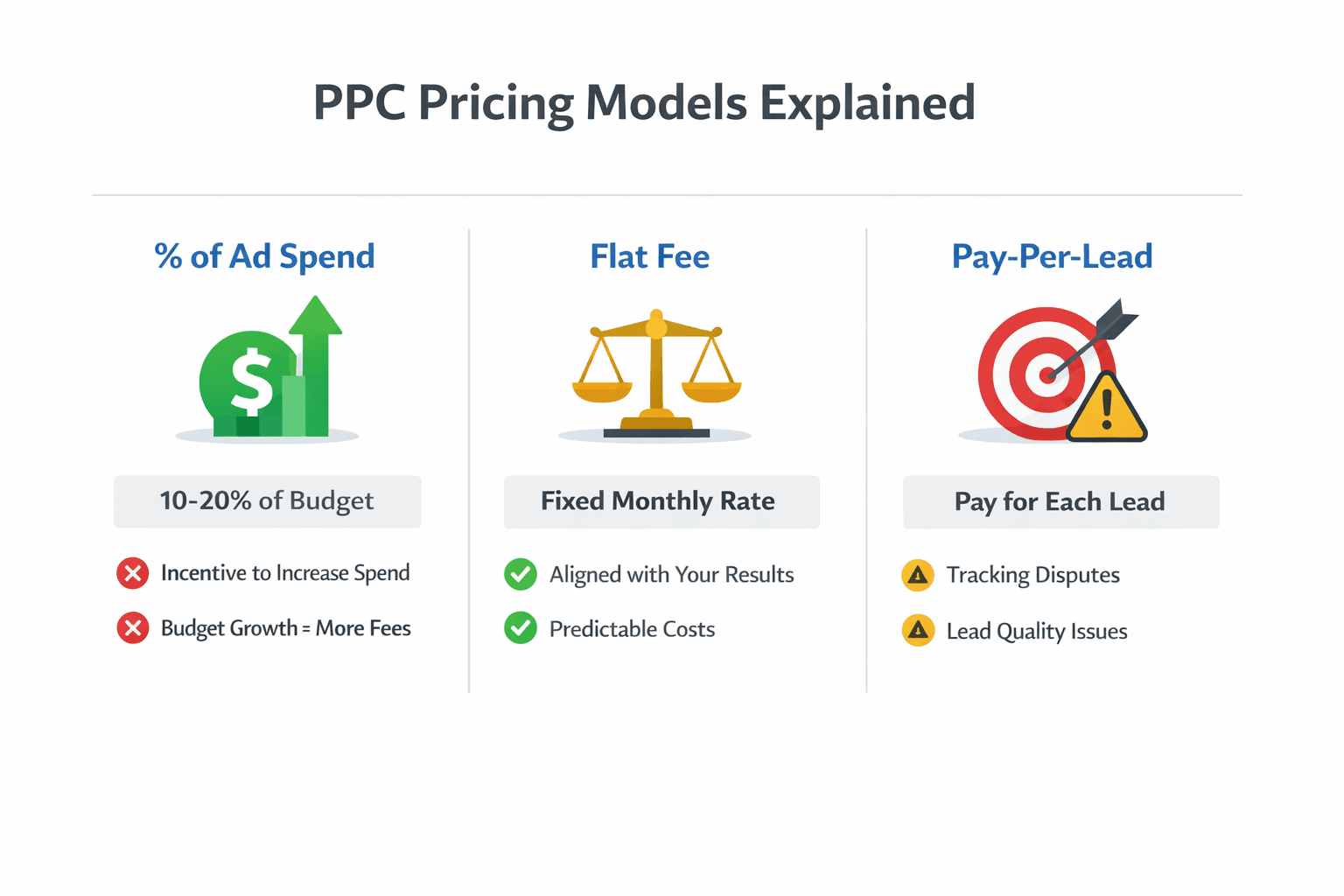
Three Google Ads Agency Pricing Models You'll Find
Every Google Ads agency charges one of three ways. Understanding how each model is structured tells you more about an agency than any credentials page.
- Percentage of Ad Spend
This is the most common model. Agencies typically charge 10–20% of your monthly ad budget. At $10,000/month in spend, that's $1,000–$2,000/month in management fees.
The problem is the incentive structure. When an agency earns a percentage of what you spend, increasing your budget is always in their interest, regardless of whether more spending produces more pipeline.
In e-commerce, this tension is manageable because revenue scales roughly with spend. In B2B SaaS, it doesn't. Search volume for most B2B categories is limited. Doubling your budget for the same audience produces diminishing returns, not doubled demos. An agency on the percentage of spend has no structural reason to tell you that.
- Monthly Retainer / Flat Fee
Flat fee agencies charge a fixed monthly amount regardless of how much you spend on ads. Typical range: $1,500–$8,000/month depending on scope, channel complexity, and the seniority of who's actually in your account.
The incentive alignment is better. We earn the same whether your budget is $5,000 or $50,000. Our interests are tied to your results, not your credit card statement.
The question to verify: who is doing the work? Flat fee agencies can still pass your account to junior operators. Ask specifically whether the person who sold you the engagement is the person managing it day to day.
- Performance-Based / Pay-Per-Lead
This model sounds right for B2B SaaS. In practice, it seldom works.
B2B sales cycles run 60–90 days on average. Clean attribution from a single channel within a calendar month is nearly impossible. Performance-based arrangements typically end in disputes; either the agency games the conversion event to generate more billable leads, or the founder disputes lead quality with no objective way to resolve it. The concept is sound. The execution breaks down on the reality of how B2B SaaS deals actually close.
What B2B SaaS Companies Are Actually Paying in 2026
Here are real market ranges across four tiers. These are the numbers you'll encounter when you actually get on calls.
[table]
Tier | Monthly Fee | What You Get
Freelancer / offshore operator | $500–$1,500 | Fast to hire, low cost. No B2B SaaS context. Campaigns run, reporting is basic, and nobody is thinking about your pipeline.
Generalist agency | $1,500–$4,000 or % of spend | Campaign management, monthly reporting, and some optimisation. No understanding of CAC/LTV ratios or what a qualified demo actually looks like.
B2B specialist/boutique | $4,000–$8,000 flat fee | Senior operator involvement, pipeline-tied reporting, ICP-first targeting logic. This is the tier that produces results in B2B SaaS.
Enterprise / full-service | $10,000+ | Useful at $5M+ ARR with multiple channels and a full growth team. Overkill at Seed or Series A.
[/table]
Find out whether to choose an in-house Google Ads manager vs Agency →
The Percentage of Spend Problem in B2B SaaS
Problem #1: Budget growth does not equal pipeline growth in B2B SaaS.
In e-commerce, spend more, and you typically sell more. In B2B SaaS, your addressable search volume is finite. There are only so many people searching "compliance automation software" or "AI-powered CRM for sales teams" in a given month.
Once you've captured the available intent, more budget produces wasted impressions and declining CPL efficiency, not doubled demos. An agency earning percentage of spend has no structural incentive to tell you that your budget is already at the right level.
Problem #2: It penalises efficiency.
If we cut your wasted spend by 30% and improve your cost per lead by 40%, which is what the best B2B PPC management actually looks like, on a percentage model, our fee just went down. We did better work and got paid less for it. That is not an alignment problem on the margin. It's a fundamental conflict built into the contract.
Problem #3: It scales with the wrong metric.
Your agency should scale its value with your pipeline and your closed revenue. Not with your monthly ad budget. Every time a percentage-of-spend agency encourages you to increase spend before the unit economics justify it, they're making that argument with their own interests ahead of yours. The right model ties our success to your demos, your SQLs, and your CAC trajectory, none of which appear in a percentage-of-spend invoice.
What You Should Actually Get for Your Money
Regardless of which tier you're evaluating, any B2B PPC management engagement should include these five things. If it doesn't, the fee, whatever it may be, is too high.
Weekly reporting tied to pipeline.
Not impressions. Not CTR. You should be getting demos booked, SQL rate, CPL trend, week over week. If you can't see pipeline contribution in the report, the agency is optimizing for Google's metrics, not yours.
Full keyword coverage.
Branded terms, competitor terms, category searches, and intent-expansion keywords. Most B2B SaaS accounts we audit cover 40–60% of available intent. The rest is pipeline that a competitor is capturing instead.
Spy on your competitors using these PPC Competitor Research Tools →
Clean CAC tracking every week.
You should know your acquisition economics at any point in the engagement. Not at the end-of-month review. Every week.
A named senior operator in your account daily.
Not a rotating team. Not an account manager who escalates to a strategist. One person who knows your account, your ICP, and your sales motion, and is in the account regularly, not just at reporting time.
Ongoing ad copy iteration.
Set-and-forget campaigns decay. Ad fatigue is real. A landing page copy that worked in month one needs to be refreshed, tested, and replaced. If nobody is touching your creative after the launch sprint, you're paying for a campaign that's getting slower every week.
One red flag to carry into every agency evaluation: if they can't tell you your CPL and your demo-to-SQL rate in the first 15 minutes of a call, keep looking.
Look at the PAM case study to understand what a structured management actually produces — $72,000 in ad spend generating $234,000 in annual contract value at 3.25x ROAS. That result didn't come from a larger budget. It came from proper account structure, ICP-aligned targeting, and weekly feedback loops between campaign performance and sales outcomes.
Find out what an actual Google Ads Audit covers →
Is a Google Ads Agency Worth It for B2B SaaS?
The honest answer is: it depends on two things. Your ACV and whether you have a working sales motion.
Worth it if:
- Your product category has search intent when buyers are actively Googling for what you do.
- ACV above $5,000, the economics of paid acquisition require deal value to justify CPL.
- At least one AE closing deals: paid media generates pipeline, but pipeline needs someone to close it.
- You have a budget to spend on ads for a minimum of 60–90 days. The learning period for B2B campaigns is real.
Not worth it yet if:
- You're pre-revenue or haven't validated your messaging through any other channel.
- You're running a pure PLG motion with no sales team; leads need a human to close.
- ACV below $3,000. The math on paid acquisition rarely works at this price point.
- You don't have a clear ICP. Campaigns built without a defined buyer profile will generate volume, but no pipeline.
The right agency should ask you about your ACV and your sales motion in the first conversation. If they're not asking, they're not thinking about whether the channel will actually work for your business. That's a red flag before the contract is signed.
FYXER AI is a case study in what happens when the readiness conditions are met. Google Ads now contributes 12% of their total ARR. Over 10,000 customers acquired through the channel. 20x revenue scaled during the engagement. That result was possible because the product had search intent, the sales motion was in place, and the campaign architecture was built to match.
The Bottom Line
Google Ads agency pricing is not a number problem; it is more structural. The model behind the fee matters more than the fee itself because the right model puts the agency on your side.
The percentage of spend doesn't. Flat fee does — when the person charging it is a specialist who understands the B2B SaaS pipeline, not just campaign dashboards.
If your current setup isn't producing predictable demos, the answer is rarely more ad spend. It's usually better structure, cleaner attribution, and an operator whose success is tied to yours.


