

Key takeaways
Landing page copy drives conversions; personalized CTAs alone can improve them by 200%.
Every copy element answers one specific visitor question. Skip any section and watch the drop-off rise.
Features describe the product; outcomes describe the visitor's life. Write the latter, always.
PAS, AIDA, and Before–After–Bridge are proven sequences—frameworks that consistently outperform unstructured copy.
Personalized landing page copy, especially CTAs, can improve conversions by over 200%. Yet most landing pages still use vague headlines, feature-heavy descriptions, and unclear value propositions, failing to connect with visitors.
The difference isn’t design but how effectively your landing page copy communicates value in the first few seconds.
We’ve already covered the broader landing page best practices, from layout to user experience.
This guide focuses on something far more critical: what you actually write on your landing page, and how to structure it to convert.
Let’s explore the frameworks, templates, and real examples behind high-converting landing page copy so you can turn more visitors into customers.
TL;DR
This blog is basically about how to write landing page copy, one that actually gets people to take action, not just read and leave. It focuses on tried and test frameworks, giving you templates you can use to structure your messaging clearly. And it also shows real examples so you understand what good copy looks like in practice.
What Is Landing Page Copy?
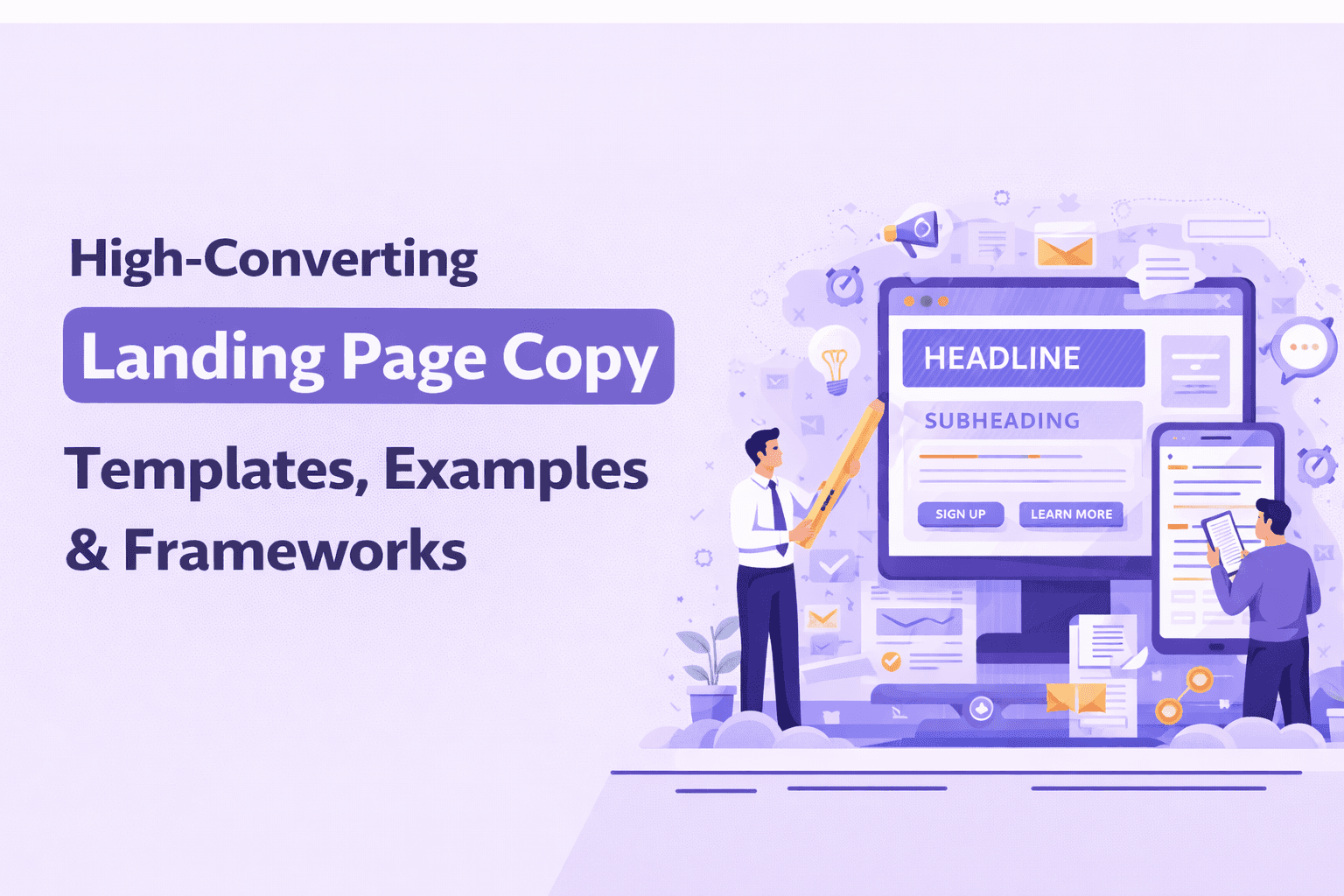
Landing page copy is simply the text on your page that convinces a visitor to take action.
That includes your headline, subheadline, body copy, social proof, and CTA, everything a user reads before deciding whether to stay or leave.
A high-converting landing page copy does four things well.
1. Grab Attention
You literally have seconds to make someone stay. This is why a clear, specific headline is better than anything clever or vague.
2. Communicate Value
The sign of a good landing page copy is that it doesn’t leave you to figure things out. It clearly tells you what the offer is. The value is immediate.
And this matters a lot because top-performing landing pages convert at 10% or higher, while average ones sit around 2–5%. The gap often comes down to how clearly value is communicated.
3. Remove Hesitation
Think about every time you’ve come across a good copy. It has always answered questions you were thinking, but before you could say them out loud, they were already answered. You knew it was for you, and how it would work out for you. Basically, there was no room for you to hesitate or wonder.
Even small shifts, like clearer wording or better positioning, can remove hesitation. In fact, pages with a single, focused CTA convert up to 266% better than those with multiple competing actions.
4. Drive Action
Every line should move the reader closer to a decision. Your CTA is where that happens. But again, it only works if the copy before it has done its job.
The Anatomy of High-Converting Landing Page Copy
The anatomy of a high-converting landing page copy is essentially the structure in which the message is conveyed to the visitor.
Each section answers a question in their mind and moves them one step closer to action.
Here’s how that structure actually works:
1. Headline: Your Value Proposition
This is where most pages win or lose. Your headline should immediately answer the question in the visitor’s mind. They want to know what they are getting and why they should care. That’s it. Don’t try to be clever or unnecessarily creative here. Just be clear.
[table]
Weak Headline | Strong Headline
Grow Your Business Faster | Generate Qualified B2B Leads Without Increasing Ad Spend
[/table]
2. Subheadline: Add Clarity and Context
The heading was there to grab the attention; if it lands, you have crossed one hurdle. Now comes the subheadline, which explains your proposition in detail.
After answering what and why in the heading, you will counter the how in the subheadline.
This is the stage where you remove ambiguity and make your proposition more believable.
[table]
Weak Subheadline | Strong Subheadline
An innovative solution designed to help businesses grow and scale efficiently. | Turn website visitors into qualified leads with AI-driven targeting and real-time personalization.
[/table]
3. Hero Copy: Focus on Outcomes
This is where you expand slightly. But the trick is to stay focused on outcomes, not features.
Get into the psychology of the visitor who has landed on your page. They don’t care about what your product does. They care about what it does for them.
[table]
Feature-heavy | Outcome-focused
Our platform uses advanced automation and machine learning. | Spend less time chasing leads and more time closing deals.
[/table]
4. Benefits Section: Show the Transformation
Taking the previous point further, shift your focus from explaining to proving impact. Instead of listing features, explain to them how their business/life can transform using that product.
[table]
Feature | Benefit
Real-time analytics dashboard. | Know exactly which campaigns are driving revenue without digging through data.
[/table]
5. Objection Handling: Remove Doubt Before It Shows Up
Most visitors won’t tell you what’s holding them back, but your copy should anticipate it. Common objections that your visitor might raise:
- Is it really worth the cost?
How is it different from the tool I am already using? - Is it complex and hard to set up?
You can remove these objections quite easily, honestly. For example: “No complex setup. Get started in under 10 minutes.” And, let me confirm, this is exactly where conversions happen.
6. Social Proof: Reinforce Trust
If the visitor has come this far, they are already interested in your product, but they are still being a little cautious. This is where you give them social proof as reassurance.
Use testimonials, customer logos, and specific results. It matters because 93% of consumers read online reviews before buying, which makes this section one of the highest-impact parts of your page.
7. CTA Copy: Trigger Action
This is where everything comes together. A good CTA should feel like the next logical step. Be sure not to be generic. Instead, be specific, action-oriented, and result-driven.
[table]
Generic | Strong CTA
Submit | Book Your Free SEO Audit Today
[/table]
Here’s the most important part. Not all landing pages use this structure in the same way. For example:
- A lead capture page simplifies this flow. This means it has fewer sections and more focus on a single action.
- A referral page leans more on trust and incentives, so the messaging shifts accordingly.
But remember that the core idea stays the same: Your landing page copy should have a clear message, it should reduce friction, and direct visitors to the obvious next step.
5 Proven Landing Page Copy Frameworks
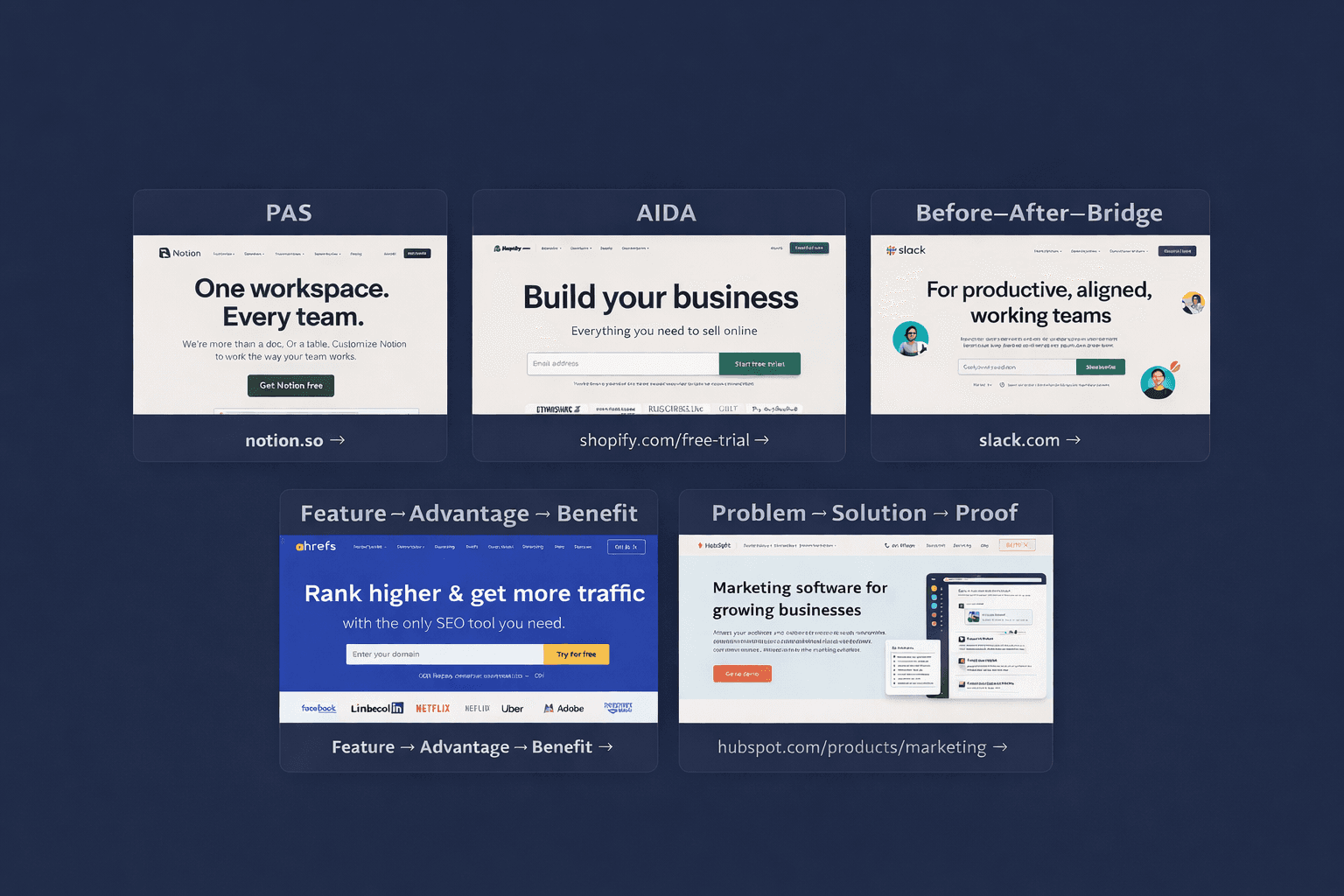
You don’t need to get creative every time you write landing page copy. All you really need is a structure that works.
Look at the following frameworks. They exist because they’ve been tested across thousands of pages. You can use them as a starting point, but make sure that you then adapt your tone and voice based on your audience.
1. PAS (Problem → Agitate → Solution)
If you follow this framework, you will start with the problem, make it feel urgent, and then present your solution.
You can use this framework when your product solves a common frustration and is a solution to a pain point.
Here’s an example.
- Problem: Struggling to get qualified leads?
- Agitate: You’re spending on ads, but most leads never convert.
- Solution: Get high-intent prospects delivered directly to your pipeline.
2. AIDA (Attention → Interest → Desire → Action)
This is a step-by-step flow that moves users from awareness to action. It works best when dealing with cold traffic or writing a landing page copy for new or complex products.
Here’s an example.
- Attention: Turn website traffic into revenue
- Interest: Identify high-intent visitors in real time
- Desire: Close more deals without increasing spend
- Action: Book a demo!
3. Before–After–Bridge
This framework is ideal when you want to show the current state, the better future, then connect the two. You should ideally use it when handling products about transformation. Let’s say, you want to portray the impact of your product and draw comparison from before to after. That’s exactly when this format works best.
Here’s a clear example for you.
- Before: Manually chasing leads and wasting time
- After: A steady flow of qualified prospects ready to convert
- Bridge: Our platform identifies and engages high-intent users for you
4. Feature → Advantage → Benefit
This format is simply involves turning product features into real outcomes. It’s best to use when you have feature-heavy products. In fact, it is ideal for B2B SaaS industries with technical tools and complex narratives to build.
Here’s an example of how you can do this. Feature: AI-powered lead scoring
- Advantage: Identifies the most valuable prospects
- Benefit: Focus your time on leads that are more likely to convert
5. Problem → Solution → Proof
This is a framework where you first state the problem, then present your solution, and then back it up with evidence. You should use it when you know your audience is a bit skeptical or when working in competitive markets.
Look at this example:
- Problem: Most landing pages fail to convert
- Solution: Use proven copy frameworks that guide user decisions
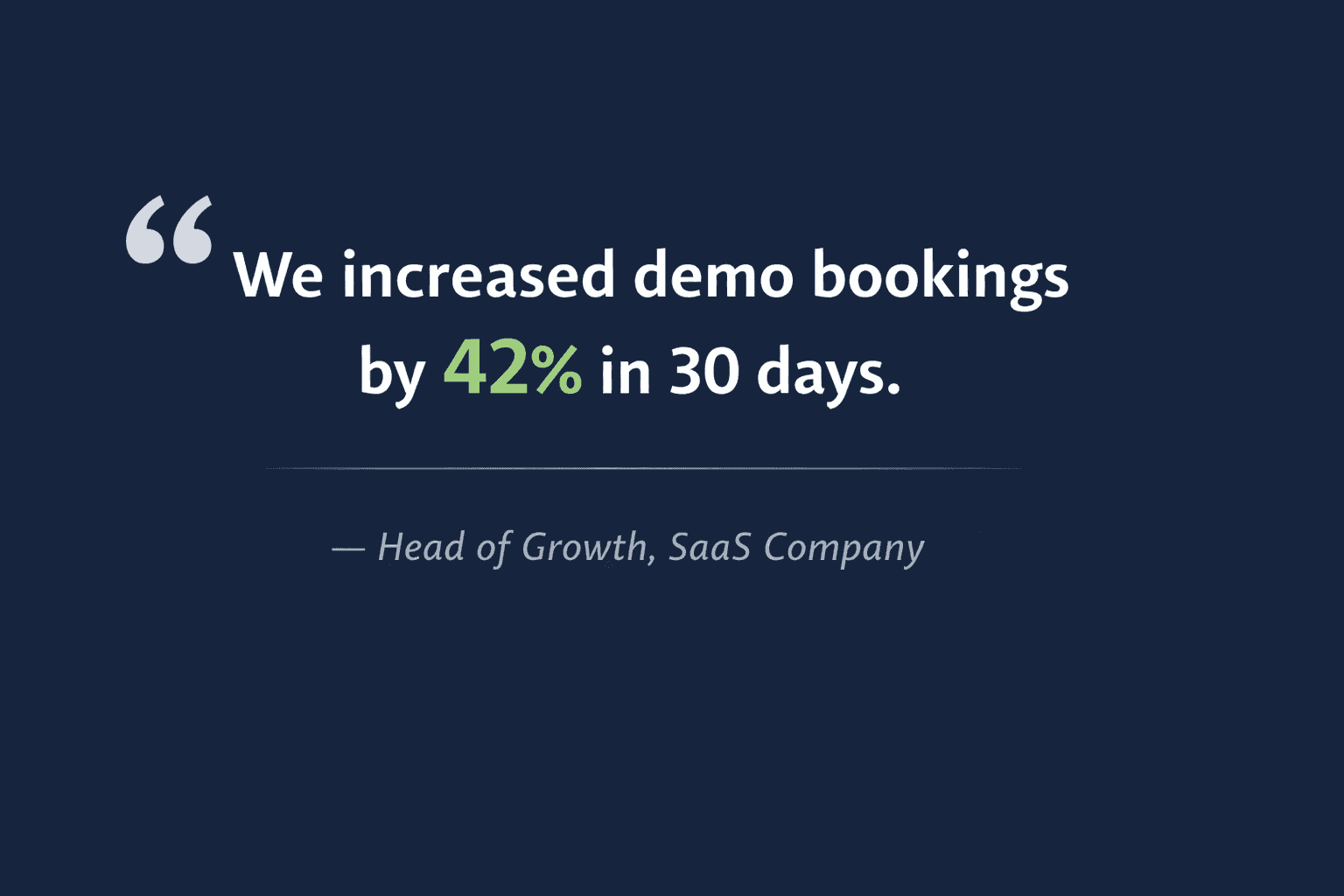
- Proof: “We increased conversions by 42% in 30 days.”
Landing Page Copy Templates You Can Use (Just Copy & Paste!)
Here are some ready-to-copy landing page copy templates that you can use as a starting point.
- Section: Headline
[table]
Template | Example
Get [desired outcome] without [pain point] | Get qualified B2B leads without wasting budget on low-intent clicks
Turn [current state] into [desired state] | Turn anonymous website visitors into revenue-ready pipeline
[Achieve result] in [timeframe] without [effort] | Book more demos in 30 days without hiring a bigger sales team
Finally, a way to [solve problem] | Finally, a way to track and convert your highest-intent visitors
Stop [pain point] and start [desired outcome] | Stop chasing cold leads and start closing high-intent buyers
[/table]
- Section: Subheadline
[table]
Template | Example
A [type of product] that helps [audience] achieve [result] | An AI platform that helps B2B teams identify and convert high-intent buyers
Built for [audience] who want to [goal] | Built for growth teams who want more pipeline without increasing ad spend
[Primary benefit], powered by [mechanism] | Higher conversion rates, powered by real-time intent data
The easiest way to [achieve result] | The easiest way to turn website traffic into qualified leads
[/table]
- Section: Hero Section
[table]
Template | Example
Headline + subheadline + CTA | Turn website visitors into pipeline. An AI platform that identifies high-intent users in real time. Get your demo!
Outcome + proof + action | Generate better leads, not just more leads. Trusted by 200+ B2B teams. Start free trial!
[/table]
- Section: Benefit Bullets
[table]
Template | Example
Eliminate [pain] so you can [outcome] | Eliminate guesswork so you can focus on high-value leads
Get [feature] without [downside] | Get real-time insights without digging through dashboards
Know exactly [what/when/how] | Know exactly which visitors are ready to convert
Spend less time on [task], more time on [result] | Spend less time qualifying leads, more time closing deals
[/table]
- Section: Objection Handling
[table]
Template | Example
No [common concern] required | No complex setup required
Works even if [doubt] | Works even if you have low website traffic
Get started in [timeframe] | Get started in under 10 minutes
No need to [painful alternative] | No need to rely on manual lead qualification
Cancel anytime / no commitment | Try it risk-free — cancel anytime
[/table]
2 Real Examples of High-Converting Landing Page Copy
Let’s decode 2 popular landing page copy examples.
Example 1: Basecamp

It works because it starts with a pain the user already feels and uses natural language, sounding exactly like how people think. And guess what? It uses the PAS framework which we just discussed.
Problem: Wrestling with projects
Agitate: “It doesn’t have to be this hard”
Solution: Basecamp simplifies it
Example 2: Netflix

It works because it gives you clear value proposition with absolutely no fluff or explanation required. It the best part is that it covers the entire product in one line. Basically, you instantly understand the offer. It follows the Feature, advantage, and benefit framework.
- Feature: movies & shows
- Advantage: unlimited access
- Benefit: endless entertainment
Common Landing Page Copy Mistakes
You don’t have much time to get your message across. This means, you don’t have any time to create confusion. Even one second of hesitation will cost you a lot. We’ve listed some of the common landing page copy mistakes below so that you don’t kill your conversations.
- Using vague headlines: Lines like “We help you grow” don’t give the reader anything concrete. If your headline could apply to any company or product, it won’t convert.
- Writing feature-heavy copy: Listing features without explaining the outcome forces the reader to do the work.
- Having a weak value proposition: If someone can’t quickly understand what you offer and why it matters, they won’t stay long enough to care.
- Trying to say too many things at once: When your copy pushes multiple messages, it creates confusion instead of clarity. Control your urge to tell them everything about your product all at once. This can quickly overwhelm them, compelling them to leave.
- Ignoring objections: If your page doesn’t address concerns like effort, cost, or fit, users hesitate. This happens even when they’re interested. Don’t assume that they’ll know, address it.
A Quick Landing Page Copy Checklist
Here is a quick landing page copy checklist that you can add to your SEO and Content Assets. Ideally, you should keep it as an SOP for your team of copywriters to use and follow.
[table]
Check | What to Look For
Value clarity | Can a visitor understand what you offer and why it matters within 5 seconds?
Headline specificity | Does your headline communicate a clear, concrete outcome instead of a vague promise?
Outcome-driven benefits | Are you focusing on what the user gets, not just what your product does?
Objection handling | Does your copy address common concerns like cost, effort, or fit?
CTA alignment | Does your CTA match the user's intent and feel like the natural next step?
[/table]
The Bottom Line
A good landing page copy turns clicks into conversions.
And when you’re running Google Ads, it becomes even more critical because every click costs money, and unclear messaging means wasted spend.
That’s where the right strategy makes the difference. At Scalix AI, we focus on aligning ad intent with high-converting landing page copy, making sure every visitor is met with the right message at the right time.
As a Google Ads management service, we help brands not just drive traffic, but convert it into real pipeline and revenue.