Curious what your competitors are running in your auction right now?
Share this Article



Key takeaways
Bidding on competitor keywords works because the searcher is already solution-aware, not because it's aggressive.
Higher CPCs on competitor terms are offset by conversion rates that often run 2-3x category traffic.
Never send competitor traffic to your homepage. Purpose-built comparison pages exist for a reason.
Ad copy that mentions the competitor by name violates Google policy and gets your ads paused within hours.
Not every competitor deserves a campaign. Bidding on the wrong ones burns budget with nothing to show for it.
Bidding on competitor keywords is one of the highest-converting plays available in B2B SaaS Google Ads, but it's also one of the easiest strategies to get wrong.
There’s a common trend in the industry where most B2B SaaS companies either don’t run competitor campaigns at all, thinking it is too aggressive, or when they do, they execute it so poorly that they end up directing the traffic to their homepage with generic ad copy. Then they wonder why the numbers look so poor compared to category search.
Honestly, neither approach is effective.
I’ve done this for hundreds of B2B SaaS accounts. If you do it right, you will find competitor keywords to be some of the highest-intent traffic in your entire account. But if you do it wrong, you will burn cash faster than any other campaign type.
Let me tell you how I run them.
Quick overview
What you'll learn in this blog:
- Why competitor keywords convert better than category keywords and how you can identify competitors worth bidding on.
- The exact ad copy framework I use for competitor conquest campaigns.
- Why homepages destroy competitor campaign performance and where to send traffic to instead.
- How you can structure a competitor conquest campaign that doesn't get flagged by Google.
Why does bidding on competitor keywords work for B2B SaaS?
Because someone searching for a competitor by name is in-market right now. They know they have a problem. They know a solution exists. They know at least one vendor that solves it. That's the highest-intent audience you can reach on Google outside of your own branded search.
The searcher hasn't decided yet. That's the opening. They're evaluating, comparing, doing due diligence. If your ad shows up in that moment with a message that acknowledges the comparison and gives them a real reason to consider you, you have a genuine shot at moving them into your funnel instead of your competitor's.
Category keywords reach buyers earlier in the process, when they're still figuring out what they need. Competitor keywords catch them when they've already narrowed the shortlist. That's why the conversion math often works better on competitor traffic even when CPCs are higher.
If you're still working out your broader Google Ads structure before adding competitor campaigns, my B2B Google Ads strategy breakdown covers the full architecture.
Are competitor keywords more expensive than category keywords?
Yes, and it's not close. Expect CPCs 1.5-3x higher than category terms in most B2B SaaS verticals. That's the cost of showing up in an auction where your competitor has every incentive to protect their traffic.
Higher CPC still makes sense because conversion rates on competitor campaigns often run 2-3x higher than category traffic when the ad copy and landing page are dialed in. The searcher already knows they need what you sell. They're not being educated. They're being persuaded.
The math works if you calculate cost per SQL or cost per opportunity, not cost per click. A $25 competitor click that converts at 8% into qualified pipeline beats a $10 category click that converts at 2%, every single time. Most companies never do that math because they stop at CPC and CPA. That's the exact mistake the top Google Ads agencies in the US don't make.
Which competitors should you bid on?
Not all of your competitors are worth bidding on. And this is a tricky line because you can easily burn your ad budget by picking the wrong competitor. Here are three specific things that make a competitor worth targeting.
- They have real search volume. If nobody searches their brand name, there's nothing to bid on. Use Google Keyword Planner, SEMrush, or Ahrefs to check monthly search volume on their brand terms. Under 500 searches a month usually isn't worth building a campaign around.
- They serve your ICP. Bidding on a competitor whose product is for a completely different buyer wastes clicks on people who will never buy from you. If they sell to Fortune 500 enterprises and you sell to Series A startups, their traffic won't convert for you no matter how good your ad copy is.
- You have a real differentiator to lead with. If your product is functionally identical to theirs at the same price point, competitor conquest campaigns fail. The landing page has to answer one question: why switch? If you can't answer that in one sentence, don't run the campaign.
The competitors worth bidding on are usually the ones your sales team hears about in every deal. My advice is to keep your ears open during demo calls. If your prospects are mentioning certain competitors, they are worth targeting in ads.
What does effective competitor ad copy look like?
Direct. Specific. And it never uses the competitor's brand name.
Using a competitor's brand name in ad copy violates Google's trademark policy and gets your ads paused within hours, sometimes minutes. Even if you own the trademark, using their name in the copy triggers the same enforcement. This trips up most companies running competitor campaigns for the first time.
What works instead is copy that speaks directly to the searcher when they are literally evaluating options. My RSA framework has seven angles, and for competitor campaigns three of them matter most:
- Comparison-aware.
“Looking for a better X?” and “Evaluating Y alternatives?” are good examples. The word "alternative" or "better" acknowledges the comparison without naming the competitor.
- Differentiator-led.
Lead with the specific thing you do that they don't. "SOC 2 compliance in 30 days" or "AI receptionist that books appointments, not just answers calls" are feature-specific and outcome-focused.
- Social proof.
Use specific customer names, results, and numbers. "Trusted by 500+ B2B SaaS companies" is better than "trusted by industry leaders" because it is specific. It makes your prospect feel seen.
You need at least 15 headlines and 4 descriptions per ad group. I test these three against each other heavily before locking in the winners. If you want the full RSA framework I use across every account, it's in the playbook at the end of this post.
Where should competitor traffic land? (Never the homepage)
This is the single biggest mistake companies make with competitor conquest. Sending competitor traffic to your homepage is malpractice. The searcher clicked because they wanted to see how you compare. The homepage tells them what you do. It doesn't answer the question they came to ask.
You need a purpose-built comparison page. Not a generic "why choose us" page. My trick? I follow this checklist:
- Name the category comparison in the headline (without naming the competitor)
- Show a direct feature-by-feature comparison
- Highlight the two or three differentiators that matter most to your ICP
- Include social proof from customers who switched
- Place a single CTA, one that matches the search intent (demo, trial, or comparison download)
The comparison page is doing the work of a sales conversation. If it doesn't answer "why switch?" in the first screen, the visitor bounces, and you've paid for a click that produced nothing.
The best B2B SaaS growth strategies I've seen all treat comparison pages as first-class landing pages, not afterthoughts. They're built with the same rigor as the homepage and updated when competitors change positioning.
How should you structure a competitor conquest campaign?
Every competitor gets its own campaign. Not its own ad group. Its own campaign. Here's why: each competitor's audience behaves differently, converts at different rates, and needs different ad copy. Mixing them into one campaign kills your ability to optimize.
The structure I use on every account:
Campaign level.
One campaign per competitor. Own budget. Own bidding strategy. Own conversion goals.
Ad group level.
Two to three tight ad groups inside each campaign.
- One for the competitor's brand terms directly.
- One for "[competitor] alternatives" and "[competitor] vs" style modifiers.
- One for "[competitor] pricing" or "[competitor] reviews" if the volume justifies it.
Match types.
Exact and phrase match only. Broad match on competitor terms wastes budget on irrelevant queries. If someone searches "salesforce customer service reviews" and your product is a Salesforce alternative for HR, broad match will trigger your ad, and it won't convert.
Negative keywords.
Aggressive. Cross-reference negatives across your Brand, Non-Brand, and Competitor campaigns so budget flows to the right place every time.
Landing pages.
Purpose-built comparison pages per competitor. Not one generic page for all competitors. Each competitor deserves its own page with its own comparison.
What role does competitor intelligence play in getting this right?
Bigger than most companies realize. You are honestly just guessing if you are running competitor campaigns without knowing what your competitors are doing. I use SpyFu, Ahrefs, Auction Insights, the Google Ads Transparency Center, and other PPC spy tools on every account to see exactly what competitors are bidding on, what their ad copy looks like, what their landing pages look like, and where their impression share sits.
Four things I check every month:
- Ad copy gaps. What angles are they leading with? Where's the whitespace they're not addressing?
- Impression share threats. A competitor at 60%+ impression share on your brand terms is stealing your traffic. That’s an emergency. Address it immediately instead of treating it as a data point.
- Landing page intel. Every competitor page gets audited. Offer, social proof, CTA, positioning. If they change something, I want to know. Explore landing page best practices to learn more.
- Conquest opportunities. Which of their terms are worth attacking, and with what specific claims?
These 4 steps aren’t optional. Skip them and watch your pipeline dry up.
What does this look like when it works?
Fyxer came to ScalixAI in early 2025 with fragmented Google Ads campaigns and inconsistent performance. Their competitor landscape was crowded with well-funded incumbents, and their previous agency had been running a mess of poorly structured Search and PMax campaigns that produced very little.
I rebuilt the account from the ground up. Part of that rebuild was structured competitor conquest campaigns targeting the incumbents Fyxer was displacing, with purpose-built comparison landing pages and RSA copy that led with their specific differentiators.
The result across the full engagement: Google Ads scaled to 12% of Fyxer's total ARR, 10,000+ new customers acquired through Google, and 20x revenue growth during the partnership. Six-figure monthly ad spend across the US, UK, Australia, and Canada.
Competitor conquest wasn't the whole story, but it was a meaningful part of it. High-intent traffic from competitor auctions, sent to comparison pages built to answer "why switch?", converted at multiples of category traffic. That's the compounding effect competitor campaigns unlock when they're done correctly.
How do you know when to pause a competitor campaign?
Three signals. If I discover any one of them, I investigate. And I immediately pause the minute I find two.
- Conversion rate collapses below category baseline.
If your competitor campaign converts worse than your category campaigns, something's broken. Usually it's the landing page. Sometimes it's the ad copy. Sometimes the competitor updated their product, and your differentiators are no longer differentiators.
- Cost per SQL exceeds category cost per SQL for 30+ days.
Higher CPCs on competitor terms are fine if they translate to qualified pipeline at reasonable cost. If they don't, the audience isn't converting, and the campaign is losing money.
- Impression share drops without a clear reason.
If your impressions collapse and you didn't change bids or budgets, either the competitor bid up hard, or your Quality Score dropped. Both need investigation before you scale spend.
I never let a competitor campaign run underperforming for more than 30 days without intervention. It must compound, or we change strategy.
Does bidding on competitor keywords hurt your relationship with them?
Sometimes. Usually not. Every well-funded B2B SaaS company runs competitor campaigns. It's a standard part of the playbook, and everyone knows it. The ones that get emotional about it are the exception.
The only time to reconsider is if and when partnership discussions are open or a referral program is in talks. And obviously, you don’t want to bid against any company you are actively trying to work with. This is not how you get their attention.
In all of these cases, either pause the campaign temporarily or use exclusion audiences to avoid triggering on their employees.
Otherwise, this is just how the game is played. If they're not bidding on you already, they will be soon.
The $1M Google Ads Playbook: B2B SaaS Edition
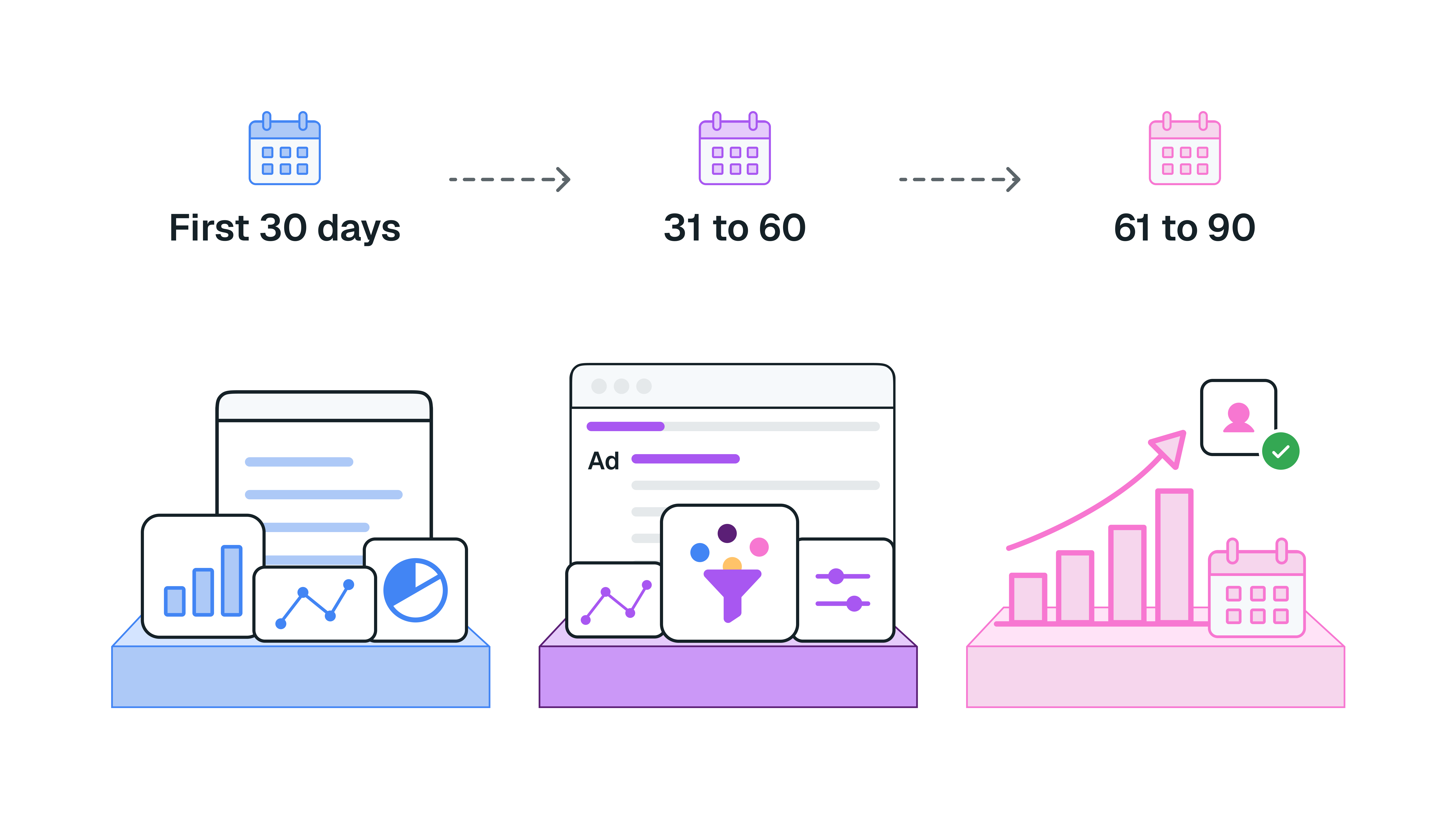
The full framework I use to run every account at ScalixAI. Campaign architecture. Competitor conquest strategy. Conversion tracking. Smart Bidding progression. The 30/60/90 rollout. Everything I've learned in nine years inside Google and $1B+ in managed ad spend, in one document.
#download::Download AI Guide::https://cdn.prod.website-files.com/69f0be63e9183e578869c4f0/6a748d0aed994f5dc8ae64a5_How%20to%20Structure%20a%20B2B%20SaaS%20Google%20Ads%20Account%20(2026).pdf
The Bottom Line
Bidding on competitor keywords is one of the most effective strategies in B2B SaaS Google Ads.
At its best, competitor bidding puts your brand in front of buyers ready to switch.
At its worst, it burns budget on the wrong competitors, weak landing pages, poor messaging, and flawed campaign structure.
And guess what? Every part of this is fixable.
I don't evaluate competitor campaigns on CPC alone. Evaluate them on cost per opportunity. I think higher click costs are justified when they lead to better conversions and a more valuable pipeline.
If you're running Google Ads for a B2B SaaS company and not running structured competitor conquest campaigns, you're leaving qualified pipeline on the table.
If you're running them badly, you're funding your competitors' brand awareness while burning your own budget.
In both cases, I can help you. Book your free 20-minute audit now.