Before ChatGPT Ads, Make Sure Your Foundations Are Solid.
Google and LinkedIn are where the B2B SaaS pipeline comes from. We build both. If your paid media isn't producing predictable demos and pipeline, start there.
Share this Article



Key takeaways
ChatGPT ads use context hints for targeting.
Pro, Business, and Enterprise ChatGPT users never see ads because B2B reach is limited.
The $50K monthly minimum disqualifies most Seed and Series A budgets entirely.
ChatGPT ads sit between demand creation and demand capture, a genuinely new position.
B2B attribution for ChatGPT ads is still new. Measurement partners have just launched.
ChatGPT ads launched in February 2026. Every marketer immediately had the same question: Is this the next Google Ads or just another shiny object?
I have a clear answer. For most B2B SaaS companies between Seed and Series B, ChatGPT ads are worth understanding and worth watching, but they are not worth betting your pipeline on yet.
Here's the complete breakdown. What they are, how they work, what they cost, and exactly where they fit, or don't, in a B2B SaaS paid media strategy.
What Are ChatGPT Ads?
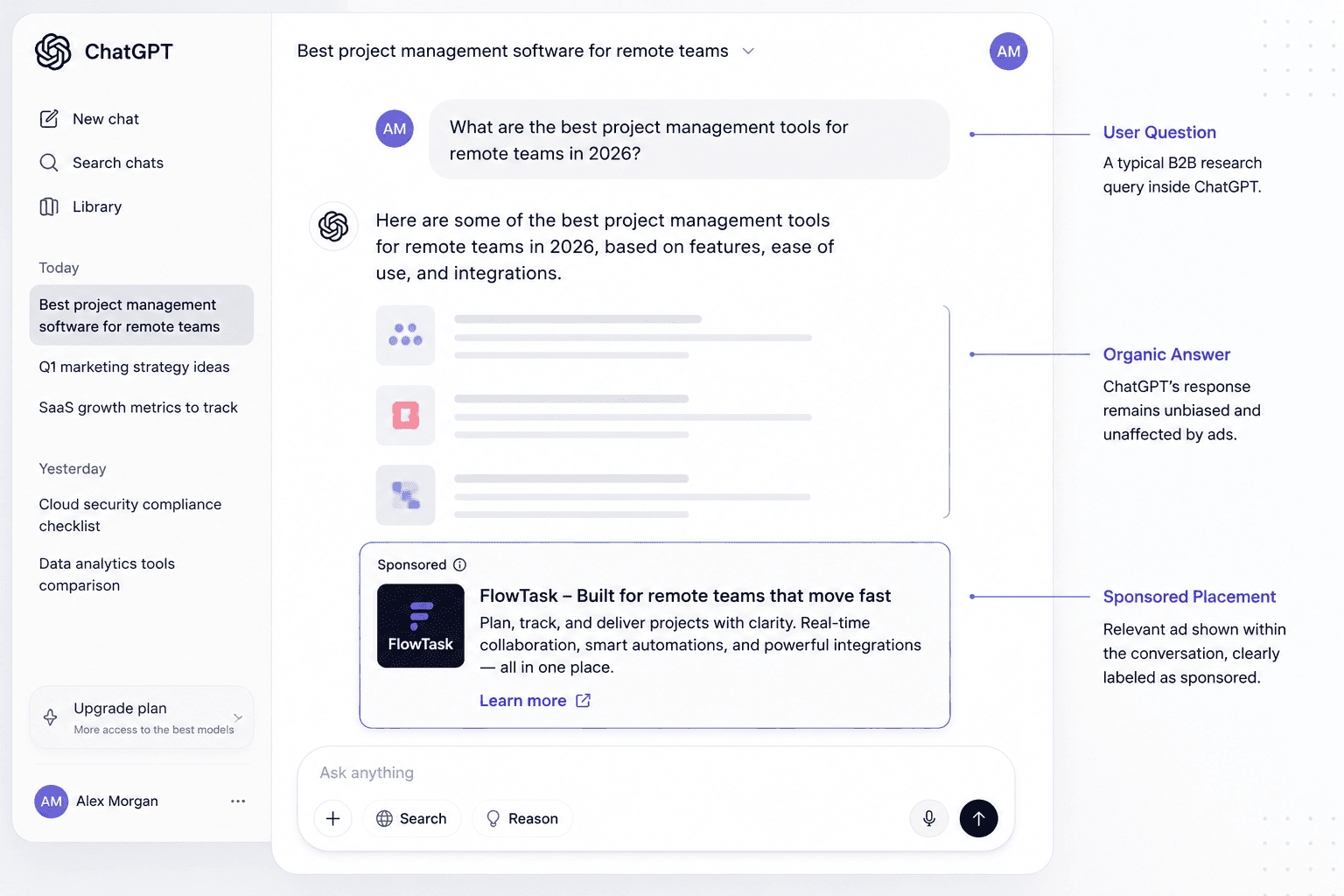
ChatGPT ads are the first native advertising format inside OpenAI's ChatGPT product. Announced in January 2026 and tested in the US from February 2026, they represent OpenAI's move to monetise its 500 million weekly active users through a model that every search engine before it has relied on: advertising revenue alongside organic answers.
The format is contextual. Ads appear within or alongside ChatGPT's responses when the conversation context matches an advertiser's targeting criteria. They are clearly labelled as sponsored content. Critically, OpenAI has been deliberate about this; ads do not influence ChatGPT's actual answers. The organic response and the sponsored placement are separate.
The timeline:
- January 2026: OpenAI announces its intention to test advertising
- February 2026: US test begins with select brand partners
- April 2026: CPC pricing model launches alongside self-serve Ads Manager
- May 2026: Third-party measurement partners introduced for attribution
Which users see ads: Free tier and Go tier only. Pro, Business, Team, and Enterprise subscribers never see ads. This is a significant detail for B2B marketers. Your enterprise buyers are almost certainly on paid tiers.
The launch of a self-serve Ads Manager is what makes this relevant beyond large brand budgets. It signals that OpenAI is building infrastructure for scale, not just a select partner programme.
How ChatGPT Ad Targeting Works
This is where B2B marketers need to pay close attention because ChatGPT's targeting model is fundamentally different from anything they're used to.
There are no keywords. No demographics. No firmographics. No job titles. No company sizes.
ChatGPT ads use a system OpenAI calls "context hints." Advertisers write plain-language descriptions of the conversational contexts in which their ad should appear.
It looks something like: "show this ad when someone is discussing project management software for remote teams" or "show this ad in conversations about cloud security compliance."
The platform matches those descriptions to live conversations using AI, not keyword triggers or profile data. The only geographic targeting available is country-level.
What this means for B2B SaaS:
LinkedIn remains the only platform with true B2B firmographic precision, targeting by job title, seniority, company size, industry, and company name. ChatGPT ads have none of that.
This means you can reach someone discussing a relevant topic, but you cannot confirm they're a Director of Engineering at a 200-person SaaS company with a $50K security budget.
For B2B Google Ads strategy, keyword intent is the targeting mechanism. You know exactly what the buyer searched for. For ChatGPT ads, you're working with conversational context inference, which is less precise and currently unproven for B2B buying signal accuracy.
This doesn't make ChatGPT ads useless for B2B. It means they operate differently, closer to contextual display than keyword search, but smarter than traditional contextual because the AI understands conversation meaning rather than just page content.
ChatGPT Ads Pricing: What It Actually Costs
ChatGPT pricing story has evolved quickly since launch and is worth understanding in full.
Pricing evolution:
- Launch pricing: $60 CPM (cost per thousand impressions)
- Revised pricing: $25 CPM
- April 2026: Shift to CPC model at $3–$5 per click average
- Minimum spend: Dropped from $200,000 to $50,000
The move to CPC from CPM is significant as it aligns OpenAI with the Google Ads model that B2B advertisers already understand and makes performance measurement more straightforward.
Real-world B2B CPC data: Early B2B software advertisers on ChatGPT are reporting $8–$15 CPCs in competitive categories. It is above the platform average, but the conversion rates are reportedly 3 to 4 times higher than social platforms. This is consistent with what intent-based advertising produces across other channels.
The minimum spend reality:
[table]
Company Stage | Monthly Ad Budget Typical Range | ChatGPT Ads Minimum | Verdict
Seed / Pre-Series A | $3,000–$10,000 | $50,000 | Not accessible
Series A | $10,000–$30,000 | $50,000 | Stretch — not recommended
Series B | $30,000–$100,000 | $50,000 | Testable as a supplement
Series C+ | $100,000+ | $50,000 | Worth building into mix
[/table]
The $50,000 minimum is the most practical filter for most of the B2B SaaS companies I work with.
Even if the targeting and conversion rates prove out, Seed and Series A companies should not be allocating budget here before their Google and LinkedIn foundations are producing a predictable pipeline.
If you haven't yet validated your seed-stage marketing budget allocation across proven channels, ChatGPT ads are not where the next dollar goes.
ChatGPT Ads vs Google Ads vs LinkedIn Ads for B2B SaaS
This is the section that matters most for strategic decision-making. Here is the honest, operator-level comparison, not the version optimized to make ChatGPT ads sound exciting.
[table]
| Google Ads | LinkedIn Ads | ChatGPT Ads
Primary function | Demand capture | Demand creation | Conversational interception
Targeting mechanism | Keywords + audience layering | Firmographic precision | Context hints (AI-matched)
B2B firmographic targeting | Limited (audience overlay) | Industry-leading | None
Buyer stage reached | Solution-aware, decision-ready | Problem-unaware to aware | Varies by conversation
Average CPC (B2B SaaS) | $4–$12 | $8–$20 | $8–$15 (early data)
Minimum spend | None | $10/day | $50,000/mo
Attribution maturity | High — CRM integration proven | Moderate — company-level | Early — just launched
Measurement partners | Extensive | Established | Just introduced
Proven B2B pipeline ROI | Yes — extensive case data | Yes — growing case data | Not yet established
Self-serve access | Full | Full | Rolling out
Who sees ads | Anyone searching | LinkedIn users (all tiers) | Free + Go tiers only
[/table]
The framework I use with every B2B SaaS client is demand creation versus demand capture. Google Ads captures existing demand. These are buyers already searching for a solution. LinkedIn creates demand. We start by reaching buyers before they search, building awareness in the buying committee. These two channels cover the full arc of B2B pipeline generation.
ChatGPT ads sit in an interesting middle position. They intercept buyers during active research conversations, not keyword searches, but also not passive scroll behaviour. That's a genuinely novel moment in the buying journey. The question is whether the targeting precision and measurement infrastructure are mature enough to make that moment actionable for B2B.
Right now, they're not. Not for most companies. But they will be.
I've run Google Ads for B2B SaaS and AI companies for years. The pattern with new channels is consistent: early movers with the budget to absorb measurement uncertainty get first-mover advantage. Early movers without that budget get expensive lessons. Know which category you're in before you commit.
Should Your B2B SaaS Company Run ChatGPT Ads? A Stage-by-Stage Framework
Seed / Pre-Series A ($500K–$2M ARR)
Not yet. The $50,000 minimum spend alone makes this inaccessible for most companies at this stage. More importantly, if your Google and LinkedIn foundations aren't yet producing a predictable pipeline, that's where every dollar should go.
ChatGPT ads on top of a broken demand generation system produce expensive noise, not pipeline. Fix your Google Ads attribution and demand creation engine first.
Series A ($2M–$8M ARR)
Watch and plan. Check whether your Google and LinkedIn are performing well. Evaluate if you have consistent demo volume, validated CAC, and clean attribution. Also, start monitoring the ChatGPT Ads Manager rollout and get on the waitlist for self-serve access.
If all signs are positive, it is time for you to build a test hypothesis: which product categories have enough conversational search volume to justify $50K in test spend? Don't allocate budget yet unless a strategic case is clear.
Series B ($8M–$20M ARR)
Worth testing as a supplementary channel. At this stage, you have the budget to absorb a $50K experiment and the measurement infrastructure to evaluate results meaningfully. Use ChatGPT ads to defend branded search in conversational contexts and capture high-intent queries in your product category. Don't shift core budget away from Google and LinkedIn — add ChatGPT ads on top of what's working.
Series C+ ($20M+ ARR)
Build it into the mix deliberately. At this scale, ChatGPT ads are a brand defence and category capture tool alongside your proven channels.
The measurement partners OpenAI just introduced make attribution increasingly viable for longer sales cycles. Start building channel-specific conversion tracking from day one.
The B2B Audience Quality Problem
One point that isn't discussed enough in coverage of ChatGPT ads: Pro, Business, Team, and Enterprise users never see ads.
For consumer brands, this doesn't matter much. For B2B SaaS companies targeting decision-makers at mid-market and enterprise accounts, it matters significantly. The buyers most likely to have purchasing authority at a target account are also the most likely to be on a paid ChatGPT tier, which means your ads never reach them.
This is the structural limitation that makes LinkedIn irreplaceable for B2B firmographic precision. A VP of Engineering at a 500-person company evaluating security software tools is probably on ChatGPT Pro or their company's Team plan. You can't reach them with ChatGPT ads regardless of how well your context hints are written.
This doesn't kill the channel for B2B. It means ChatGPT ads are more effective for reaching individual contributors and earlier-stage researchers than for reaching economic buyers. In B2B, that's typically top-of-funnel brand awareness, not bottom-of-funnel pipeline generation.
Understanding demand generation versus lead generation is what shapes how to position ChatGPT ads in your strategy. Start with awareness and education first, conversion later through proven channels.
The Measurement Problem with ChatGPT Ads and Why It Matters More in B2B
OpenAI only introduced third-party measurement partners in May 2026. That means for the first three months of the channel's existence, advertisers had almost no independent attribution data.
For B2B SaaS with sales cycles of 45 to 90 days, this is a serious constraint. Even now that measurement partners are in place, connecting a ChatGPT ad impression to a deal closed two months later through a multi-stakeholder buying process requires exactly the kind of CRM-integrated attribution infrastructure that most companies don't have in place.
The same attribution challenge applies to LinkedIn, and we've seen how that plays out. A B2B client of ours recently proved $779K in LinkedIn-influenced revenue through company-level attribution that last-click models completely missed. The infrastructure to prove ChatGPT ads ROI will take time to develop. B2B companies should wait for it before committing significant spend.
What to Do Right Now? Regardless of Whether You Run ChatGPT Ads
1. Audit your current paid media foundations. Are Google and LinkedIn generating a predictable, attributable pipeline? If not, that's the problem to solve. No new channel fixes a broken foundation. Our Google Ads management services start with exactly this audit.
2. Optimize your content for AI search visibility. ChatGPT's organic answers cite sources. You can earn more organic visibility in ChatGPT responses without paying for it if your content is structured for LLM retrieval: direct answers, clear entity attribution, and FAQ schema. This is a channel you can compete in now, at zero media cost.
3. Get on the ChatGPT Ads Manager waitlist. Self-serve access is rolling out. Getting early access means you can run small tests before the minimum spend requirements potentially increase again. The first-mover window on new channels is real.
4. Build your demand creation to demand capture system. LinkedIn creates demand. Google captures it. That integrated system produces a compounding pipeline. ChatGPT ads, when they mature, will sit alongside this system, not replace any part of it. Companies that have the foundation in place will be best positioned to layer in new channels profitably.
5. Monitor measurement partner data. As third-party measurement for ChatGPT ads matures over the next two quarters, real B2B attribution data will emerge. Watch for CPC benchmarks by vertical, conversion rates by buyer stage, and pipeline attribution case studies. That data will clarify whether and when the channel makes sense for your specific category.
Conclusion
ChatGPT ads are a real evolution in paid media. For B2B SaaS companies, they represent a genuinely new moment in the buyer journey: the conversational research session. That moment will become increasingly valuable as targeting precision and measurement infrastructure mature.
But ChatGPT ads don't change the fundamentals of B2B pipeline generation in 2026. Pipeline predictability still comes from covering the full demand creation to demand capture arc. That's the system that produces consistent, attributable revenue for the B2B SaaS and AI companies I work with at ScalixAI.
If you're considering adding ChatGPT ads to your B2B paid media mix, start by making sure Google and LinkedIn are generating a pipeline you can defend in a board meeting. That foundation is what makes any new channel addition productive rather than expensive.
Book a free audit, and we'll tell you exactly where your paid media foundations stand, and whether you're ready to start testing what comes next.
.gif)