Not sure if your paid ads are actually working?
Get an honest audit from an ex-Googler who's seen it all.
Share this Article



Key takeaways
Seed-stage budgets prove customer acquisition, not brand awareness.
Allocate 15–25% funding to high-intent, scalable acquisition channels.
Build measurement infrastructure before spending on any paid acquisition.
Prioritize Google Ads and SEO for bottom-funnel SaaS growth.
Apply the 70-20-10 rule to balance core growth, testing, and exploration.
Most seed-stage founders I speak with make one of two mistakes with their marketing budget.
They either pour money into brand awareness before they've proven they can acquire a customer cost-effectively, or they spend so little on measurement that they have no idea what's working.
Both mistakes are expensive, and both are avoidable.
The goal of a seed-stage marketing budget isn't to build a brand. It's to prove that you can acquire customers at a cost that makes your business model work. Everything else, from brand to community and thought leadership, comes later.
First, you prove the engine.
I've spent 9 years at Google managing over $1 billion in ad revenue across North America. I've worked with dozens of seed-stage SaaS companies building their first paid acquisition systems.
What I consistently see: founders who treat their marketing budget as a proof-of-acquisition exercise walk into their Series A with data. The others walk in with a story.
This guide gives you the framework, benchmarks, and quarter-by-quarter plan to be in the first group.
What Is a Seed-Stage Marketing Budget?
A seed-stage marketing budget is the portion of your seed funding allocated to acquiring, measuring, and understanding customers. It is not a branding budget. It's the capital you deploy to answer one question: can I acquire customers at unit economics that scale?
This is fundamentally different from what you'd build at Series A or the growth stage. At Series A, you've proven acquisition works, so now you scale it. At the growth stage, you invest in brand moats, content, and community. At seed, you're still in proof mode.
[table]
Stage | Primary Goal | Budget Focus
Seed | Prove acquisition model | Measurement, high-intent paid capture, conversion testing
Series A | Scale what works | Double down on proven channels, expand to adjacent ones
Growth | Build a defensible position | Brand, content, community + continued paid scale
[/table]
The 15–20% of total funding rule is a starting point, not a strategy. A founder who raised $2M and spent $400K on brand campaigns before proving CAC may be burning runway on the wrong thing. Allocation matters more than total spend.
How Much Should a Seed-Stage Startup Spend on Marketing?
This is the most common question I get. Here's the honest answer: it depends on your ACV, your sales cycle, and what you're trying to prove.
The general benchmark for a typical startup marketing budget:
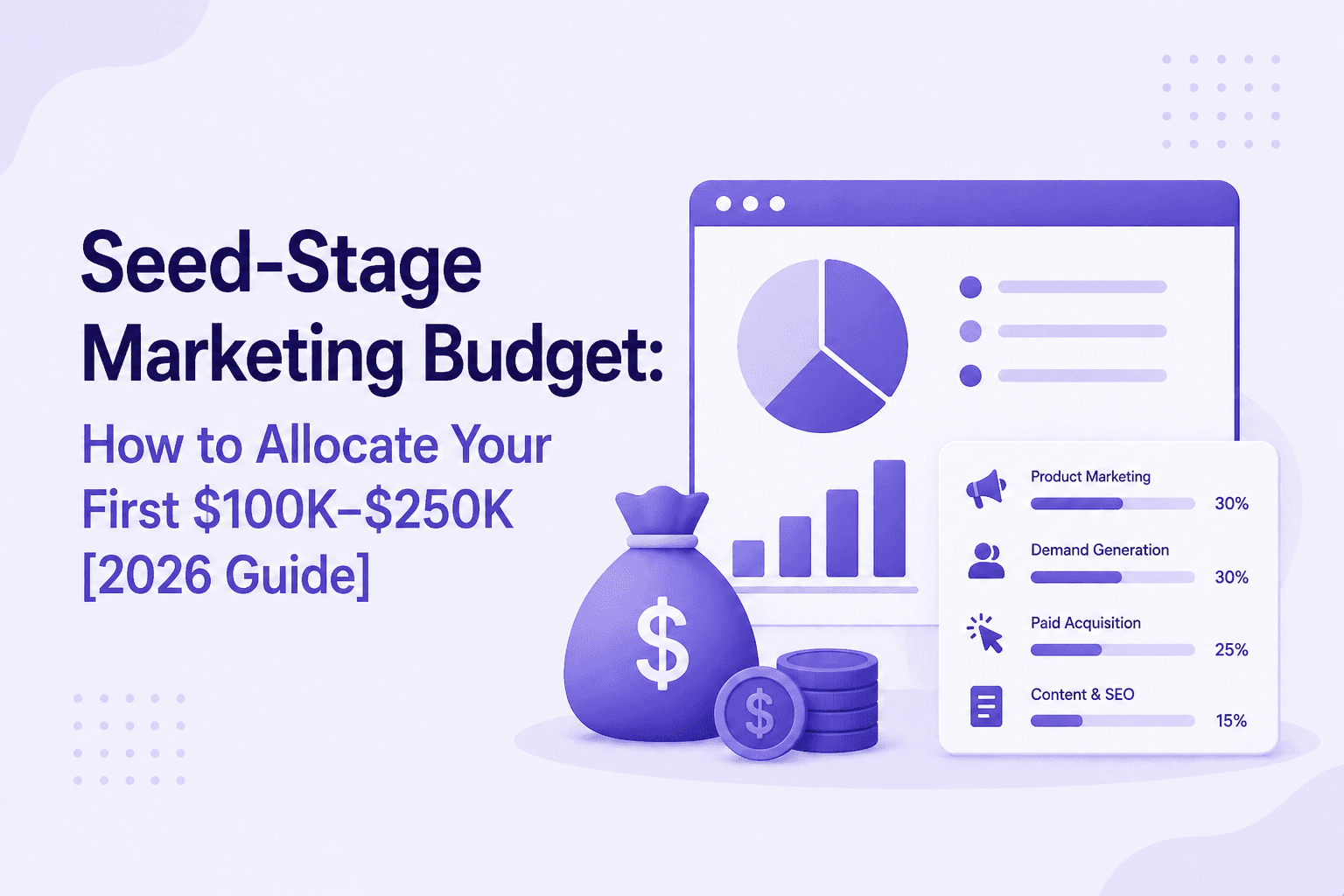
Seed-stage SaaS companies should plan to allocate 15–25% of total seed funding to marketing over 12–18 months. For a $1M raise, that's $150K–$250K. For a $3M raise, that's $450K–$750K.
But these aren't rigid rules. Here's how the average marketing budget for a startup breaks down by company type:
[table]
Startup Type | Recommended Annual Marketing Budget | Key Notes
B2B SaaS (high ACV, $10K+/yr) | $80K–$200K | Longer sales cycles; weight toward measurement and content
B2B SaaS (low ACV, PLG motion) | $50K–$150K | Paid search + product-led trials work well together
AI / Dev Tools | $60K–$180K | Heavy on content + search; community often outperforms paid early
Marketplace / Platform | $100K–$250K | Two-sided demand requires simultaneous paid investment on both sides
B2C SaaS | $75K–$200K | Meta and Google are both relevant; product virality can reduce spend
[/table]
If you have early revenue, think in terms of startup marketing budget percentage of revenue as well. SaaS companies at seed typically spend 20–40% of ARR on combined sales and marketing. For a startup at $200K ARR, that's $40K–$80K per year. Below $200K ARR, default to the percentage-of-funding benchmark.
For a startup without revenue, or with minimal ARR, the marketing budget defaults to the 15–25% of funding model. You're investing ahead of revenue, and that's fine, as long as every dollar is tracked and tied to a learnable outcome.
The Seed-Stage Marketing Budget Allocation Framework
This is the framework I use when I onboard a new seed-stage SaaS client. The percentages shift based on your go-to-market motion, but this is the right starting structure for most B2B SaaS and marketing budgets for tech startup situations.
[table]
Category | % of Budget | What It Covers
Measurement & Attribution | 10–15% | GA4 setup, CRM integration, conversion tracking, attribution dashboards
High-Intent Paid Capture | 30–40% | Google Ads (bottom-funnel search), LinkedIn retargeting, intent-based campaigns
Content & SEO | 20–25% | Buyer-intent content, comparison pages, landing pages, and technical SEO foundation
Experimentation Budget | 10–15% | Messaging tests, audience pilots, channel experiments, landing page variants
Team / Agency | 15–20% | Fractional CMO, agency retainer, or first marketing hire
[/table]
This table represents one of the most practical startup marketing budget examples you'll find for B2B SaaS at the seed stage. Here's what each line actually means in practice:
Measurement & Attribution (10–15%)
Most seed-stage founders skip this and regret it. You cannot optimize what you don't measure. Before spending a dollar on paid acquisition, you need to know which campaigns drive demos, which demos convert to customers, and what your CAC looks like by channel. This means GA4 properly configured, a CRM that captures UTM data at the lead level, and a simple dashboard that maps spend to pipeline. The first thing I do when I take on a new client is audit this infrastructure. Half the time, it doesn't exist, which means every dollar spent before that was flying blind.
High-Intent Paid Capture (30–40%)
This is where seed-stage SaaS companies should put their largest allocation, and it should be focused entirely on the bottom of the funnel. People who are actively searching for a solution like yours right now.
For most B2B SaaS, this means Google Ads for startups, specifically, high-intent search campaigns targeting pricing, demo, and comparison keywords. This is the channel I know best from my time at Google, and it's where I've consistently seen the clearest, fastest signal on acquisition cost and conversion rate at the seed stage.

When I started working with FYXER, their Google Ads account was mismanaged, with campaigns producing near-zero results. I rebuilt the account from scratch, starting with minimal spend to validate performance, then expanding methodically across the US, UK, Australia, and Canada.
Google Ads scaled to a six-figure monthly spend and became responsible for 12% of FYXER's total ARR. Revenue scaled 20x during our partnership, with 10,000+ customers acquired through the channel. That outcome started with a small, disciplined investment in the right channel at the seed stage.
Content & SEO (20–25%)
Content at seed stage isn't about volume. It's about ranking for the specific queries your best-fit buyers search when they're actively evaluating options. Comparison pages. Category landing pages. Bottom-funnel guides like this one. One well-built comparison page ranking for "[your category] vs [competitor]" is worth more than 50 top-of-funnel blog posts about industry trends.
This investment also compounds over time, unlike paid, content keeps working for 24+ months after publication.
Experimentation Budget (10–15%)
At seed stage, you don't know everything yet. You might think LinkedIn works, but maybe Reddit or niche newsletters drive better leads for your specific ICP. This allocation is your dedicated budget for finding out without letting failed experiments drain your core channel performance.
Team / Agency (15–20%)
At seed stage, unless you can hire a genuinely senior growth marketer as your first hire, a fractional expert or specialist agency is almost always a better use of this budget line than an in-house generalist.
Marketing Budget Rules Applied to Seed Stage
As a SaaS founder at Seed stage, these frameworks are essential when deciding marketing budget.
The 70-20-10 Rule
The 70-20-10 rule allocates 70% of your marketing budget to proven channels, 20% to promising experiments, and 10% to wildcards or high-risk bets.
For seed-stage SaaS, I'd adapt it slightly:
- 70% on your primary, conversion-proven channel (usually Google Ads for SaaS or direct outbound)
- 20% on a second channel you're testing with genuine intent (LinkedIn, content, events)
- 10% on pure exploration, like a new platform, new format, or new audience segment
This is the rule I'd recommend most strongly for seed-stage companies. It gives you predictability where you need it while preserving space to discover new channels without letting experimentation drain your primary engine.
The 40-40-20 Rule
The 40-40-20 rule from direct response marketing says that 40% of campaign results come from audience and targeting quality, 40% from the strength of your offer, and 20% from creative execution.
For seed-stage founders, this is less a budget formula and more a prioritization framework.
- Spend 40% of your marketing thinking on ICP clarity (who you're targeting)
- 40% on your offer and positioning (why someone buys today)
- 20% on creative execution (how the ad or page looks)
Most early-stage teams do the inverse; they obsess over design and neglect targeting and offer. The creative is visible. The offer and targeting are where the money actually moves.
The 3-3-3 Rule
The 3-3-3 rule is simpler: test at least 3 channels, 3 messages, and 3 audience segments simultaneously. The goal isn't to win all 9 combinations, but to generate enough signal, fast enough, that you don't spend six months on a channel that was never going to work for your ICP.
At seed stage, compressed learning cycles are more valuable than optimized efficiency. You want to know what works before you've spent half your runway finding out the answer the slow way.
Seed-Stage Budget Allocation by Startup Type
Not all seed-stage companies should spend the same way. The typical marketing budget for a startup changes significantly based on model, motion, and buyer type.
[table]
Startup Type | Primary Channel | Secondary Channel | Budget Emphasis
B2B SaaS (high ACV) | Google Ads (branded + category keywords) | LinkedIn ABM | Bottom-funnel capture, attribution infrastructure
B2B SaaS (PLG, low ACV) | Google Ads (trial-focused) | Content/SEO | Product page conversion, activation
AI / Dev Tools | Content + community | Google Ads | Education-first; organic leads warm faster
Marketplace / Platform | Google Ads (both sides) | Paid social | Split the budget proportionally by the supply/demand ratio
B2C SaaS | Meta + Google | YouTube | Volume matters more; brand and retargeting are critical
[/table]
The biggest mistake I see is founders copying a marketing budget model from a company in a different category.
A B2C SaaS doubling down on Meta is not the right playbook for a B2B vertical SaaS with a $50K ACV. Your channel mix should match how your buyers actually search and decide, not what you read in a growth newsletter.
Your First $100K: A Quarter-by-Quarter Breakdown
Here's how I'd deploy $100K over 12 months advising a seed-stage B2B SaaS founder in 2026.
Q1: Infrastructure + First Signal ($20K–$25K)
- $5K–$8K: Measurement infrastructure, including CRM setup, conversion tracking, and attribution dashboards
- $8K–$12K: First paid campaigns including tight keyword targeting, 3–5 ad groups, 2–3 landing pages
- $3K–$5K: First BOFU content pieces, including 1–2 comparison pages, product landing page copy
Goal: Establish clean data. Get your first 10–15 demo conversions through paid. Understand your real CPL (cost per lead) and CPD (cost per demo). Nothing else matters until you have this baseline.
Q2: Double Down on Signal ($25K–$30K)
- Increase budget on winning campaigns from Q1 (the ones with the lowest CPL and highest demo rate)
- Launch retargeting campaigns for engaged visitors who didn't convert
- Add 2–3 new ad groups based on search terms that actually converted
- Begin A/B testing landing pages
Goal: Reduce CPL by 20–30% from Q1 baseline. Reach 25–30 demos booked from paid total.
Q3: Add Content + SEO ($25K–$30K)
- Launch content program: 4–6 BOFU-focused articles or comparison pages targeting high-intent keywords
- Technical SEO foundation: site structure, page speed, internal linking
- Add LinkedIn for account-based retargeting of paid visitors
- Continue scaling winning paid campaigns
Goal: First organic leads from SEO appearing in your attribution data. A cross-channel view of how customers find and evaluate you.
Q4: Optimize and Build Series A Data Room ($20K–$25K)
- Cut underperformers. Reduce wasted spend.
- Document CAC, LTV, and pipeline contribution by channel
- Build 90-day efficiency trend data (showing CPL improving over time)
- Prepare your marketing metrics narrative for investor conversations
Goal: Walk into Q1 of the following year with a clear, data-backed story: "Here's what I've proven, here's my CAC by channel, here's where I'm investing at Series A."
Common Seed Marketing Budget Mistakes (and How to Avoid Them)
Mistake 1: Over-investing in the brand before proving the acquisition
Brand building before proven CAC is a luxury. Press mentions, thought leadership, podcast appearances, none of that should be a budget line until your acquisition engine works. Awareness without conversion proof is just spending money to feel like a company.
Fix: Allocate zero to awareness channels until your paid conversion metrics are positive and your CPL is understood.
Mistake 2: No measurement infrastructure
I see this every month. Founders launch Google Ads or LinkedIn campaigns with no conversion tracking. Then they wonder why it isn't working. You have no idea if it's working because nothing is measuring it.
Fix: Spend the first $5K–$10K on measurement infrastructure, not ads. Build the tracking layer before the acquisition layer.
Mistake 3: Confusing demand generation vs. lead generation
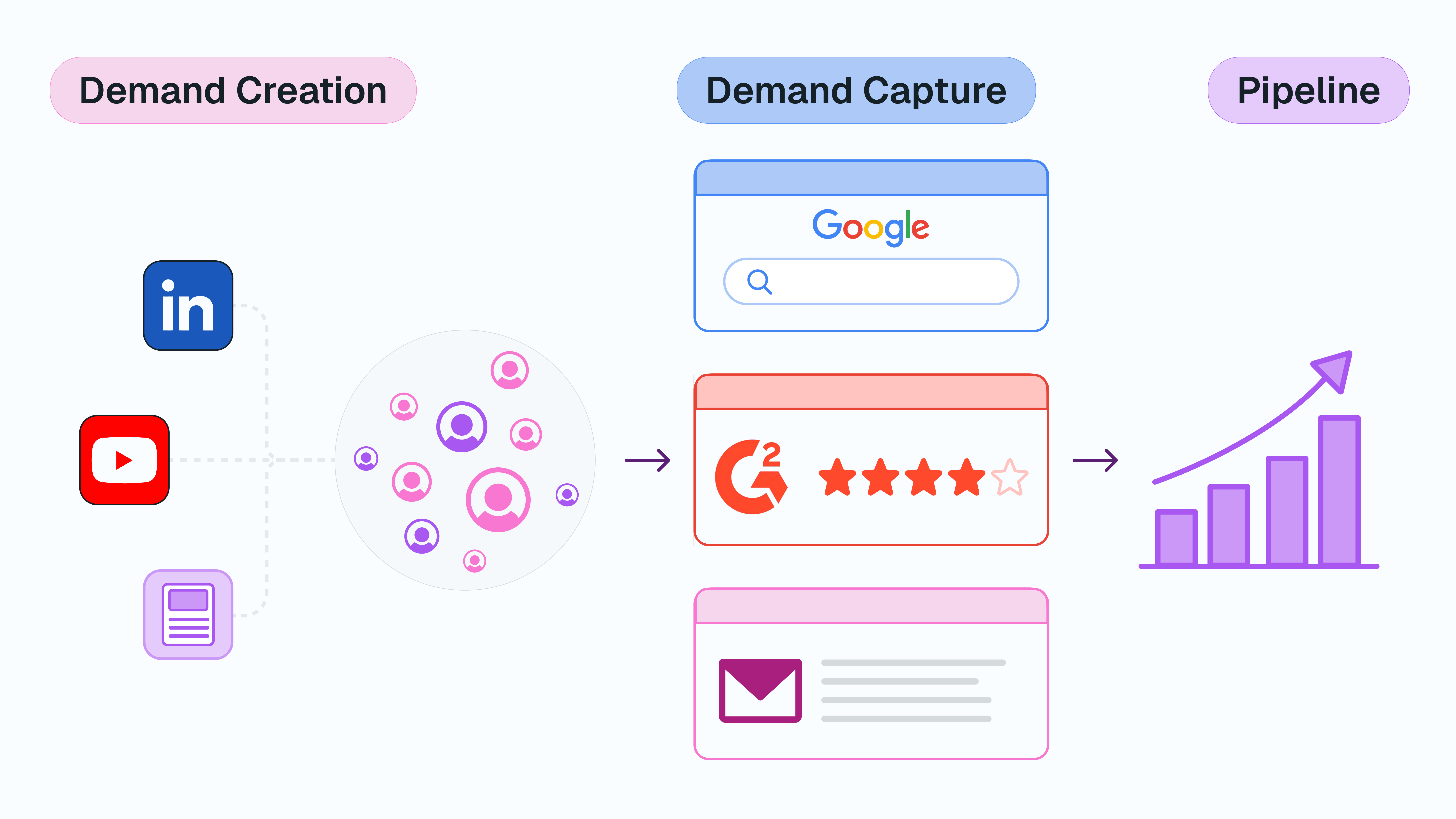
Demand gen creates awareness of a problem. Lead gen captures people who already have the problem and are actively searching for a solution. At seed stage, you almost exclusively want lead generation — bottom-funnel capture of high-intent buyers. Demand gen is for later, when you have enough budget to play both games simultaneously.
Fix: At seed stage, 80%+ of your paid budget should be on bottom-funnel, high-intent keywords and offers. Create demand with content. Capture it with paid.
Learn more about demand generation vs lead generation
Mistake 4: Building a marketing team too early
Hiring a marketing manager before you have channel proof is expensive and usually counterproductive. Most seed-stage companies don't have enough budget to give a new hire the runway they need to iterate and figure things out. You end up paying for experiments that a specialist would run faster and cheaper.
Fix: Use a fractional CMO or specialist agency first. Hire full-time after you have a working channel to hand off and scale.
Mistake 5: Over-investing in PR before product-market fit
PR agencies at seed love to promise TechCrunch coverage. That coverage rarely drives B2B SaaS pipeline. A single well-executed Google Ads campaign targeting demo-intent keywords will generate more qualified leads than most earned media placements, and you'll be able to measure it.
Fix: Zero PR budget until you have measurable acquisition metrics. Let the results get the press after PMF.
Mistake 6: Ignoring sales-marketing alignment
You can have a perfectly optimized paid campaign driving 50 demo requests a month, and watch all that pipeline die because your sales follow-up is slow, or your demo experience doesn't match what the landing page copy promised. Marketing can't fix a broken handoff.
Fix: Before scaling spend, close the loop. Track demo-to-close rate by channel. Make sure what you promise in ads matches what you deliver in sales.
Mistake 7: Chasing vanity metrics
Impressions, followers, engagement rates. None of these pay rent. At seed stage, the only metrics that matter are: demo requests, SQLs, and closed customers by channel.
Fix: Build your attribution dashboard around revenue metrics only. If a metric doesn't connect to pipeline or closed revenue, it's a distraction.
Mistake 8: Not testing enough, early enough
The opposite of mistake 7: being so cautious that you run one ad with one message, it doesn't convert, and you call it a failed channel. One test is not a test.
Fix: Apply the 3-3-3 rule. Test at least 3 messages, 3 audiences, and 3 channel variations before concluding. The learning from failed tests is as valuable as winning ones — if you're structured enough to capture it.
Hire vs. Outsource: Building Your Seed-Stage Marketing Team
This is the most practical question I get from seed-stage founders, and the one most budget guides skip entirely. Here's my honest take after years of seeing both paths play out.
Hire a full-time marketer when:
- You have a proven channel that needs operational management, not strategic discovery
- Your ARR is above $500K–$750K, and you need a dedicated owner
- You have enough budget to give them 6+ months of runway to iterate and improve
Use a fractional CMO when:
- You need senior strategy, but can't justify the cost of a VP Marketing
- You need someone who's done this exact motion, SaaS, B2B, your specific category, before
- You want accountability and strategic oversight without a long-term hire commitment
Use a specialist agency when:
- You need a specific channel executed well: Google Ads, LinkedIn, SEO
- You want access to channel expertise that would take 12–18 months to hire for in-house
- You want month-to-month flexibility while you prove which channel works
Cost comparison at seed stage:
[table]
Option | Typical Monthly Cost | Best For
Full-time Marketing Manager | $8K–$12K (+ equity) | Post-PMF execution at scale
Fractional CMO | $5K–$10K | Strategy + senior oversight
Specialist Agency (e.g., Google Ads) | $3K–$7K | Channel execution with deep expertise
Freelancer | $1K–$4K | Tactical task execution, not strategy
[/table]
For most seed-stage B2B SaaS companies, the most efficient model is a specialist agency for your primary paid channel, plus founder involvement in content and positioning. That gives you professional execution on the channel that drives pipeline, without the overhead of a full-time hire before you know what you're optimizing for.

When PAM, a voice-AI platform for car dealerships, brought me in at the seed stage, they'd already burned through their budget with an agency that relied on off-the-shelf AI tools without understanding their sales cycle.
Campaigns had no proper segmentation, attribution was broken, and there was no funnel from ad click to qualified lead.
After rebuilding the account structure, defining their ICP, implementing full attribution, and building a feedback loop with the sales team, PAM generated $234K in annual contract value from $72K in total ad spend, a 3.25x return.
The issue was never the channel. It was the execution quality at a critical stage.
If you're evaluating what agencies actually charge and what you should expect for your budget, my guide on Google Ads agency pricing breaks it down specifically for B2B companies.
Essential Marketing Tools for Seed-Stage Startups
Keep it lean. Seed-stage startups that build a 15-tool marketing stack before they have 50 customers are optimizing for the wrong problem. Here's what you actually need:
Analytics & Measurement
- GA4 (free): The non-negotiable baseline. Configure conversion events tied to your key funnel actions — demo bookings, trial signups, form submissions.
- Hotjar (~$32–$99/mo): Session recordings and heatmaps. Essential for CRO on your landing pages.
CRM
- HubSpot Free: More than adequate at seed stage. Captures UTM parameters at the lead level, tracks source, and integrates with Google Ads for closed-loop attribution.
Paid Ads Management
- Google Ads: Your primary acquisition channel for intent-based B2B demand. For insider tips on getting more out of the platform from someone who spent 9 years there, see my Google Ads tips from an ex-Googler.
- LinkedIn Campaign Manager: For ABM retargeting, after Google Ads is profitable and converting.
SEO
- Ahrefs ($99–$199/mo): Keyword research, competitive analysis, backlink monitoring. Worth every dollar once you're investing in content.
- Screaming Frog (free up to 500 pages): Technical SEO audits. Find crawl errors and indexing issues before they silently kill your content investment.
Content Operations
- Notion: Editorial calendar and content briefs.
- Surfer SEO or Clearscope ($89–$189/mo): Content optimization for target keywords. Meaningful lift for content teams at seed stage.
Total lean tech stack cost:
$300–$600/month. That's it. Don't add tools until you've maxed out what you already have. More tools before you have channel proof adds overhead without adding signal.
How to Make Your Marketing Budget Series A-Ready
Investors don't just fund your product. They fund your acquisition model. When you walk into a Series A pitch, the question isn't just "what have you built?" It's "how much does it cost you to acquire a customer, and what's the return on that?"
Here's what your marketing data room needs to show:
CAC by channel (not blended)
Blended CAC is almost always misleading at seed stage.
Investors want to know: when you spend $1 on Google Ads, what does it cost to close a customer through that channel? Separately from outbound. Separately from referrals.
Channel-level CAC tells them whether you have a scalable, repeatable acquisition system or just luck.
LTV: CAC ratio with a trajectory
You don't need a perfect 5:1 ratio. You need to show it's improving.
A 2:1 LTV: CAC that improved from 0.8:1 six months ago is a better story than a static 3:1 with no trend data.
Investors are buying the trajectory, not just the current snapshot.
Payback period under 18 months
For SaaS at seed stage, investors want to see a payback period under 18 months. Under 12 months is strong.
This tells them how fast their capital recycles back into the business and whether the acquisition model can survive a funding gap.
Month-over-month efficiency gains
Show that your CPL and CPA have decreased over time as you've optimized. This proves your team knows how to run a paid acquisition engine, not just launch one and hope. It's the difference between a scalable system and a one-time result.
Pipeline attribution
Which marketing channels contributed to your last 20 customers? If you can answer that question with data, not instinct, you're ahead of 80% of seed-stage companies going into a raise.
When Delve, an AI compliance automation platform founded by MIT researchers, partnered with ScalixAI ahead of their Series A, we rebuilt their Google Ads and LinkedIn campaigns with full pipeline attribution.
The result: $7M in influenced pipeline and $1.2M in closed-won revenue within six months. That commercial data gave Delve's leadership the proof they needed to raise a $32M Series A led by Insight Partners, with participation from CISOs at Fortune 500 companies.
The marketing metrics weren't just nice to have. They were central to the fundraising narrative.
The Bottom Line
If you're looking for a B2B Google Ads agency that understands how to build an acquisition engine that serves both your near-term pipeline and your Series A story, that's exactly what we do at ScalixAI.
You can also see how we compare to other options in our breakdown of top Google ad agencies in the US, including what to look for at each stage of growth.