Running One Channel and Wondering If the Other Is Worth It?
Share this Article



Key takeaways
Google Ads averaged $9.76 CPC and $524 CPL for B2B in 2025. LinkedIn averaged $9.39 CPC and $202 CPL in the same dataset.
LinkedIn Ads costs are about audience precision. Google Ads costs are about intent proximity. Neither is universally cheaper.
LinkedIn Document Ads produced the lowest CPL in Metadata's B2B dataset at $142, undercutting Google's B2B CPL by 3x.
Running both channels together compounds pipeline. A buyer exposed to LinkedIn ads before Googling your category clicks at 3 to 5x the rate of a cold searcher.
Practitioner consensus is a $3,000 to $5,000 monthly minimum on LinkedIn for a meaningful signal. Below that, the algorithm doesn't have enough data to optimize.
Short Answer
Google Ads captures buyers already searching for your category. LinkedIn Ads reaches the buying committee before they search. Start with Google if your category has search volume; start with LinkedIn if it does not, or your ACV is above $25K. Most SaaS companies past $1M ARR need both.
What is the difference between LinkedIn Ads and Google Ads?
LinkedIn Ads target buyers by identity. Google Ads target buyers by intent. That single distinction shapes cost, lead quality, funnel role, and which platform to start with, more than any other factor.
Google Ads runs on declared intent. A buyer types "B2B SaaS CRM software," Google's auction matches the query to advertisers bidding on it, and the ad appears at the top of the search results. The signal is short and specific. Every dollar you spend is proportional to how urgently that buyer is looking for a solution right now.
LinkedIn Ads runs on identity. There is no query. Instead, LinkedIn matches your ad to buyers based on their job title, company size, industry, seniority, department, and target account list membership. The buyer isn't searching. You are choosing to appear in their feed because they match your ICP.
Both are legitimate. Neither replaces the other. The question is which buyer moment matters most for your current pipeline gap.
[table]
Factor | LinkedIn Ads | Google Ads
Targeting basis | Identity (job title, company, seniority) | Intent (keyword, in-market signals)
Intent level | Low to mid (buyer isn't searching yet) | High (buyer typed a query)
Funnel role | Demand creation | Demand capture
Best formats | Sponsored Content, Document Ads, Thought Leader Ads | Search, Performance Max, Demand Gen
Typical CTR | 0.67% (Metadata 2025) | 6.10 to 6.33% (WordStream / Metadata)
Typical CPC | $9.39 (Metadata 2025) | $5.87 to $9.76 (WordStream / Metadata)
Sales cycle fit | Longer cycles, larger deals | Shorter cycles, transactional intent
Audience minimums | 300 for Matched Audiences; 25K for lookalikes | 1,000 for Customer Match
Attribution difficulty | Higher (view-through matters, longer window) | Lower (last-click friendly)
Best for | ABM, category creation, ACV above $25K | Categories with existing search demand
[/table]
How much do LinkedIn Ads cost compared to Google Ads?
LinkedIn Ads and Google Ads cost roughly the same per click in the B2B dataset. What separates them is cost per lead and cost per qualified opportunity. LinkedIn CPLs are lower in Metadata's dataset. Google CPLs are lower in WordStream's business services dataset. The difference is what each source is measuring.
2025 to 2026 benchmarks
[table]
Metric | LinkedIn Ads | Google Ads | Source
CTR | 0.67% | 6.33% B2B / 6.10% business services | Metadata.io 2025 B2B / WordStream 2026
CPC | $9.39 | $9.76 B2B / $5.87 business services | Metadata.io 2025 B2B / WordStream 2026
CPM | $63.19 | Not comparable (search auction) | Metadata.io 2025
CPL | $202 (Sponsored Content) / $142 (Document Ads) | $524 B2B / $93.69 business services | Metadata.io 2025 / WordStream 2026
CVR | 0.98% | 4.85% | Metadata.io 2025 / WordStream 2026
[/table]
The two Google CPLs differ because Metadata measures B2B SaaS specifically (higher-intent demo forms, longer cycles, larger deals), while WordStream measures the broader business services category (mixed lead types). B2B SaaS demo-form leads run in the higher range.
CPM comparisons across search and social are misleading. A search impression happens when a buyer types a query. A feed impression happens when a scroll passes an ad in a social feed. They are not the same unit of attention.
The most useful specific finding in Metadata's dataset: LinkedIn Document Ads produced a $142 CPL, the lowest across all formats measured. If LinkedIn Ads feels expensive on a $200+ CPL basis, Document Ads is the format that resets the math.
For the full breakdown on LinkedIn's cost structure, see the LinkedIn advertising costs analysis.
Which channel has the lower cost per opportunity?
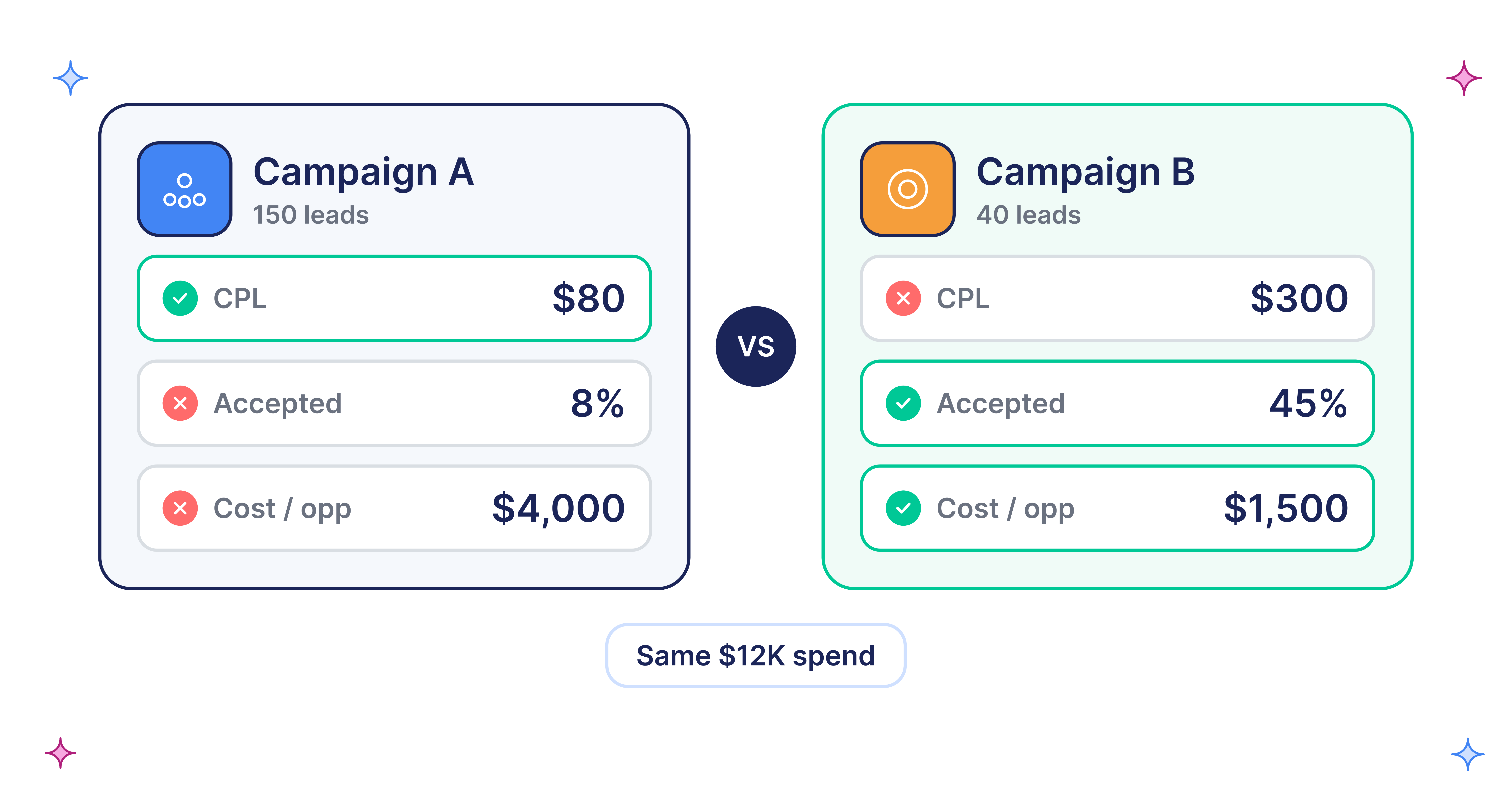
Neither is universally cheaper on cost per opportunity. LinkedIn tends to produce a higher CPL but a higher lead-to-SQL conversion rate. Google tends to produce a lower CPL but a lower SQL-to-opportunity rate. Which one wins on cost per opportunity depends entirely on fit.
Cost per opportunity worked example
[table]
Step | LinkedIn Ads | Google Ads
Monthly spend | $10,000 | $10,000
CPL | $200 | $150
Leads generated | 50 | 67
Lead-to-SQL rate | 40% (tight ICP fit) | 20% (mixed intent)
SQLs | 20 | 13
Cost per SQL | $500 | $769
SQL-to-opportunity rate | 30% | 25%
Opportunities | 6 | 3
Cost per opportunity | $1,667 | $3,333
[/table]
Note: rates above are illustrative benchmarks based on typical B2B SaaS performance. Actual results vary by ICP, offer, and sales motion.
The lesson: a higher CPL on LinkedIn can still produce a lower cost per opportunity when the fit rate is stronger. This is why comparing platforms on CPL alone almost always misleads a B2B SaaS buyer.
- Cost per SQL is closer to the truth.
- Cost per opportunity is the honest metric.
- Cost per closed deal is the only metric that fully closes the loop.
The math flips if your Google Ads keyword strategy is tightly built around commercial-intent, category-match terms with high AE acceptance rates.
It also flips if your LinkedIn targeting is too broad and you're paying for impressions across the wrong seniority.
Neither channel wins on cost per opportunity by default. Execution decides.
Which channel delivers better lead quality for B2B SaaS?
LinkedIn produces higher firmographic fit at lower buyer intent. Google produces higher intent at lower firmographic fit. Which one delivers "better" lead quality depends on which of those two variables matters more for your sales motion.
Lead quality across the two channels breaks down like this:
- Firmographic fit. LinkedIn wins. You can require a lead to be a VP of Engineering at a Series B SaaS company with more than 200 employees. Google can't filter beyond keyword intent and audience proxies.
- Intent level. Google wins. A buyer who typed "B2B SaaS CRM software" is closer to a purchase decision than a VP scrolling LinkedIn. Google captures declared intent; LinkedIn creates it.
- AE acceptance rate. Depends on your ICP. For $30K+ ACV products with a 5+ person buying committee, LinkedIn leads usually convert to opportunities at higher rates because the fit is tighter. For self-serve or lower-ACV products where any decision-maker can act, Google converts faster.
- Time to opportunity. Google wins in the short window. LinkedIn wins over 60 to 90 days because the relationship has time to develop.
Google Ads for SaaS captures buyers at the moment they're comparing competitors, so win rate depends on the strength of your offer against alternatives they're evaluating.
LinkedIn leads look weaker on a 30-day attribution window because conversion rates to opportunity are slower. Over 90 days, LinkedIn leads often outperform because the trust built by the content ecosystem shows up as higher win rates when the deal finally closes.
Measuring on 30-day windows kills channels that need 60.
See the demand generation vs. lead generation breakdown for how these two motions work together in a B2B SaaS pipeline.
How does the buying committee change the choice?
The B2B SaaS buying committee dynamic shifts the LinkedIn vs Google calculation because the two platforms reach different committee members at different points in the deal cycle. Ignoring this is the single most common way B2B SaaS teams miscalculate channel spend.
Google Ads typically reaches the person actively researching the solution: often the technical buyer or end user searching for product information. Their query is specific, intent-driven, and usually action-oriented. They're evaluating options right now.
LinkedIn Ads reaches the broader committee earlier in the cycle. The economic buyer who controls budget, the technical buyer evaluating fit, the end user concerned about implementation, and the various influencers shaping the decision can all be reached on LinkedIn before any of them start actively researching. This is where LinkedIn ABM campaigns become especially valuable, because the platform lets you target the full committee at named target accounts.
The strongest B2B SaaS programs use Google to capture the active researcher and LinkedIn to surround the broader committee with content tailored to each role's concerns. The deal closes faster because every stakeholder has seen your company before the RFP hits their desk.
Should B2B SaaS start with LinkedIn Ads or Google Ads?
Start with Google Ads if your category has meaningful search volume. Start with LinkedIn Ads if it doesn't, or if your ACV is above $25,000 with a multi-stakeholder buying committee. Most SaaS companies past $1M ARR eventually run both.
Decision matrix
[table]
Your situation | Start with | Why
Category has 1,000+ monthly searches | Google | Intent already exists. Capture it before you educate.
New category, little search volume | LinkedIn | No one is searching yet. Educate first, capture later.
ACV under $10K | Google | Faster payback fits shorter cycles. LinkedIn floor eats margin.
ACV above $25K with 5+ person committee | LinkedIn | Google reaches one committee member. LinkedIn reaches all.
Target account list under 1,000 companies | LinkedIn | Matched Audiences and ABM work at this scale. Google can't isolate them.
Budget under $5K/month total | Google | LinkedIn needs $3K to $5K minimum for signal. Google works at any budget.
Competitor terms are available and cheap | Google | Direct conquest of in-market buyers. Fastest pipeline.
You need pipeline in 30 days | Google | LinkedIn takes 60 to 90 days to produce measurable pipeline.
[/table]
If your category has search volume but every commercial term is above $30 CPC, LinkedIn may still be the better start because the Google math doesn't close at your CPL target.
Also, if you're a Seed-stage company with an emerging category and a target account list of 200 named accounts, LinkedIn's precision matters more than Google's intent.
For the deeper breakdown on how Google Ads fits into a B2B SaaS growth motion specifically, see Google Ads for SaaS. For LinkedIn, see LinkedIn Ads for B2B.
Running one channel and not sure the other is worth it? We'll look at your account and your market and tell you which to fund next. Book a Free Audit
How should you split budget between LinkedIn and Google?
Split budget by stage. Seed companies concentrate on the higher-intent channel until unit economics prove out. Series A adds the second channel at 30 to 40% of total media spend. Series B runs both at meaningful scale, typically 40 to 60% each depending on category maturity.
Budget split by stage
[table]
Stage | Google % | LinkedIn % | Monthly media floor
Seed (under $1M ARR) | 80 to 100% | 0 to 20% | $5K to $10K total (Google-heavy)
Series A ($1M to $5M ARR) | 55 to 70% | 30 to 45% | $15K to $30K total, $3K to $5K LinkedIn floor
Series B ($5M to $20M ARR) | 40 to 55% | 45 to 60% | $30K+ total, LinkedIn scaled to $10K+
[/table]
The LinkedIn floor matters more than the percentage. Below $3,000 to $5,000 per month on LinkedIn, the algorithm doesn't have enough conversion data to optimize. Impressions serve, but the placement quality drops and the CPL rises. Practitioner consensus is that $3,000 to $5,000 monthly is the minimum for a meaningful signal on Sponsored Content and Lead Gen forms.
Google Ads doesn't have the same floor. Small budgets ($1,000 to $2,000 per month) can produce useful signal if the keyword list is tightly targeted. The trade-off is Smart Bidding needs volume to optimize against, so accounts under $5,000 per month in spend usually spend longer in learning than accounts at $10,000+ per month.
For a budget calculation tool specific to your ACV and target CAC, see the Google Ads ROI calculator for SaaS.
How do LinkedIn Ads and Google Ads work together?
The strongest B2B SaaS paid programs run LinkedIn and Google as one system, in a 90-day sequence where each channel warms up the demand the other channel captures. Neither channel alone reaches the pipeline the combination does.
The 90-day sequence:
Weeks 1 to 4: foundation.
Launch Google Search on high-intent commercial terms and competitor conquest. Simultaneously, build the LinkedIn audience (target account list uploaded to Matched Audiences, ICP filters set on Sponsored Content, first Thought Leader Ads live to warm the committee).
Google produces pipeline immediately from the existing 3 to 5% of the market actively searching. LinkedIn is in build phase, no expectation of pipeline yet.
Weeks 5 to 8: demand creation.
LinkedIn Thought Leader Ads and Document Ads run to the buying committee at target accounts. Sponsored Content amplifies the strongest founder-led posts. Google continues to capture existing search.
This is the phase where branded search volume starts to lift as LinkedIn creates awareness that later shows up in Google.
Weeks 9 to 12: retargeting and capture.
LinkedIn retargeting audiences (site visitors, video watchers, form abandoners) get product-specific creative. Google branded search and category search catch the lift LinkedIn created. Cross-channel attribution shows LinkedIn-exposed accounts converting on Google at 3 to 5x the rate of cold searchers.
This is the sequence that produced Delve's $1.2M in attributed pipeline in 90 days, contributing to their $32M Series A. The pipeline didn't come from one channel. It came from the system, run as one motion.
Fyxer's engagement showed the same pattern at a different stage. Fyxer scaled 20x in revenue with ScalixAI running Google Ads and LinkedIn together, with Google Ads representing 12% of total ARR and supporting more than 10,000 new customers. That's what full-funnel paid media looks like when it's operated as one program rather than two isolated channels.
For the mechanics of the LinkedIn campaigns specifically, see the LinkedIn Document Ads glossary.
What we see across ScalixAI accounts
Across active B2B SaaS accounts as of November 2026 (anonymized, aggregated):
- Median LinkedIn CPC: $8.20 (range $6.50 to $12.00)
- Median Google CPC (non-brand): $11.40 (range $6.80 to $19.30)
- Median LinkedIn demo-to-SQL rate: 32%
- Median Google demo-to-SQL rate: 24%
- Median LinkedIn cost per SQL: $625
- Median Google cost per SQL: $580
LinkedIn CPCs are slightly lower than Google non-brand CPCs, but LinkedIn's tighter fit produces a higher demo-to-SQL rate. The cost per SQL is close between the two channels, with Google marginally ahead. The combined program produces a lower blended cost per SQL than either channel alone.
How do you measure LinkedIn and Google Ads together?
Measuring both channels requires accepting that last-click attribution will always undercount LinkedIn. Use a self-reported attribution field on demo forms, a 90-day CRM-linked window, and multi-touch analysis. If you're relying on Google Analytics conversion reports alone, LinkedIn will look weaker than it is.
The five things to set up:
- Offline conversion import from your CRM into Google Ads. So the algorithm optimizes toward SQL and closed-won, not form fills.
- LinkedIn Insight Tag with revenue attribution enabled. So LinkedIn campaigns train against pipeline value, not lead volume.
- Self-reported attribution field on demo forms. "How did you hear about us?" A large share of buyers will name LinkedIn even when last-click credits Google.
- 90-day attribution windows. B2B SaaS sales cycles run 45 to 120 days. Any window shorter than 90 days will misrepresent the compounding effect of LinkedIn on Google conversion rates.
- Blended cost per SQL and cost per opportunity metrics. Not per-channel. The combined program is what matters, not which channel gets last-click credit.
See Google Ads attribution for B2B SaaS for the technical setup and pipeline velocity for how to interpret the combined data over time.
What about Meta, YouTube and ChatGPT Ads?
Meta Ads work for B2B SaaS as a lower-cost demand creation channel when the ICP includes SMB buyers or self-serve users. The targeting depth doesn't match LinkedIn's firmographic precision, but CPMs are lower and creative testing runs faster. See Google Ads vs Meta Ads for the full comparison.
YouTube Ads through Demand Gen serve B2B SaaS as a scaled awareness channel, especially for categories where video explanation matters. Attribution is view-through heavy, so the payoff shows in downstream branded search and pipeline over 90 to 180 days, not same-month demo forms. See Google Ads vs YouTube Ads for B2B.
ChatGPT Ads are live but currently reach only ChatGPT Free and Go users. Paid business seats see no ads. Custom audiences need 25,000 matched users. For B2B SaaS in 2026, it's a test channel, not a base to build on. See ChatGPT Ads vs Google Ads for the full breakdown.
For the broader map of every ad platform that can and cannot reach a B2B SaaS buyer, see B2B advertising platforms beyond Google.
The Bottom Line
LinkedIn Ads vs Google Ads isn't a versus question. It's a sequencing question.
Google captures the 3 to 5% of the market actively searching. LinkedIn creates demand in the other 95%. Companies past $1M ARR running only one channel are leaving compound pipeline on the table.
Start with the channel that matches where your buyers actually are:
- Google if the category has search volume.
- LinkedIn if it doesn't, or your ACV is high enough to justify the precision.
Add the second within 60 to 90 days. Measure on 90-day windows tied to CRM data. If you get the sequencing right, the pipeline math starts closing in the second quarter, not the fourth.
For agency support running both channels as one system, see current flat-fee pricing.