


Same Problems. Different Results.
See if your account has what FYXER had before the rebuild.
Share this Article



Key takeaways
The FYXER Google Ads case study proves broken tracking destroys performance before campaigns even start.
Performance Max without clean conversion signals optimises toward volume, not customers.
Competitor campaigns didn't exist in the account — the highest-intent clicks were uncaptured.
Bidding automation only compounds performance when the conversion data underneath it is clean.
12% of total ARR from one channel is what a properly rebuilt account produces over time.
When FYXER's CMO Franky first showed me their Google Ads account in February 2025, the campaigns were technically alive. Spend was going out. Some leads were coming in. But nothing about the account was built to scale, and deep down, he already knew it.
What followed was one of the cleaner transformations I've seen. Within months, Google Ads went from FYXER's most neglected channel to its most reliable one.
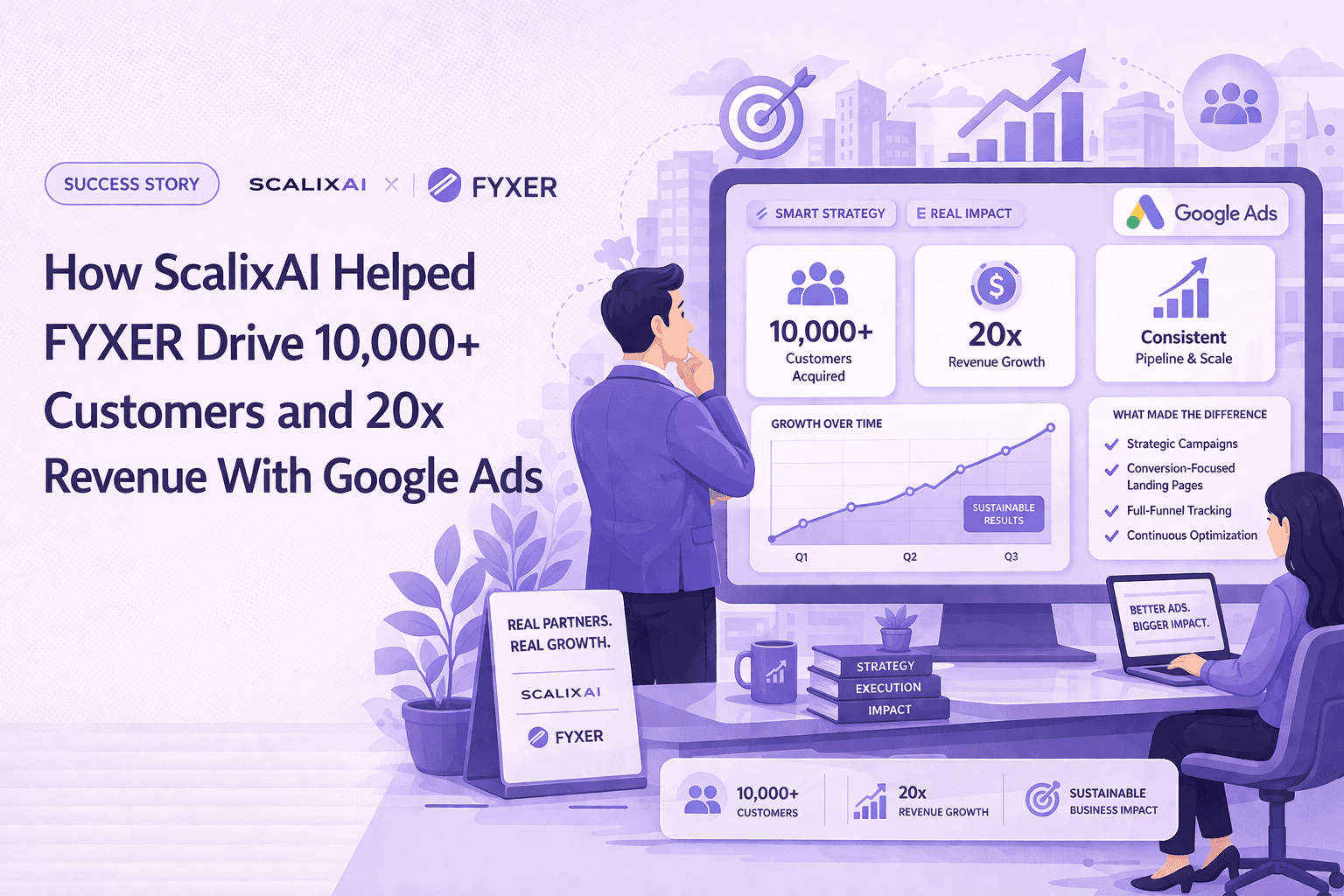
Today, the channel contributes 12% of FYXER's total ARR, has brought in over 10,000 customers, and helped scale revenue 20x during our partnership.
I created this post to tell you the full story of what was broken, what we rebuilt, and exactly how we did it.
What FYXER's Google Ads Account Looked Like Before
FYXER is an AI-powered email management product. The product is genuinely good. It solves a real problem that knowledge workers face every day, and the market for AI productivity tools is growing fast. The issue wasn't the product. It was the infrastructure around it.
Before ScalixAI, FYXER had been working with another agency. The campaigns were running, but the structure underneath was fragmented.
- Performance Max campaigns were absorbing most of the budget without any clear attribution to customer acquisition.
- Search campaigns were broad, poorly segmented, and had mixed intent levels that should never share the same ad group.
- There was no clean separation between branded traffic, competitor searches, and category-level demand.
- Technical issues, like the Gmail connection problem, were affecting account functionality.
- Also, the payment structure had errors, creating instability in campaign delivery.
None of this was visible in the top-line metrics, which is exactly why it had gone unaddressed.
- The conversion tracking setup was the most critical failure. Conversions were being counted in a way that gave Google's algorithm the wrong signal.
- Smart Bidding was optimising toward surface activity rather than real customer acquisition. The more the account spent, the more it optimised toward the wrong outcome.
This is the failure mode I see most often in B2B SaaS Google Ads accounts: campaigns that look functional from the outside, quietly running on broken foundations.
Click here to see how to run Google ads for B2B SaaS Google →
The Audit: What We Found and What It Meant

I ran a full Google Ads account audit before touching a single campaign. The audit covered campaign structure, match type logic, conversion tracking accuracy, search term coverage, landing page alignment, and budget allocation.
The findings were clear.
Performance Max was generating volume, but with no attribution reliability, a common problem in AI product advertising where the audience is broad and the algorithm has too much autonomy without enough signal.
Search campaigns were running on broad match without sufficient negative keyword coverage, which meant a meaningful percentage of spend was going to queries completely unrelated to FYXER's ICP.
The conversion tracking was counting the wrong events as primary conversions. This meant every bidding decision the algorithm made was informed by data that didn't reflect actual customers. Fixing this before anything else was non-negotiable. You cannot optimise an account that's measuring the wrong thing; you only make it more efficient at producing the wrong result.
Franky reviewed the audit findings and made the call to bring me on immediately. The rebuild started the same week.
The Rebuild: Audit → Restructure → Scale
Phase 1 — Fix the Foundation
The first action was rebuilding conversion tracking from scratch. Demo signups and free trial activations with intent signals became the primary conversion events. Proxy metrics, like page views and generic form fills, were removed from primary conversion tracking or reclassified as secondary.
Simultaneously, I worked with Google Cloud teams to resolve the technical infrastructure issues. Gmail connection problems and payment structure errors were cleared before a single campaign went live. There's no point rebuilding campaigns on a platform that has unresolved technical debt underneath it.
This is the part of Google Ads management that most agencies skip because it's unglamorous. But it's what everything downstream depends on.
Phase 2 — Restructure the Campaign Architecture
With clean tracking in place, I rebuilt the campaign architecture from the ground up. The account was organised into distinct intent tiers, exactly the approach I use across all B2B SaaS paid acquisition engagements.
Branded campaigns were isolated to efficiently protect existing demand.
Competitor campaigns, which included targeting searches such as "[competitor] alternative" and "[competitor] pricing," were built as a separate tier. These are the highest-intent clicks available in any Google Ads account, and FYXER had none before.
Category and solution-aware campaigns targeted buyers searching for AI email tools and productivity automation. And problem-aware searches from people who didn't yet know FYXER by name.
Performance Max was restructured with tighter asset groups, clearer audience signals, and explicit exclusions to prevent it from cannibalising the Search campaigns that were now doing the heavy lifting. For AI product advertising, PMAX works best as a scaling layer once Search has established baseline conversion data, not as the primary campaign type from day one.
Match types were tightened across the account. Broad match was restricted to campaigns with sufficient conversion volume to support it. Exact and phrase match dominated the early structure, with a negative keyword list built before campaigns went live to prevent broad match waste from the start.
Click here to see the ultimate Google Ads Strategy in 2026 →
Phase 3 — Landing Page and Offer Alignment
Traffic quality matters, but a well-targeted click that lands on the wrong page still doesn't convert. FYXER's landing pages needed to match the specific intent behind each campaign tier.
The competitor campaign traffic landed on a dedicated comparison page, positioning FYXER directly against the alternatives that buyers were already evaluating. The category campaign traffic landed on a page that led with the specific outcome the buyer searched for, not a generic AI productivity overview.
These are the landing page best practices that most media buyers don't touch because it lives outside the Google Ads interface. It's also where a significant share of conversion rate improvement comes from. A well-structured campaign driving traffic to a misaligned page is leaving most of its potential on the table.
Discover the proven strategies for improving conversion rates →
Phase 4 — Bidding Evolution
We started with manual CPC bidding and Target CPA on campaigns with sufficient conversion history. As conversion data accumulated and the algorithm had reliable signals to learn from, bidding evolved toward Target ROAS on the campaigns where customer acquisition value was clear.
The bidding progression mattered because Smart Bidding is only as good as the data it trains on. Nine years inside Google taught me one thing above all else: the algorithm rewards clean inputs. Structured campaigns, accurate conversion events, and patient bidding transitions produce compounding performance improvement. Rushing to automated bidding before the data exists is one of the most common Google Ads mistakes I see.
The account scaled to six-figure monthly spend across the US, UK, Australia, and Canada, markets that were added progressively as performance in each region validated expansion.
The Results
The numbers are real, and they're documented.
10,000+ new customers acquired through Google Ads. 20x revenue scaled during the ScalixAI partnership. 12% of FYXER's total ARR now comes directly from the channel. Six-figure monthly spend running profitably across four countries.
These results didn't arrive overnight. The first qualified customers came through within weeks of the rebuilt campaigns going live. Meaningful scale happened over months, as the algorithm accumulated conversion data, bidding strategies matured, and geographic expansion proved out.
Franky described the engagement directly: "From day 1, it felt like Waqas had become a part of our team. He knows his craft inside out and has helped us stand up a paid ads engine we have confidence in."
That confidence, the ability to look at the account and understand exactly what it's producing and why, is what sustainable paid acquisition actually looks like. It's the difference between a channel that produces unpredictable results and one that compounds.
See how ScalixAI helped Delve get $1.2M closed-won revenue within six months →
What This Means for Your AI or SaaS Product
FYXER's situation before ScalixAI is not unusual. Fragmented campaigns, wrong conversion tracking, Performance Max absorbing budget without attribution, and no competitor conquesting. These are the same structural problems that show up in the majority of AI startup Google Ads accounts we audit.
The channel works when the foundation is right. Google Ads for an AI product is a demand capture tool. This means that it intercepts buyers who are already searching for a solution in your category. FYXER's market has strong search intent. The buyers existed. The campaigns just weren't built to find them.
Understanding what Google Ads can and cannot do for your product is the starting point. For FYXER, Google captured demand that existed and wasn't being captured. For other products, the channel mix might look different. But the diagnostic is always the same: audit the foundation before scaling the spend.
If you are in a similar situation, book a free audit.


