





Key takeaways
The best B2B SEO tools aren't the most number of tools; they're the right ones for your stage and workflow.
B2B keyword research is about buyer intent at each funnel stage, not search volume alone.
Technical SEO gaps are invisible without an audit tool; broken crawlability kills content before it ranks.
Content optimization tools tell you what topics competitors cover that you're missing, and that gap costs rankings.
SEO reporting only compounds when it connects organic traffic to pipeline, not just impressions and clicks.
If you're building an SEO B2B strategy in 2026, the tools you pick will either speed up your work or bury you in data you never act on.
Most B2B SaaS teams have the opposite problem. They have way too many subscriptions and too little clarity. They're paying for overlapping tools, pulling reports nobody reads, and still wondering why organic isn't converting into pipeline.
The right SEO B2B stack isn't about having the most tools. It's about having the right ones for your stage, your team size, and your actual workflow.
This guide covers 13 tools that consistently show up across top-performing B2B SEO setups in 2026. We discuss what each one does, how to use it day-to-day, and whether the pricing makes sense. No fluff, no padding.
Why B2B SEO Without the Right Tools Is Just Guesswork
B2B SEO sounds straightforward until you're actually doing it.
You're targeting buyers who don't search the way consumers do. Their queries are specific, low-volume, and spread across a buying journey that can take three to nine months. A keyword with 50 monthly searches can be worth more than one with 5,000 only if the intent behind it is right.
The problem is you can't see any of that without tools.
Without the right B2B SEO tools, you're making decisions based on gut feel. You publish content and hope it ranks. You assume your site is technically healthy until something breaks. You think you understand what your competitors are doing, but you're really just guessing based on what you can see on the surface.
Here's what that looks like in practice:
You write a blog post targeting what you think is a high-intent keyword. It gets traffic but zero conversions.
- Without a content optimization tool, you don't know that the top-ranking competitors are covering three subtopics you completely missed.
- Without GA4 set up properly, you don't know that 80% of visitors are bouncing from that page in under 30 seconds.
- And without Search Console, you don't know the page is actually ranking for the wrong query entirely.
Every one of those problems is invisible without the right tools in place.
B2B SEO is also more competitive than most teams realize. Your competitors aren't just other companies in your space; they're industry publications, review platforms, and aggregator sites that have been building domain authority for years.
Competing with them manually, without data, is the fastest way to burn time and budget with nothing to show for it. The right tools don't replace strategy. But they make your strategy visible, measurable, and repeatable.
That's the real difference between SEO that compounds over time and SEO that feels like it's going nowhere.
The 5 Things Every B2B SEO Tool Stack Must Cover
Before you spend a dollar on SEO software, get clear on what your stack actually needs to do. Most B2B teams end up with overlapping subscriptions because they buy tools reactively: one for a specific problem, another because a competitor mentioned it, and another because of a free trial.
A well-built B2B SEO tool stack covers five distinct functions. If you have a gap in any one of them, the rest of your stack is working harder than it needs to.
1. Keyword and Intent Research B2B keyword research isn't about finding the highest volume terms. It's about identifying the specific queries your buyers use at each stage of the funnel, from problem-aware to solution-ready. You need a tool that surfaces intent signals, not just search volume numbers.
2. Technical SEO and Site Health: Search engines can't rank what they can't crawl. Broken links, redirect chains, duplicate content, missing metadata, and slow page speeds all quietly kill organic performance. You need a tool that audits your site the way a search engine does and flags issues before they compound.
3. Content Optimization: Getting to page one in B2B requires content that covers a topic with real depth. Tools in this category analyze what's actually ranking and tell you the related terms, questions, and subtopics your content needs to address. This is also what makes content eligible to be cited in AI-generated answers, critical for GEO and AEO visibility in 2026.
4. Performance Tracking and Analytics: Rankings are a leading indicator. What you actually care about is organic traffic converting into demo requests, trial sign-ups, and pipeline. Your stack needs at least one tool that connects SEO activity to real business outcomes, not just impressions and clicks.
5. Reporting: If your SEO data lives in five different dashboards that only you understand, it won't get acted on. B2B teams report upward. Your stack needs to produce clean, automated reports that leadership can read in two minutes and understand why organic is worth investing in.
The 13 tools in this guide are organized around these five functions. Every tool earns its place by covering at least one of them well.
Quick Comparison: At a Glance
[table]
Tool | Best For | Free Plan? | Starting Price
Semrush | All-in-one B2B SEO | Limited | $139.95/mo
Google Search Console | Organic performance monitoring | Free | Free
Screaming Frog | Technical SEO crawls | Limited | £259/year
Sitebulb | Visual technical audits | No | $13.50/mo
Surfer SEO | On-page content optimization | No | $99/mo
Clearscope | Content intelligence | No | $189/mo
Moz Pro | Rank tracking + authority | Limited | $99/mo
Google Analytics 4 | Web analytics | Free | Free
Frase | AI content briefs | No | $45/mo
MarketMuse | Content strategy + gaps | No | $149/mo
SE Ranking | Affordable all-in-one | No | $65/mo
BuzzSumo | Content research + ideation | No | $199/mo
Looker Studio | SEO reporting dashboards | Free | Free
[/table]
All-in-One B2B SEO Platforms
1. Semrush

What it does: Semrush is the most comprehensive all-in-one SEO platform on the market. For B2B teams, it covers keyword research, competitor gap analysis, site audits, rank tracking, backlink analysis, and content marketing, all under one roof.
Daily workflow: Start each Monday with the Site Audit report to catch any new technical issues. Use the Keyword Gap tool weekly to see what your competitors rank for that you don't. The Position Tracking dashboard becomes your north star. Check it daily once you've built out your target keyword list. For content, the SEO Writing Assistant inside Semrush integrates directly with Google Docs.
Why it works for B2B: The Keyword Magic Tool filters by intent. For B2B SaaS, you're not chasing volume. Instead, you're after low-volume, high-intent keywords that bring in qualified buyers. Semrush gives you the intent filter to do this properly.
Pros:
- Covers almost every SEO use case in one platform
- Strong competitor intelligence features
- Integrates with Google Analytics 4, Search Console, and HubSpot
Cons:
- Expensive for small teams
- Data can feel overwhelming without a clear workflow
- Some limits on daily keyword queries on lower plans
Pricing: Free limited plan. Pro at $139.95/mo, Guru at $249.95/mo.
2. Moz Pro

What it does: Moz Pro is built around three core things B2B SEO teams care about: keyword research, rank tracking, and backlink analysis. It's less feature-dense than Semrush, which makes it faster to act on.
Daily workflow: Use the Rank Tracker to monitor your priority keywords weekly. The Link Explorer is your go-to for analyzing a competitor's backlink profile before pitching a content asset for link acquisition. The On-Page Grader runs a quick check when you publish or update a page.
Why it works for B2B: Moz's Domain Authority (DA) metric, while not a Google ranking factor, is still one of the most widely used signals for evaluating link quality when doing outreach for B2B SEO.
Pros:
- Clean interface, easier for non-technical marketers
- Solid keyword difficulty scoring
- MozBar Chrome extension for quick on-page checks
Cons:
- Smaller backlink index than Semrush
- Rank tracking limited on lower plans
- Less useful for technical SEO depth
Pricing: Standard at $99/mo, Medium at $179/mo.
3. SE Ranking
What it does: SE Ranking is the most affordable full-featured SEO platform in this list. It covers keyword research, rank tracking, site audits, backlink monitoring, and competitor analysis, at roughly half the price of Semrush.
Daily workflow: For lean B2B marketing teams, SE Ranking's white-label reporting makes it easy to share progress with leadership or clients. Set up automated weekly rank tracking reports to hit inboxes every Monday. Use the On-Page SEO Checker before publishing any new content.
Why it works for B2B: If you're a B2B SaaS company under $5M ARR and can't justify Semrush pricing, SE Ranking is the most complete alternative. It's not a downgrade; it covers all core use cases.
Pros:
- Best value-for-money all-in-one tool
- Clean rank tracking with flexible reporting
- Solid site audit with actionable recommendations
Cons:
- Smaller database than Semrush or Moz
- Keyword data depth less granular on niche B2B terms
- Fewer third-party integrations
Pricing: Essential at $65/mo, Pro at $119/mo.
Technical SEO Tools
4. Google Search Console
What it does: Google Search Console (GSC) is the only tool that shows you exactly how Google sees your site. It tracks impressions, clicks, average position, Core Web Vitals, index coverage, and crawl errors, straight from Google itself.
Daily workflow: Check the Performance tab weekly. Filter by page and by query to spot pages that have high impressions but low CTR; these need better title tags and meta descriptions. The Coverage report catches indexing issues before they compound. For any new blog you publish, submit the URL for indexing immediately via the URL Inspection tool.
Why it works for B2B: It's free, and it's the ground truth. No third-party tool is more accurate than GSC for understanding what's actually ranking and what's not. Every B2B SEO setup starts here, regardless of what else you use.
Pros:
- Completely free
- Direct data from Google's own index
- Core Web Vitals monitoring is built in
Cons:
- Data is delayed by a few days
- Limited to 16 months of historical data
- No competitor data
Pricing: Free.
5. Screaming Frog SEO Spider

What it does: Screaming Frog crawls your website the way a search engine does, surfacing broken links, redirect chains, duplicate content, missing metadata, thin pages, and crawl depth issues. It's the standard tool for technical SEO audits.
Daily workflow: Run a full crawl once a month and after major site updates or migrations. Before any content audit, pull a crawl to identify orphaned pages, duplicate title tags, and pages with missing H1s. Pair it with Google Search Console and GA4 data for a complete picture of technical health.
Why it works for B2B: B2B SaaS sites often have complex URL structures, multiple product pages, and integration directories that accumulate technical debt fast. Screaming Frog finds it all in one crawl. At £259/year, it's the highest-ROI tool in any SEO stack.
Pros:
- Extremely thorough technical crawl
- Integrates with GA4, Search Console, and PageSpeed Insights
- One-time annual payment, not monthly
Cons:
- Desktop app — not cloud-based
- Steep learning curve for non-technical users
- Free version limited to 500 URLs
Pricing: Free up to 500 URLs. Paid at £259/year (~$325).
6. Sitebulb

What it does: Sitebulb does similar work to Screaming Frog, which is website crawls for technical SEO, but with visual site maps and prioritized recommendations that are far easier to share with developers and non-technical stakeholders.
Daily workflow: Use Sitebulb after each major content push or site update to check for internal link equity issues. The visual crawl maps are particularly useful for identifying orphaned pages and thin content clusters. Send the automated PDF audit to your dev team with issues already prioritized by severity.
Why it works for B2B: In B2B SaaS organizations, SEO often has to compete with engineering resources. Sitebulb's visual reports make technical issues digestible for product and engineering teams who don't speak SEO.
Pros:
- Best visual crawl maps of any tool
- Prioritized issue severity scoring
- Easier for non-SEO stakeholders to understand
Cons:
- Desktop app (cloud version is pricier)
- Less powerful than Screaming Frog for advanced custom extraction
- Smaller user community
Pricing: Desktop from $13.50/mo. Cloud from $198/mo.
Content Optimization Tools
7. Surfer SEO

What it does: Surfer SEO analyzes the top-ranking pages for your target keyword and tells you exactly how to optimize your content: keyword frequency, word count, heading structure, NLP terms, and content score. It's built for writers and SEO editors working on content at scale.
Daily workflow: Before writing any B2B blog post or landing page, run the keyword through Surfer's Content Editor first. Write directly in the editor to hit the content score in real time. Use the Audit feature on existing pages to find quick-win optimization opportunities on content that already ranks on page two.
Why it works for B2B: B2B content is dense and research-heavy. Surfer ensures you're not missing semantic terms that the top competitors are using, particularly important for complex topics like search engine ranking factors, where topical depth matters.
Pros:
- Real-time content scoring inside the editor
- Strong NLP keyword suggestions
- Integrates with Google Docs and WordPress
Cons:
- Over-reliance on its score can produce mechanical content
- Doesn't replace a solid content strategy
- Pricier for team plans
Pricing: Essential at $99/mo, Scale at $219/mo.
8. Clearscope

What it does: Clearscope is the premium content intelligence tool in this list. It uses IBM Watson NLP to analyze top-ranking content and surfaces the most important related terms and topics you need to cover to rank. It's built for teams that prioritize content quality over volume.
Daily workflow: Use Clearscope to build content briefs before handing topics to writers. After a piece is drafted, run it through the grader to find semantic gaps. It's especially powerful for refreshing older content. Input an existing URL, and Clearscope shows exactly what's missing.
Why it works for B2B: B2B buyers read deeply before making decisions. Clearscope helps ensure your content actually covers the topic comprehensively, not just surface-level enough to rank, but deeply enough to convert and be cited by AI systems for GEO and AEO visibility.
Pros:
- Best-in-class NLP content grading
- Clean, writer-friendly interface
- Strong for content refresh workflows
Cons:
- No keyword research or technical SEO features
- Expensive for small teams
- Credit-based model limits usage
Pricing: Essentials at $189/mo, Business at $399/mo.
9. Frase

What it does: Frase combines AI writing assistance with content optimization. It automatically generates content briefs from SERP analysis, builds outlines, and scores content against top-ranking competitors. Think Clearscope plus a writing assistant, at a lower price point.
Daily workflow: Use Frase to generate content briefs from scratch in under five minutes. For a B2B SaaS blog targeting a specific keyword, Frase pulls together the top results, common questions, and key topics to cover, saving hours of manual SERP research. The AI writing features handle first drafts that you then rewrite with your brand voice.
Why it works for B2B: When you're producing content at scale for multiple buyer stages, awareness (TOFU), consideration (MOFU), and decision (BOFU), Frase speeds up the research phase without sacrificing depth.
Pros:
- Fastest brief generation of any content tool
- Combines research and writing in one workflow
- Most affordable content intelligence option
Cons:
- AI writing quality needs heavy editing for B2B
- Content scoring less precise than Clearscope
- Limited integrations
Pricing: Solo at $45/mo, Basic at $115/mo.
10. MarketMuse

What it does: MarketMuse analyzes your entire content library and your competitors' to identify topic gaps, content quality scores, and priority pages to build or update. It's less a writing tool and more a strategic content planning tool.
Daily workflow: Use MarketMuse quarterly to audit your full content library and identify which topics you have authority in versus where you're thin. Before building a new content cluster, run a Compete report to see how your coverage compares to competitors across a given topic area.
Why it works for B2B: B2B SEO success is built on topical authority. MarketMuse maps that authority at scale, critical for SaaS growth strategies that rely on organic as a pipeline channel.
Pros:
- Best tool for content strategy and topic modeling
- Full-site content scoring in one view
- Strong for planning content clusters
Cons:
- Expensive for the level of use most teams need
- Steep learning curve
- Less useful for individual page optimization
Pricing: Free limited plan. Standard at $149/mo, Team at $399/mo.
Analytics & Reporting Tools
11. Google Analytics 4

What it does: GA4 is your source of truth for website behavior: sessions, engagement rate, conversions, traffic sources, and user journeys. For B2B SEO, it tells you which organic landing pages are actually driving form fills, demo requests, and pipeline.
Daily workflow: Set up conversion events for every meaningful action; form submits, demo requests, free trial sign-ups. Build a custom report that shows organic traffic, landing page, and conversion in one view. Review this weekly, not monthly. If a page ranks and gets traffic but converts at 0%, that's a content-to-offer mismatch worth fixing.
Why it works for B2B: Vanity metrics are the enemy in B2B. GA4 forces you to connect SEO activity to business outcomes. Paired with Search Console data, it's the most powerful free analytics combination available.
Pros:
- Completely free
- Deep conversion tracking when set up properly
- Integrates with Search Console, Looker Studio, and most CRMs
Cons:
- Complex setup for accurate conversion tracking
- Learning curve moving from Universal Analytics
- Data sampling on high-traffic sites
Pricing: Free. GA4 360 (enterprise) starts at $50,000/year.
12. BuzzSumo
What it does: BuzzSumo tracks which content is performing across the web, most shared, most linked, and trending by topic. For B2B SEO, it's primarily useful for content ideation, finding linkable asset opportunities, and monitoring competitor content performance.
Daily workflow: Use BuzzSumo monthly to research what content in your niche is generating links and shares. Before investing in a major content piece, check if similar content exists and how it performed. The Alerts feature notifies you when your brand or keywords get mentioned, useful for link reclamation.
Why it works for B2B: In B2B, content that earns links tends to be data-driven, research-based, or opinion-led. BuzzSumo shows you what's already working so you can build on proven formats rather than guessing.
Pros:
- Best tool for content ideation and trend research
- Brand monitoring and link reclamation alerts
- Identifies top-performing competitor content
Cons:
- Expensive relative to its narrow use case
- Not useful for technical SEO or keyword research
- Data can feel dated for niche B2B topics
Pricing: Content Creation at $199/mo, PR & Comms at $299/mo.
13. Looker Studio
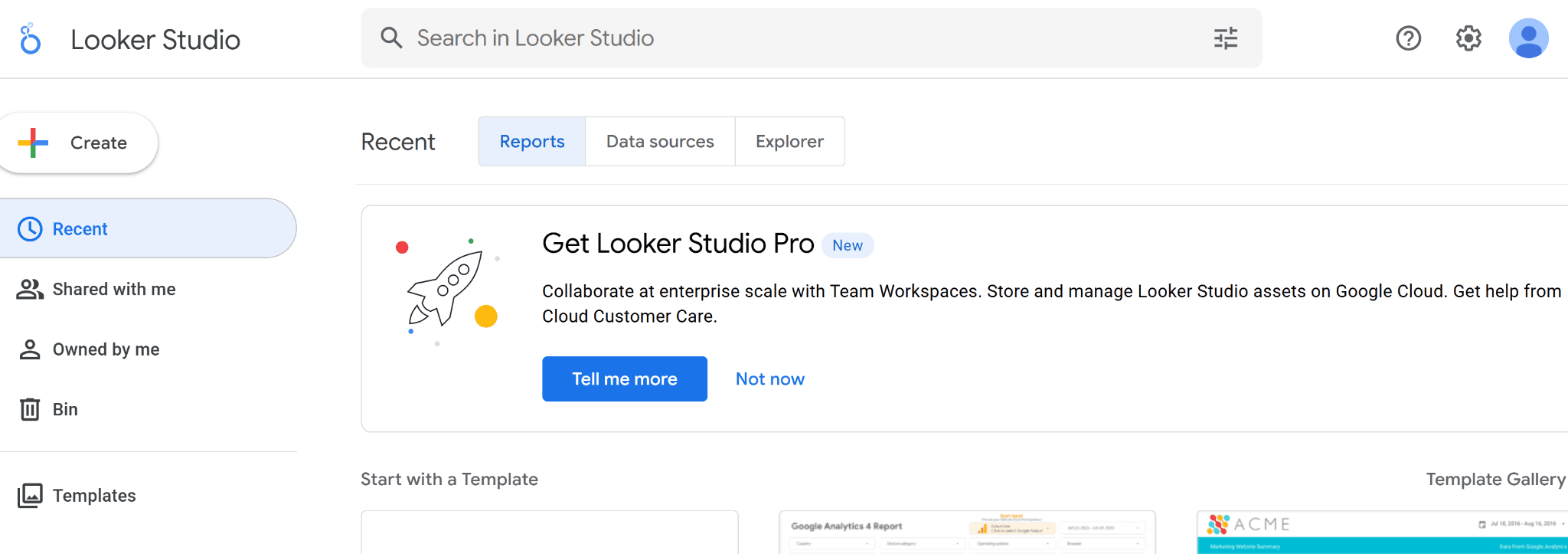
What it does: Looker Studio (formerly Google Data Studio) is a free reporting tool that pulls data from Search Console, GA4, Semrush, and other sources into custom dashboards. For B2B SEO teams, it's where you turn raw data into clean executive-ready reports.
Daily workflow: Build a single SEO dashboard that shows weekly organic traffic, top landing pages, keyword position changes, and conversion data, all in one place. Set it to refresh automatically and share the link with leadership. No more manual monthly reporting.
Why it works for B2B: B2B marketing teams are always reporting upward. Looker Studio eliminates the manual effort and lets you tell the SEO story in terms that leadership cares about, not impressions, but leads and pipeline.
Pros:
- Completely free
- Connects to dozens of data sources
- Automated reporting saves hours weekly
Cons:
- Requires some setup time initially
- Can be slow to load with large datasets
- No built-in SEO-specific templates by default
Pricing: Free.
Operational B2B SEO Tools
14. AI Assistants; Claude

What they do: AI assistants like Claude and ChatGPT don't replace dedicated SEO platforms, but they've become one of the most useful layers in a modern B2B SEO workflow. They accelerate the thinking-heavy, time-consuming tasks that sit between data collection and execution: content briefs, title tag testing, FAQ generation, schema markup drafting, internal linking recommendations, keyword clustering, and meta description variations at scale.
For B2B SEO specifically, where content needs to be technically accurate, deeply researched, and written for sophisticated buyers, AI assistants are most valuable as thinking partners and workflow accelerators, not autopilots.
Daily workflow: Use Claude or ChatGPT to turn a Semrush keyword cluster into a structured content brief in minutes. Feed in your Screaming Frog crawl data and ask it to prioritize the highest-impact technical fixes. Draft five title tag variations for a page you're trying to improve CTR on. Generate FAQ sections structured for AEO: direct answers first, then expanded explanation, exactly the format Google and AI systems prefer for featured snippets and AI Overview citations.
One particularly high-value use case for B2B SEO: use Claude to analyze your top-performing page and identify the semantic entities and related concepts it covers. Then compare that to a competitor page that outranks you. The gap is your content optimization brief.
Why it works for B2B: B2B content is dense. Research cycles are long. AI assistants compress the time between "we need a piece on this topic" and "here's a fully structured brief ready for a writer." For lean marketing teams running SEO alongside paid channels, that time saving is significant.
There's also a deeper strategic reason to use AI assistants in your SEO workflow in 2026: understanding how AI systems read and process content helps you optimize for them. The better you understand how Claude or ChatGPT interprets a page, for example, what it extracts, what it summarizes, what it cites, the better positioned your content is for GEO and AEO visibility across AI-powered search platforms.
Pros:
- Dramatically speeds up content and SEO workflow tasks
- Useful across every stage: research, writing, optimization, reporting
- Claude excels at structured reasoning tasks; strong for technical SEO analysis and content strategy work
- Both tools are constantly improving with new capabilities
Cons:
- Neither is a replacement for dedicated SEO data platforms, no keyword database, no rank tracking, no backlink index
- Output quality depends entirely on the quality of your prompts and the context you provide
- AI-generated content still needs human editing and fact-checking before publishing
- Can create a false sense of productivity if used to generate content at volume without a real strategy behind it
Pricing: Free plan available, Claude Pro at $20/mo.
How to Build Your B2B SEO Tool Stack
You don't need all 13 B2B SEO tools. Here's a practical stack by team size:
[table]
Team Stage | Recommended Stack
Solo or early-stage (0–2 people) | Google Search Console + GA4 + Frase + Screaming Frog
Growing team (2–5 people) | Semrush or SE Ranking + Surfer SEO + Screaming Frog + GSC + GA4 + Looker Studio
Scaling team (5+ people) | Semrush + Clearscope or MarketMuse + Screaming Frog + Sitebulb + GSC + GA4 + Looker Studio
[/table]
The three free tools, Google Search Console, Google Analytics 4, and Looker Studio, belong in every stack at every stage. Everything else depends on your budget and where your biggest gaps are.
If your biggest gap is technical SEO, prioritize Screaming Frog. If it's content quality, Surfer SEO or Clearscope. If it's keyword and competitor intelligence, Semrush or SE Ranking. If you're already strong on strategy but weak on reporting, Looker Studio will have an immediate impact.
One more thing worth noting: SEO tools and PPC tools often overlap in competitive intelligence. If you're also running paid campaigns alongside organic, our guides on PPC competitor research tools and best PPC spy tools show you how the two stacks can complement each other.
Final Thought
The best B2B SEO tool is the one your team will actually use consistently. A $500/month platform that sits unused is worse than a $65/month tool that gets reviewed every week.
Start lean. Get the workflow right with two or three core tools before adding more. And always connect what you're tracking back to the pipeline, not just rankings.
But here's something worth being honest about. Tools only work when someone knows how to use them strategically.
Semrush won't tell you which keywords align with your buyer's journey. Screaming Frog won't prioritize which technical issues actually affect revenue. And Clearscope won't build you a content cluster that converts.
The tools surface the data, but turning that data into organic growth that fills your pipeline is a different skill entirely.
That's exactly what Scalix AI does.
We provide done-for-you SEO services built specifically for B2B SaaS companies, from technical audits and keyword strategy to content execution and performance reporting tied to real business outcomes: Pipeline.
We've been recognized as one of the best SEO agencies in the US, not because we chase rankings, but because we build SEO systems that actually convert.
If you're at the stage where you know SEO matters but don't have the time, team, or expertise to execute it properly, that's exactly who we built Scalix AI for.
Book a free audit, and we'll show you exactly where your organic gaps are, what your competitors are doing that you aren't, and what a realistic SEO roadmap looks like for your business in 2026.


