


High CAC Is a Structure Problem.
We'll show you exactly which of the 5 your account has.
Share this Article



Key takeaways
Google Ads for AI startups' high CAC is a structural problem.
Broad match on AI keywords funds irrelevant traffic, and consumer queries eat B2B budget silently.
Training Smart Bidding on form fills instead of CRM signals optimises toward the wrong buyer.
Targeting competitor keywords delivers the highest-intent clicks, yet most AI startups never build it.
Category creation and demand capture require different strategies; conflating them kills efficiency.
If you're running Google Ads for your AI startup and your CAC is climbing despite reasonable spend, you're not alone — and the problem is almost never what your Google rep tells you it is.
I spent nine years inside Google. I've reviewed hundreds of B2B SaaS and AI company accounts since. The same five structural problems show up in AI startup paid acquisition consistently, and every one of them is fixable. But you have to diagnose them correctly first.
The average B2B SaaS CAC is around $1,200 per customer.
For AI products specifically, it's often significantly higher, not because the channel doesn't work, but because AI products carry a set of advertising challenges that standard campaign setups are not designed to handle. Abstract value propositions, limited search volume, category creation dynamics, and poor CRM feedback loops all compound into a CAC number that makes your CFO nervous and your board skeptical.
This post covers the five reasons Google Ads CAC is systematically higher for AI companies — and what to do about each one.
The CAC Reality Check for AI Startups
Before diving into the problems, let's anchor to the numbers.
B2B SaaS companies average $1,200 per customer acquired, and bottom-quartile performers spend $2.82 to acquire just $1 of new ARR. For AI startups, where product categories are often undefined, search volumes are thin, and buyers need more education before converting, these numbers get significantly worse before any optimization is applied.
The median CAC-to-new-ARR ratio across SaaS rose 14% in 2024 alone. The trend is moving in the wrong direction for everyone, but AI companies get hit harder because of how their specific product and market dynamics interact with how Google Ads actually works.
Let's get to the why.
Reason 1: You're Trying to Capture Demand That Doesn't Exist Yet
This is the category creation vs demand capture problem, and it's the most expensive mistake AI startup founders make on Google Ads.
Google Ads is a demand capture tool. It intercepts buyers who are already searching for a solution. If your AI product is genuinely new, a category that didn't exist 18 months ago, there may not be enough search volume to build a profitable paid search channel on product terms alone.
For example, bidding on "AI workflow automation assistant" or "LLM-powered customer support tool" may sound right at first. But if only 200 people per month are searching those terms in the US, you're fishing in a very small pond with a very expensive rod.
What Google reps will tell you: activate Performance Max and let the algorithm find demand across all surfaces.
What actually happens: PMAX serves your ads to broad, low-intent audiences, burns budget on discovery placements, and reports conversions that don't map to real pipeline.
The fix: Stop leading with your product category. Start leading with the problem your buyer already searches for. A buyer who types "reduce customer support response time" is the same buyer who eventually wants your AI tool. They just don't know your category name yet. Build campaigns around the problem-aware search terms first. Your product keywords can run alongside at a lower budget.
This approach lowers your effective CPC, improves Quality Score for AI keywords, and reaches buyers at a moment when they're genuinely open to a new solution.
Reason 2: Broad Match Is Absorbing Your Budget Without Telling You
Broad match waste is disproportionately damaging for AI products because AI-adjacent terms pull in an enormous range of irrelevant queries.
For example, "AI productivity tool" on broad match will trigger searches for AI art generators, AI homework tools, AI essay writers, and dozens of other categories that share a keyword pattern but have nothing to do with your buyer.
WordStream’s analysis of 15,000+ Google Ads accounts found that businesses waste over $1,000 per month on non-converting clicks, often due to poor targeting and a lack of optimization.
For AI tools, that number runs higher because the vocabulary around AI is shared across consumer products, enterprise tools, academic research, and job seekers, all in the same keyword namespace.
What Google reps recommend: keep broad match enabled because it helps the algorithm learn.
What that advice omits: the algorithm learns from whatever conversions you're tracking. If your conversion events aren't tightly mapped to qualified pipeline moments, broad match trains the algorithm to find more of the wrong people efficiently.
The fix: Audit your search term report immediately. Pull the last 90 days and filter for queries that spent more than $50 with zero conversions. Add a negative keyword list specifically for AI-adjacent consumer terms: AI image, AI art, AI essay, AI homework, AI course, AI jobs, AI resume. Run your primary campaigns on phrase and exact match until you have conversion data that reflects real pipeline.
Broad match can return later, once the algorithm has the right signal to work from.
Find high-intent PPC keyword ideas →
Reason 3: Your Landing Page Creates a Search Intent Mismatch
A buyer searches "automate compliance monitoring with AI." Your ad is relevant. Your Quality Score is acceptable. But your landing page opens with a generic headline about your AI platform's capabilities and a demo form that asks for company size, team size, use case, and annual revenue before showing them anything of value.
That search intent mismatch is why your conversion rate is 0.8% when it should be 3–4%.
Search intent mismatch is one of the most commonly under-discovered CAC drivers in the AI product Google Ads strategy. The keyword and the ad can be well-matched, but if the landing page doesn't immediately reflect the specific intent behind the search, the bounce happens before the form is ever considered.

I saw this clearly with FYXER AI, an AI email management product. Their campaigns were live and spending, but the landing page spoke to broad productivity benefits rather than the specific outcome the buyer searched for.
After aligning landing page messaging directly to the search intent of each campaign tier, qualified demo volume increased materially, and acquisition costs dropped.
FYXER now runs six-figure monthly Google Ads spend across the US, UK, Australia, and Canada, with Google contributing 12% of total ARR.
The fix: Every campaign tier needs its own landing page. Not a different headline, a different page, built around a specific buyer intent. A buyer searching for "AI compliance tool SOC 2" lands on a page that leads with SOC 2 outcomes. A buyer searching "AI customer support automation" lands on a page that leads with support ticket reduction. The ad gets the click. The landing page closes the conversion. Treating them as separate jobs, with separate pages, is what increases your conversion rate from under 1% to above 3%.
See all the landing page best practices for high conversion rates →
Reason 4: You're Ignoring Competitor Conquesting
Most AI startup founders spend their entire paid media budget on branded and category terms. They ignore competitor conquesting entirely, either because it feels aggressive or because nobody set it up.
This is a significant missed opportunity. Look at these competitor keywords examples:
- [competitor name] alternative
- [competitor name] pricing
- [competitor name] vs
These are keywords that capture buyers who are already in the evaluation stage. These are the highest-intent clicks available in any AI product Google Ads strategy. The buyer isn't researching a category. They're comparing vendors. They already have budget approval. They're already speaking to sales teams.

For Delve, an AI-native compliance automation platform competing against Drata and Vanta, competitor conquesting was a core part of the Google Ads rebuild that ScalixAI ran from April 2025.
Buyers searching for "Drata alternative" and "Vanta pricing" were intercepted by Delve's campaigns, directed to a dedicated comparison landing page, and converted into qualified demos.
The result was $5.59M in Google Ads-attributed pipeline and $1.04M in closed-won revenue in a category where Delve competed against better-funded, more established players.
The fix: Build a dedicated competitor campaign with its own ad group per competitor. Write landing page copy that acknowledges the comparison directly. Don't pretend the buyer wasn't searching for your competitor. Create a landing page for each comparison that addresses the specific evaluation criteria a buyer switching from that competitor would care about. Also, set bids conservatively at first and let conversion data guide scaling.
This campaign tier will consistently deliver your lowest CAC and your highest-intent leads.
Click here to see the best Google Ads strategy for startups →
Reason 5: Your Conversion Tracking Has No CRM Signal Feedback
This is the one that causes AI startup founders the most damage, and it's the one that's hardest to see from inside the account.
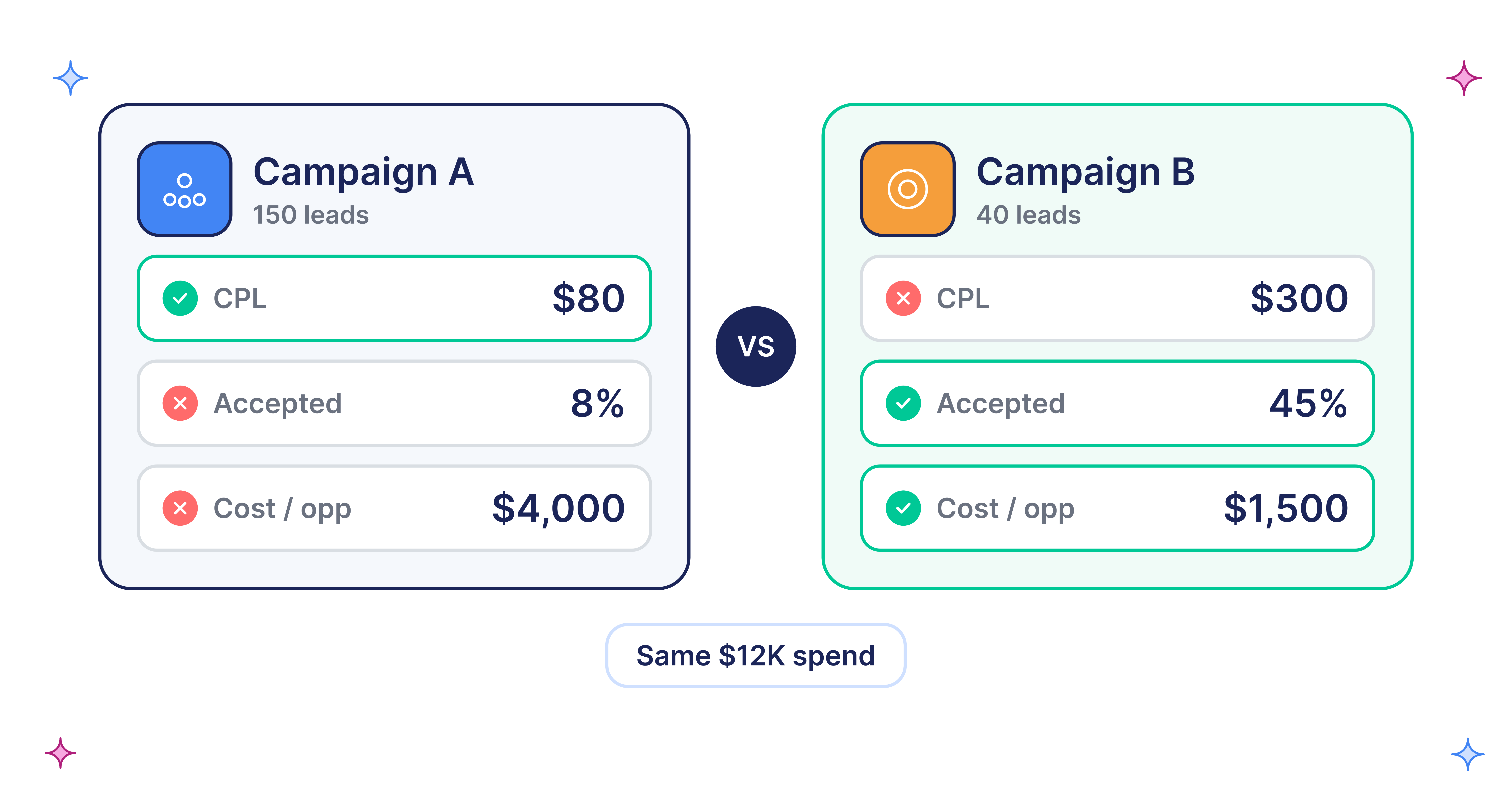
If your primary conversion event is a form fill or a thank-you page view, you are training Google's Smart Bidding algorithm to find more people who fill out forms. That is not the same as training it to find people who become paying customers.
In B2B SaaS, especially for AI startups with 30–90 day sales cycles, the gap between “filled out a form” and “closed deal” is enormous. If that gap isn't fed back into your bidding system, your CAC will keep climbing as the algorithm optimises toward the wrong signal.

With PAM, a voice AI platform for car dealerships, the previous agency had no CRM linkage. There was no feedback loop between ad spend and sales outcomes. Campaigns were generating activity. Revenue wasn't moving.
After rebuilding the account with proper attribution, CRM integration, and offline conversion imports, $72,000 in ad spend produced $234,000 in annual contract value, a 3.25x return, with three enterprise deals closed.
The fix: Set up offline conversion imports from your CRM into Google Ads. Map your primary conversion event to demo bookings confirmed by your sales team, not raw form fills. Import SQL signals back into the bidding algorithm so Smart Bidding learns from the closed pipeline, not surface activity.
This one change, which takes a developer a few hours to implement, is often the highest-leverage action available in a struggling AI product Google Ads account.
Check out our 5-Step Google Ads Attribution Setup for B2B SaaS →
What Google Reps Actually Recommend vs. What Works
Google reps aren’t trying to hurt you, but they’re often more focused on increasing your ad spend, not your results.
When your CAC is high, a Google rep will typically recommend: activating Performance Max to access additional inventory, enabling broad match to expand reach, increasing budget to give the algorithm more data, and turning on auto-applied recommendations.
Some of these have merit in the right context. Most of them are wrong for an early-stage AI startup spending $5K–$20K/month with a limited ICP and a 60-day sales cycle.
The advice that actually reduces AI startup Google Ads CAC is less exciting: tighten match types, build the negative keyword list, fix the CRM feedback loop, create intent-matched landing pages, and add competitor campaigns before touching the budget. None of that is what Google reps lead with. All of it is what moves the numbers.
Running Google Ads for your AI startup? Get some tips from an Ex-Googler →
The CAC Reduction Framework for AI Startup Google Ads
[table]
Problem | Symptom | Fix
Category creation vs demand capture | Low search volume, high CPCs | Bid on problem-aware terms, not product names
Broad match waste | Budget spending with no pipeline | Phrase/exact match + 90-day negative keyword audit
Search intent mismatch | Low conversion rate despite clicks | One landing page per campaign intent tier
No competitor conquering | High CPL on category terms only | Dedicated competitor campaigns with comparison pages
No CRM signal feedback | CAC climbing despite optimisation | Offline conversion imports, demo bookings as primary event
[/table]
Is Google Ads the Right Paid Acquisition Channel for Your AI Startup?
Google Ads works for AI startup paid acquisition when two conditions are met:
- Your product category has search intent; buyers are actively Googling for a solution in your space
- Your ACV supports the economics of paid acquisition.
If you're a PLG AI product with a $29/month plan and no sales team, combining SEO and PPC will serve you better than search-only at high spend. If you're a B2B AI tool with a $15K+ ACV and an active sales motion, Google Ads is likely your most efficient demand capture channel, as long as the account is built for pipeline, not for clicks.
The framework is the same one we applied at FYXER, Delve, and PAM: structure the account around intent tiers, fix the conversion tracking before scaling, feed CRM signals back into the algorithm, and let data, not spend, drive decisions.
The Bottom Line
Google Ads for AI startups produces a high CAC when the account is built for the wrong signal, and almost every AI startup account we audit is built for the wrong signal.
The five problems I discussed are structural, not cosmetic. Increasing the budget before fixing the CAC problem makes it worse, not better.
The fix in every case starts the same way: audit what's actually happening in the account before spending another dollar justifying what you hope is happening.
If your paid acquisition numbers aren't making sense, ScalixAI will tell you exactly why. Book a free audit, and we'll tell you exactly why.

.webp)
