Fix Your Google Ads
Get a free SaaS growth audit today
Share this Article


Key takeaways
You should know how google ads work if you run a SaaS company.
Google Ads captures high-intent buyers actively searching for SaaS solutions.
Quality Score directly reduces CPC and improves overall ad performance.
Ad Rank rewards relevance more than simply higher bidding budgets.
Poor attribution leads to incorrect Google Ads optimization decisions.
If you run a SaaS company and you want to learn how Google Ads work, this guide is for you.
Google Ads generated over $264.6 billion in revenue in 2025. That is not because the platform is simple. It is because the platform is powerful when you know what you are doing. The problem is that most people do not.
In this guide, we break down exactly how Google Ads works. And that means understanding the mechanics of it so that you know how you’re spending every single dollar.
Let’s get started.
What Is Google Ads?
Google Ads is Google's online advertising platform. It lets you place ads in front of people who are actively searching for what you sell. You pay when someone clicks your ad. That is why it is called pay-per-click (PPC) advertising.
Here is what makes Google Ads different from every other ad platform: intent.
When someone types "best project management tool for remote teams" into Google, they are not scrolling. They are looking. They have a problem, and they want a solution right now. Google Ads puts your product in front of that person at that exact moment.
Compare that to meta ads, where you interrupt someone watching cat videos. Google catches people when they are already raising their hand. That is why Google search ads remain the highest-intent paid channel in digital marketing.
As of 2026, Google holds 89.8% to 90% of global search traffic across all devices. If your buyers are searching for solutions online, they are searching on Google. Period.
Discover which platform brings more ROI: Meta Ads or Google Ads here ->
How Does the Google Ads Auction Work? A Step-By-Step Process
Every time someone types a query into Google, an auction happens behind the scenes. This auction decides which ads show up, in what order, and how much each advertiser pays. Here’s how it happens:
Step 1: You Choose Your Keywords
Keywords are the search terms you want your ad to show up for. If you sell cybersecurity software, you might bid on keywords like "endpoint security platform" or "best cybersecurity tools for startups."
Choosing the right keywords is the foundation of everything. Get this wrong, and you will show up in front of people who will never buy from you. Solid PPC keyword research is the difference between a campaign that works and one that burns cash.
Step 2: You Set Your Bid
Your bid is the maximum amount you are willing to pay for a single click on your ad. This is called your Max CPC (cost per click).
Important: You almost never pay your full bid. Google uses a modified second-price auction. That means you only pay enough to beat the advertiser below you, plus one cent. So if your max bid is $10 and the next highest competitor would need $6.50 to win, you pay roughly $6.51.
Step 3: Google Calculates Your Ad Rank
This is where it gets interesting. Google does not just give the top spot to the highest bidder. It uses a formula called Ad Rank:
Ad Rank = Max CPC x Quality Score + Ad Extensions Impact
Your Quality Score is a rating from 1 to 10 that Google assigns to each keyword based on three factors:
- Expected Click-Through Rate (CTR): How likely people are to click your ad based on its past performance.
- Ad Relevance: How closely your ad copy matches the search query.
- Landing Page Experience: How useful, fast, and relevant your landing page is after someone clicks.
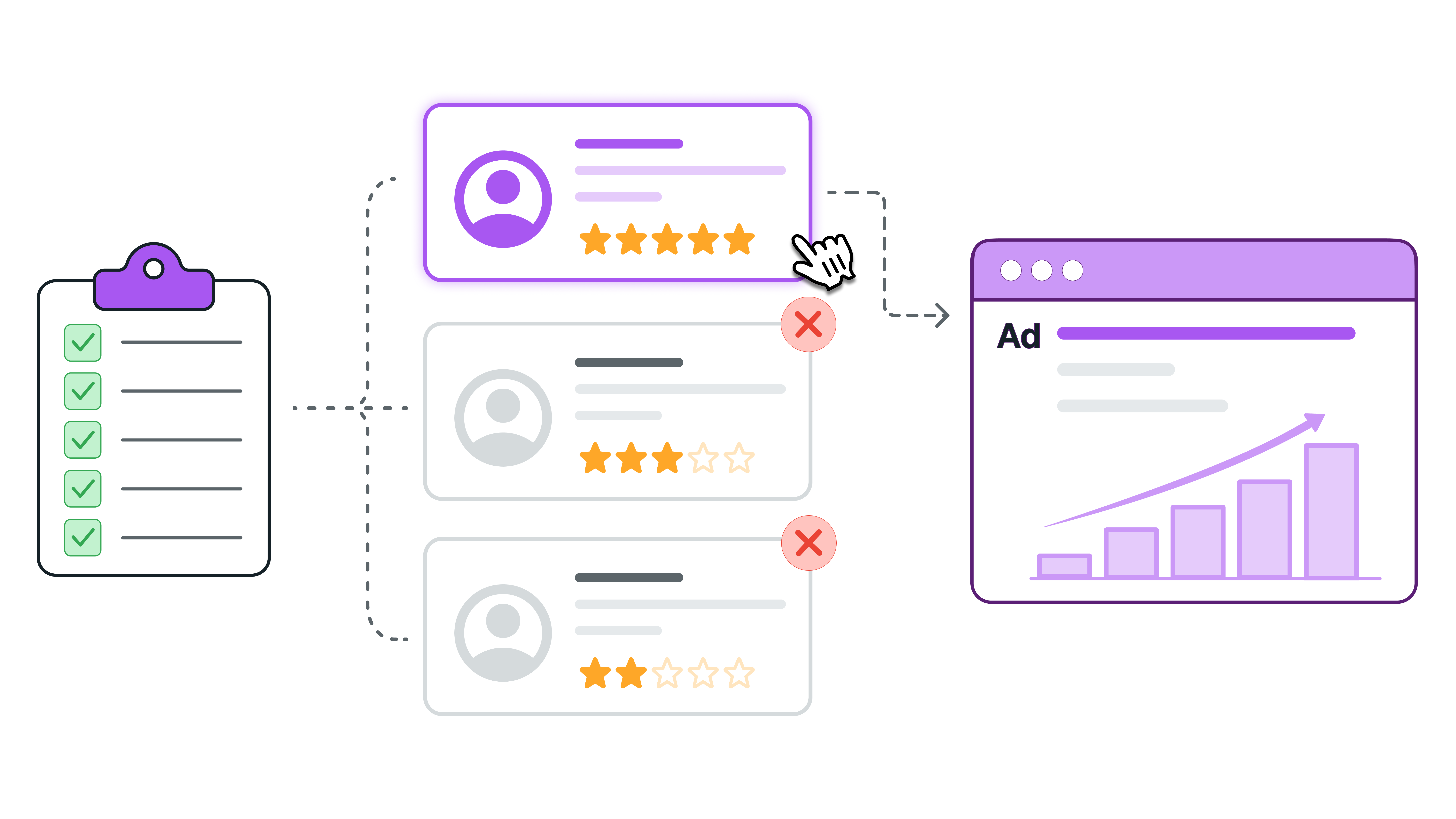
This means a smaller company with a great ad following landing page best practices can outrank a bigger competitor that simply bids higher. Google rewards relevance, not just budget.
Step 4: Google Picks the Winners
Based on Ad Rank scores, Google decides which ads appear and in what position. The ad with the highest Ad Rank gets position one. The second highest gets position two. And so on.
Ads with low Ad Rank scores might not show at all, even if the advertiser bid a lot of money.
Step 5: You Pay (Only if Someone Clicks)
You only pay when someone actually clicks your ad. Not when they see it. The amount you pay is calculated with this formula:
Actual CPC = (Ad Rank of the competitor below you / Your Quality Score) + $0.01
This is why Quality Score matters so much. A higher Quality Score literally lowers your cost per click. You pay less for the same position. That is free money if you know how to optimize for it.
Based on an analysis of 16,000 campaigns, the average cost per click across US search advertising hit $5.26 in 2025. But for B2B SaaS, your CPC will depend heavily on your industry, competition, and how well your campaigns are built.
What Are the Different Google Ads Campaign Types?
Google Ads is not just one thing. There are several campaign types, each designed for a different goal. Here is what you need to know about each one.
Search Campaigns
Search campaigns are the text ads that appear at the top of Google search results when someone types in a relevant query.
For B2B SaaS companies, search campaigns are where you catch the buyers with high purchase intent. Someone searching "CRM software for sales teams" is much further along the buying journey than someone scrolling LinkedIn.
Search campaigns use responsive search ads where you provide multiple headlines and descriptions, and Google's AI tests different combinations to find what performs best.
In 2026, Google introduced AI Max for Search campaigns, which expands your ads into new relevant queries using AI-based matching and dynamically customizes your ad creative for each search. This means your ads can reach queries you did not even think to bid on, as long as they are relevant.
Check out how to use AI for Google Ads
Performance Max Campaigns
Performance Max (PMax) is Google's AI-powered campaign type that runs ads across every Google channel from a single campaign. That includes Search, YouTube, Display, Discover, Gmail, and Maps.
You provide your goals, budget, creative assets, and audience signals. Google's machine learning handles the rest.
PMax requires careful handling, especially in B2B SaaS. Without strong audience signals and conversion data, the AI can spend your budget on low-quality traffic. This is one of the most costly ad mistakes we see with SaaS companies.
Display Campaigns
Display campaigns show visual banner ads across Google's Display Network, which includes over 2 million websites, apps, and Google properties like YouTube.
Display ads are great for brand awareness and retargeting ad campaigns. If someone visited your website but did not book a demo, you can show them display ads as they browse other sites to stay top of mind.
The average CPC for Display Ads is about $0.63, much cheaper than Search. But the intent is lower, so conversion rates are typically lower, too.
Demand Gen Campaigns
Demand Gen replaced the old Discovery campaigns. These are visually rich ads that appear across YouTube, Discover, and Gmail.
Think of Demand Gen as the Google equivalent of social media ads. You are reaching people before they are actively searching.
For B2B SaaS companies that understand the difference between demand and lead generation, this campaign type can help build awareness with your target audience before they ever type a search query.
Video Campaigns (YouTube)
Video campaigns let you run ads on YouTube, the second largest search engine in the world. YouTube video ads have a median ROI of 2.70x, which is competitive with Meta and TikTok.
For B2B SaaS, YouTube is underused. Product demos, customer testimonials, and thought leadership videos can reach decision-makers while they are consuming content.
Shopping Campaigns
Shopping campaigns show product listings with images, prices, and descriptions. These are mostly relevant for e-commerce and not typically used by B2B SaaS companies. If you are selling software subscriptions, skip this one.
How Google Ads Bidding Works
Bidding is how you tell Google what you are willing to pay. But in 2026, bidding is no longer just about setting a number. Google offers several bidding strategies that range from full manual control to complete AI automation.
Manual CPC
You set the exact max bid for each keyword. You have full control, but it requires constant monitoring. This is becoming less common as Google pushes toward automation.
Enhanced CPC
Google adjusts your manual bids up or down based on how likely a click is to convert. It is a hybrid between manual control and automation.
Target CPA (Cost Per Acquisition)
You tell Google the average amount you want to pay for a conversion (like a demo booking). Google's AI adjusts bids in real time to hit that target. This works well for Google Ads SaaS campaigns that have enough conversion data.
Target ROAS (Return on Ad Spend)
You set a target return, and Google optimizes bids to hit it. This is more common in e-commerce, but some B2B SaaS companies with strong revenue tracking use it.
Maximize Conversions
Google spends your entire daily budget to get as many conversions as possible. No target, just volume. Be careful with this one because Google will spend aggressively.
Maximize Clicks
Google gets you as many clicks as possible within your budget. Good for driving traffic, but not always good for driving quality leads.
For most B2B SaaS companies, Target CPA is the go-to strategy once you have 30 or more conversions per month. Before that, Manual or Enhanced CPC gives you better control while you build up data.
How Much Does Google Ads Cost?
There is no single answer. Your cost depends on your industry, competition, keywords, and how well your campaigns are built.
B2B SaaS keywords can range from $3 to $50+ per click, depending on the category. High-value keywords like "enterprise security software" will cost much more than "project management tool."
The average click-through rate across all industries is 6.66% on Search. The average conversion rate is 4.40%, though B2B tends to be slightly lower because of longer sales cycles.
What matters more than CPC is your customer acquisition cost (CAC) and how it relates to your customer lifetime value (LTV).
If you are paying $30 per click but your ACV is $25,000, the math works. If your ACV is $500, it probably does not. Understanding your high CAC issues is critical before scaling spend.
Check out the general practice for Google Ads agency pricing.
How to Set Up a Google Ads Campaign
Here is a simplified walkthrough of what it takes to get a campaign live.
1. Create Your Google Ads Account
Go to ads.google.com and sign up. Link your Google Analytics and Google Search Console for better tracking and data.
2. Define Your Campaign Goal
Google will ask what you want to achieve: sales, leads, website traffic, brand awareness, or app promotion. For B2B SaaS, "Leads" is almost always the right choice.
3. Choose Your Campaign Type
Start with Search campaigns. They give you the most control and capture the highest intent traffic. You can add Performance Max or Display later once your Search campaigns are generating consistent results.
4. Set Your Budget and Bidding
Set a daily budget you are comfortable with. Start with Manual CPC or Enhanced CPC so you can control costs while learning. You can switch to automated bidding once you have conversion data.
5. Build Your Keyword List
Research and select keywords that your ideal buyers are searching for. Use a mix of branded terms (your company name), competitor terms, and product category terms. Group similar keywords into tight ad groups.
This is where many companies go wrong. Broad, unfocused keyword lists waste money. Tight, intent-driven keyword groupings drive results.
Discover our optimization checklist guide to see the steps you need to take to build your own keyword list.
6. Write Your Ad Copy
For responsive search ads, you will provide up to 15 headlines and 4 descriptions. Google tests combinations to find what performs best. Your landing page copy should be clear about what you offer, who it is for, and what the next step is.
Strong B2B SaaS ad copy speaks directly to the buyer's pain point. Not "Best Software Solution" but "Cut Onboarding Time by 60%. Book a Demo."
7. Build Your Landing Page
This is where most campaigns fail. Your ad can be perfect, but if the landing page is slow, confusing, or generic, people will bounce. Your landing page should match the promise of your ad, load fast, and have one clear call to action.
A good landing page can increase your conversion rate without spending an extra dollar on ads.
8. Set Up Conversion Tracking
If you do not track conversions, you are flying blind. Set up tracking for demo bookings, free trial signups, or whatever your primary conversion event is. Without this, Google's AI cannot optimize, and you cannot measure ROI.
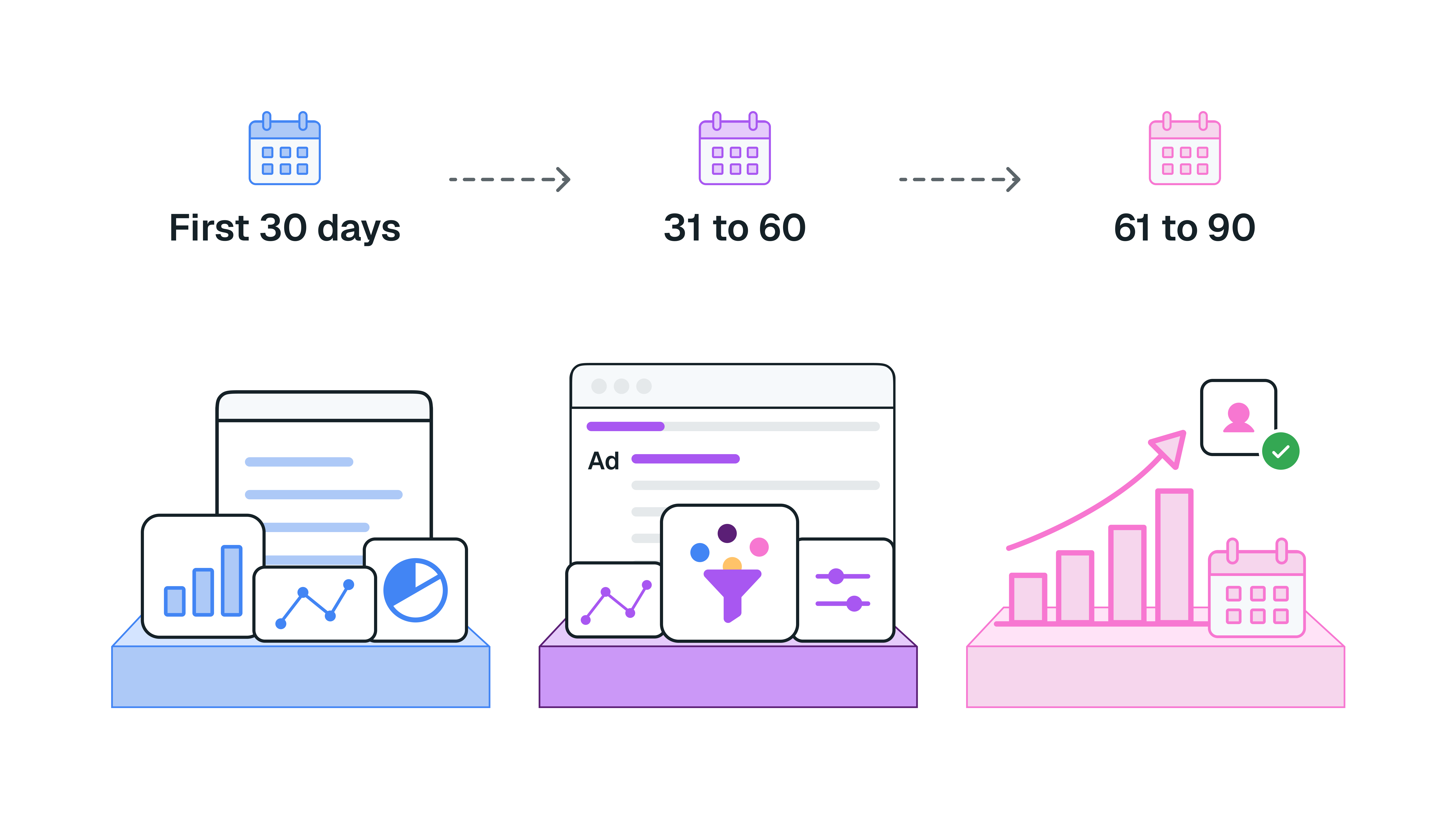
For B2B SaaS, a proper ad attribution SaaS setup is non-negotiable. Your sales cycles are 45 to 90 days. Same-month attribution tells you nothing useful.
Why Google Ads Works for B2B SaaS
Google Ads is not just for e-commerce stores and local businesses. It is one of the most effective channels for B2B SaaS companies when it is run properly.
Here is why:
You capture demand that already exists.
When a VP of Engineering searches "best CI/CD platform," they have a problem they need solved. Google puts your product in front of them at that exact moment. No other channel gives you that level of intent.
You reach buyers across the entire journey.
Search campaigns capture high-intent buyers who are ready to evaluate. Demand Gen and Display campaigns reach buyers earlier in their journey, before they start searching. Together, these campaign types cover the full funnel from top funnel marketing to bottom-of-funnel conversion.
You can measure everything.
Unlike brand marketing or content that takes months to show results, Google Ads gives you real-time data on impressions, clicks, conversions, and cost. You know exactly what is working and what is not.
You can scale predictably.
Once you find a campaign structure that works, you can increase budget and scale results in a linear way. This is the pipeline predictability that every SaaS founder and growth leader is looking for.
The companies that struggle with Google Ads are almost always making one of two mistakes. Either their targeting is too broad (showing ads to people who will never buy) or their measurement is wrong (cutting campaigns before they have a chance to compound).
That’s what happened when PAM reached out to us. They had a broken campaign structure, poor attribution, and a weak creative strategy. We did a full account audit, clearly defined their ICPs, and did a full funnel setup. Within months, they closed 3 enterprise deals.
Check out our breakdown of in-house vs agency for B2B SaaS lays out the real trade-offs.
Google Ads vs Other Ad Platforms for B2B SaaS
[table]
Platform | Role | Strength | Weakness
Google Ads vs Meta Ads | Demand capture vs demand creation | Google = high-intent leads | Meta = weaker B2B targeting (no strong firmographic data)
Google Ads vs LinkedIn Ads | Intent vs targeting precision | LinkedIn = job title, company size, seniority targeting | Higher CPC, slower conversions
Google Ads vs SEO | Paid vs organic | Google Ads = instant leads | SEO = slow but compounding
[/table]
Common Google Ads Mistakes B2B SaaS Companies Make
Here are the 5 Common Google Ads Mistakes B2B SaaS Companies Make:
- Bidding on keywords that are too broad. Targeting "software" instead of "inventory management software for wholesalers" wastes budget on clicks that never convert.
- Ignoring negative keywords. If you sell enterprise software and someone searches "free project management tool," you do not want to pay for that click. Negative keywords block irrelevant searches.
- Sending traffic to the homepage. Your homepage is not a landing page. It has too many options and no clear path to conversion. Every ad should link to a dedicated landing page that matches the search intent.
- Measuring wrong. Looking at the same-month ROI in B2B is misleading. Your buyer clicked your ad in January, booked a demo in February, and closed in April. If you kill the campaign in January because you see no revenue, you just lost three months of compounding results.
- Not running an audit. If you are already running Google Ads and not seeing results, the issue is usually fixable. A proper Google Ads audit can identify exactly where the leaks are.
How ScalixAI Runs Google Ads for B2B SaaS Companies
At ScalixAI, we are not a generalist ad agency that runs Google Ads as one of fifteen services. Google Ads for B2B SaaS is what we do. Every day.
Our founder, Waqas, spent nine years inside Google. Not running Google Ads from the outside but inside Google itself. He knows how the algorithm thinks, where the leverage points are, and how to extract performance that generalist operators leave on the table.
We cover the full demand creation to demand capture journey. We report on pipeline, not impressions. When your board asks how paid media is performing, you have a real answer.
If you are a B2B SaaS company between Seed and Series B and you need predictable demo volume, that is exactly the problem we built Scalix to solve. Book a free Google Ads audit, and we will show you exactly where the opportunity is.